Thursday, September 24, 2020

Postblogging Technology, June 1950, I: No Coke


R_. C_.,
Shaughnessy, Vancouver,
Canada


Dear Father:

You will have heard from Uncle George, but I'm still going to repeat what he told me. The North Koreans --and not the Russians or Chinese-- are going to invade the South in the first week of summer. This is through the family network, although I'm sure Uncle George told you more than he did me about sources! He also didn't share how he passed on the information, but I'm not surprised to hear that he didn't get a hearing from MacArthur's staff or the Generalissimo. Other quarters of the Koumintang are a different matter, but basically everyone who is in the know on Formosa, which isn't a long list, sees this as a last minute reprieve. I do wonder if someone has got it out, because there's a long story in Time about how the South Koreans are ready to receive the north and send it home. Uncle George's sources don't agree, but it goes beyond that, because he figures  the South Korean army will fold like the Koumintang, for the same reason. The officers are a lot more attached to the skim than to their "careers."  That's why Uncle George is staying in Hong Kong, and why he's telling me to dig in for a long stay. 

I really hope that I'm not running mining missions against Shanghai any time soon. The latest Russian fighters are pretty hot stuff, and that's not even getting into their fighter jets, which as usual with the hottest new ships might be a far off vista at the flight development unit, or in service by the dozens. 


Your Loving Son,
Reggie


Wednesday, September 16, 2020

A Technological Appendix to Postblogging Technology, May 1950: "No Way Out"

 Well, the UBC Library system has taken the perfectly reasonable and in no way money-saving step of extending its whole library-free university experiment into the Fall semester. Yay. Because, really, what kind of university lets its precious monetary fluids be sapped by researchers who seek to consume its essence? (Technically, the kids can get a book or two or maybe some photocopies if they ask politely a week in advance and it's not too much work, but alumni and other community users can go suck it. I'd recruit my nephew, but periodicals and other ephemera definitely count as "too much work.")


I will get on June, 1950 next week. In the mean time, there's a bit more to be said about spinning things. Because while I'm upset at UBC, there is still something to be said for looking at a project that you've gotten yourself into, and just deciding that it's too hard, and shutting it down. It might not be what we're told to do by children's programming television, but look how many lives Armstrong Whitworth must have saved by giving up on the Apollo!


In 1950's No Way Out, Sidney Poitier and Mildred Joanne Smith play nice Black hospital people who have to deal with a White racist criminal patient. Smith's promising career was cut short on 11 February, 1952, when she was aboard National Airlines Flight 101, a DC-6 departing Newark Airport, when, it suddenly began to veer left while losing altitude. Two minutes later, it clipped an apartment building and plunged into the ground, "narrowly missing an orphanage," says Wikipedia, and bursting into flames. Twenty-nine of 63 people aboard perished, along with another four from the apartment building. Smith survived, but with severe injuries, including a broken back. 


The CAB determined that the cause of the accident was the accidental reversal of the propeller of the No. 3 engine. Coupled with the crew's mistaken decision to feather the No. 4 engine, Flight 101 was pretty much a brick. This was three weeks after the crash of an American Airlines Convair 240,  with the loss of all onboard and two girls associated with the girl's school near which it crashed, and two months after the crash of a Miami Airlines Curtiss C-46 with the loss of all onboard, again with additional losses on the ground in spite of managing to crash into a warehouse district. Neither of the earlier two accidents go to  the subject of this post, which overworked postwar airscrews, turbines, rotors and closely associated spinning things, but they are a pretty good reminder of just how dangerous postwar civil aviation actually was. Having the propellers of a major airliner be subject to three separate Airworthiness Directives in four years, warning of separation of neoprene layers in the propeller core, overspeeding, and engine overheating issues doesn't help. (That's the Stratocruiser, if you were wondering. The poor British taxpayer just can't catch a break.) 

Tuesday, September 8, 2020

A Technological Appendix to Postblogging Technology, May 1950: Jetliner Dreams


Early jets tended to lack a bit of oomph coming off the runway.

I've covered the outline of the early passenger jet here before. The De Havilland Comet seemed to have the market to itself at first, but then was pinched out by the Boeing 707, which was developed from a jet-powered tanker that the USAF eventually decided it needed to support its B-47 fleet. The Comet plays an important part in the British narrative that says that Britain's postwar aviation subsidy programme was a big waste of money. Meanwhile, the USAF order for 250 KC-135 Stratotankers cushioned Boeing's 707 project and suggests that Cold War military spending played an important role in the transition to jet transports. 

But is there more to say about this? In a quiet week before, hopefully, the UBC Library reopens, I take my inspiration where I find it, and Brad DeLong has posted a lecture online suggesting that the historic expansion of the British economy through 1870 might have run up against a renewed Malthusian world but for a bunch of exogenous factors that accelerated "innovation." 

It's modern economics latest surrender to the implacable grasp of the "free lunch" school of technological progress, according to which "innovation" comes from outside the economic process, and that the human species is forever vulnerable to a return to a Malthusian world of subsistence economics at any arbitrary level of technological achievement if we ever fail in our continuing propitiation of the mad gods of invention. 

As, away back in May of 1950, the American aviation industry plays with the idea that a transition to jets is impossible, barring some kind of "socialist" intervention to pay the costs of developing a jetliner out of the taxpayers' pocket, I'm inclined to stop and meditate on exogeneity.


Wednesday, September 2, 2020

Postblogging Technology, May 1950, II: Is The World Warming Up?


R_. C_.,
Shaughnessy,
Vancouver, Canada.


Dear Father:

Not much to report from steamy Formosa, where all the news is about Koumintang evacuations of offshore islands and everyone is waiting for Congress to come through. Chiang apparently thinks that he can twist MacArthur round his little finger, same as Chennault. The connection is probably GOP politics, which the Madame plays like a maestro. 

I know, I know. No-one reads this for my political opinions. I'd like to update you on the latest family news, but I'm down here on Formosa and I'm as much in the dark as you! Or more! 


Your Loving Son,
Reggie


Sunday, August 30, 2020

Travel Notes, II: Tashme

 Here I am, back at my comfortable computer station in Vancouver, as from 9:40 last night. With the ergonomic issues --and the fatigue that comes from riding six hour+ stages-- I could write something more substantial, but I'm not going to, because I have a very small but personal matter in my teeth, and I am going to get it out!


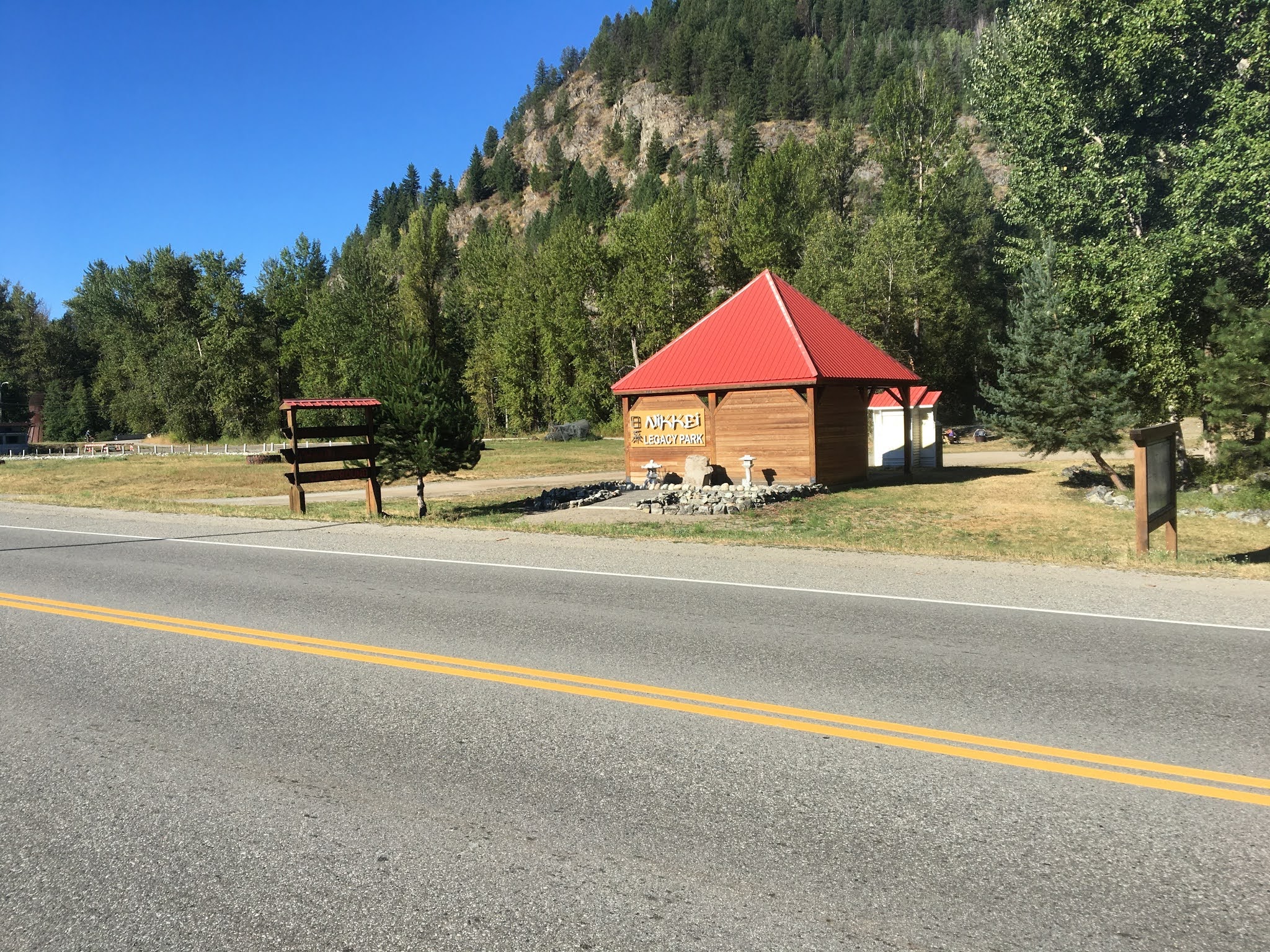
A large part of high school Canadian history, at least in my day, was dedicated to the building of the Canadian Pacific Railway.  I am not even sure that it is possible to argue that this is wrong, and offer a revisionist "People's History of Canada." It's not that there's not counter-narratives --that is, in fact, what I'll be writing about today-- but there is a very strong case that there would not be a Canada without the "iron road from the sea to the sea." I'm going to waffle all over that claim (I think it's wrong but am utterly unprepared to do the work needed to sustain a counterargument), but it's hard to argue against the economic and geographical logic. 


Hardrock miners on the porch of the Deadwood Store,
Greenwood, BC, c. 1900. It's hard to understate how strong
the completely unexamined notion that white Britons were 
the first "outsiders" in this province

The old-time historians and commentators were not modest about our ancestral achievement.  Firm that the "natural" lines of North American communication ran north-south, so that the railway realigned the geopolitics of a continent in line with the sociopolitical preferences of the infant nation. It was even, at least by the 1970s, the fashion to acknowledge some non-White participation, with dutiful Chinese labourers and misunderstood Metis, as well as the usual lot of "Indian guides."

Leaving everything else aside, there was a strong British Columbia connection to the generation that gave us this history, starting with Pierre Berton himself. For them, much of this argument was intuitive. It is hard to get from Vancouver to the interior of the province of British Columbia, and, more specifically, to travel between the Okanagan Valley and the Coast. For my grandfather's generation, you could take either I-95 or I-97 south until they joined away down south, at which point San Francisco --heck, Tijuana-- were as close as the other part of your native province, or the arduous but patriotic alternative of wagon road down the Fraser Canyon. 

Sunday, August 23, 2020

Travel Notes: Thoughts on Sugarloaf Summit

 The Crow's Nest Highway, Number 3, along which I stumbled and bumbled on my vacation last summer presents the Hope-Princeton as the first challenge for the avid bicyclist out of Vancouver, and it is a pretty meaty one. 

The way mountain roads are supposed to be, the road ascends a watercourse on one side, reaches the water parting at a "pass," and descends the other side. You might not know that the St. Bernard Pass is reached from a tributary of the Rhone that runs into Lake Geneva, on the one side, and a tributary of the Po on the other, but you know that's how it works.

The Hope-Princeton, on the other hand, ascends a left bank tributary of the Fraser, then switches to climb a significant hill to Sunshine Valley, of which I would have a vacation picture if my motel wireless were up to it. 

Stealing from Wikipedia is faster, and hardly a crime at all.


The Valley in the Sunshine is carved by the Sumallo River, a tributary of the Skagit and of little consequence unless you live in Bellingham, Washington, where the Skagit enters Puget Sound.

From the end of the Sumallo/Skagit uplands, the highway ascends rapidly to the valley of the Similkameen, a tributary of the Okanagan, which falls into the Columbia far to the south in Washington State. Mount Allison summit, the highest on the route, marks the entry in the Columbia's enormous watershed, and since Princeton is on the Vermilion forks of the Similkameen, it's all downhill from there. 

Or would be if the highway didn't depart the Similkameen and climb its merry way up Sugarloaf Sumnit in order to avoid some unspecified hold up in the valley of the river. 

While I was not intellectually unaware of the existence of Sugarloaf Sunmit, I encountered it at 7:30 on Friday night, after departing Hope at 7:30 that morning. I summited, and made the hair raising glide down into Princeton in the dark (barring a few mild climbs that had me cursing the perversities of our sublunary world, but I only arrived at the Sandman Motel in Princeton at 9:45, after more than fourteen hours on the road. 

Which is why this week's blog post is just me checking in to say that Keremeos is a very night place to catch 11 hours of sleep.

Saturday, August 15, 2020

Postblogging Technology, May 1950, I: Counting Down


R_., C.,
Shaughnessy, Vancouver,
Canada


Dear Father:

Well, it's definite. No Reds. Just like Uncle George said at Thanksgiving, the  typhoons arrived before the Communists were ready for anything like an invasion across the Straits. We've had the first of the season and the Reds have gone for Hainan. We cacn count on no more South Seas invasions till at least, the Fall. At which point, if Hainan is any guide, it'll be curtains for Peanuts and the Koumintang. It's just too much to expect the northerners to cross the mountains in the summer and span the waters in one winter, and this island will be brought beneath communist Heaven under the eyes of the Goddess of Mercy. 

Yes, I'm wasting a lot time around here shooting the breeze with practically everybody but Koumintang officers, including an old folk musician who is tickled that I want to hear the old Hakka songs that Uncle George butchers. I was going to share my version with Ronnie, but got the best glare you can give by trans-Pacific phone call, and fair enough when we're spending our retirement money on the calls.

So, around here, we haven't had a coup, we haven't had (much of a) purge, and we haven't had an invasion. We're all watching the invasion of Hainan, and everyone's calculation is about just when and how to jump. I've been firmly instructed to shut up and soldier (by Uncle George, not my CO, since I know you're worried). So all I can do is look forward to furlough in Hong Kong. I'm trying to wrangle a flight down to Singapore to see the other side. Ronnie's coming out in July, probably just before you, and there's rumblings that our subscriptions might be freed from the Post Office purgatory as soon as next month. 

I know Mother will complain that she's not hearing from me when I have so much time, etc. So I've sent her a big long letter, regular post, with snapshots of picturesque Formosa. And then another one, and . . At that point, I decided to stifle myself, as I've been warned (by Uncle George), that loneliness and inactivity can loosen the tongue and make you say things you regret. 


Your Loving Son,
Reggie