Bench Grass is a blog about the history of technology by the former student of a student of Lynn White. The main focus is a month-by-month retrospective series, covering the technology news, broadly construed, of seventy years ago, framed by fictional narrators. The author is Erik Lund, an "independent scholar" in Vancouver, British Columbia. Last post will be 24 July 2039.
Because honestly, The Engineer: Who wants to hear about heating houses in August? Or a really hot, summery Vancouver September, for that matter.
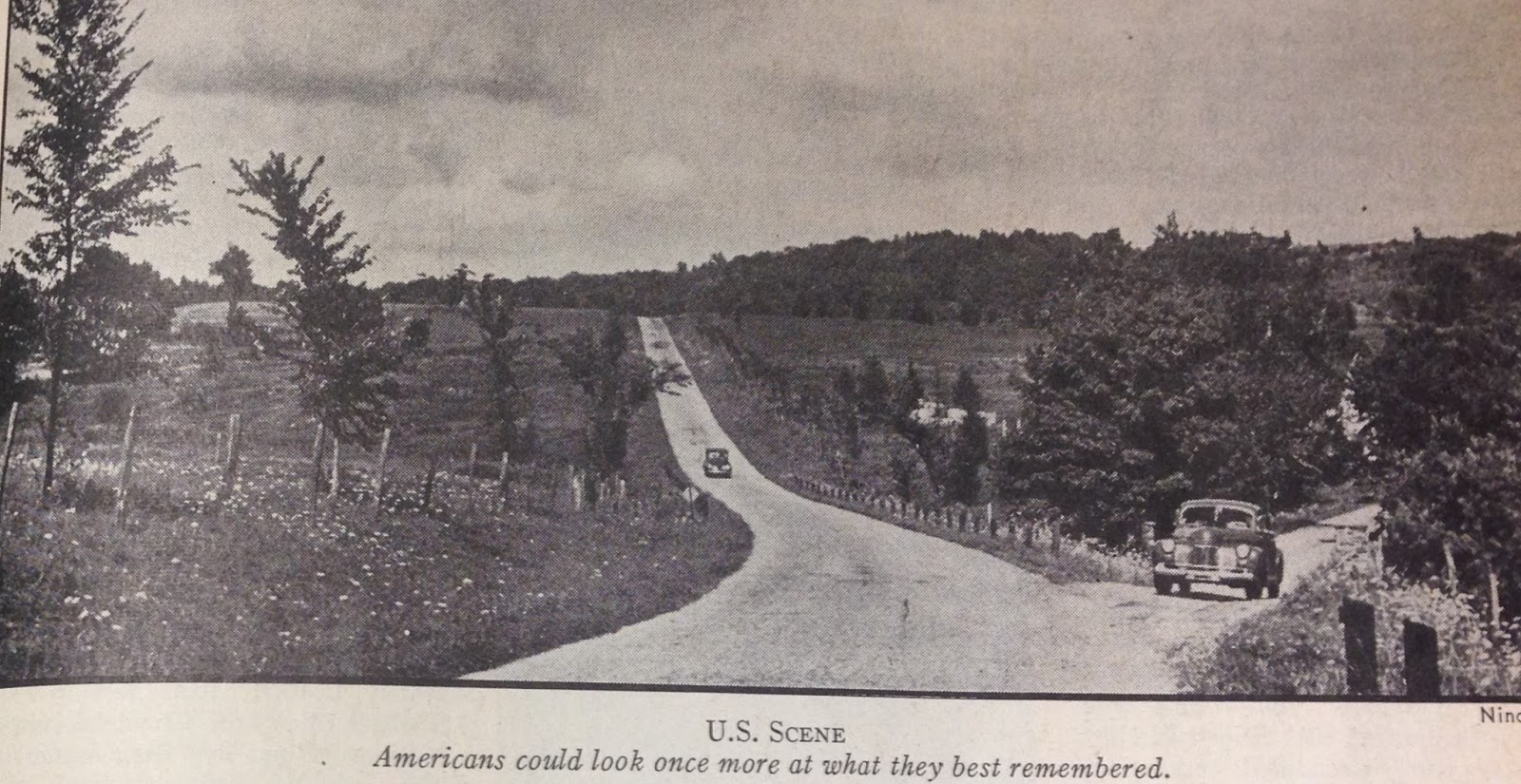
Speaking of the month of school starts and new beginnings: September, 1945. "The last corner before home."
The "last corner" a returning veteran rounds before seeing his actual home, after all those long, weary weeks of travel back from Europe/Okinawa/practically anywhere on Earth.*
At the time this picture appeared, people were probably looking forward to the biggest and wildest American holiday season, ever. If so, they were disappointed. Retail spending numbers were good, but the story was one of silence: houses bright and warm, but for family, not wassail. Maybe it was the suffering experienced by so much of the rest of the planet that put a damper on the festivities.
Maybe it is just a perception born of the first signs of the post-cost-plus advertising crunch. What I'm going for in this introduction is the idea that Thanksgiving and Christmas '45 were intensely private, bourgeois affairs: a moment to gather around a hot stove and bridge those lost Best Years of Our Lives. Private --and warm.
I hope that you're not too surprised to get this addressed from Hawaii, although it looks like I'll be putting a Denver postmark on it, as I'm not going to be done with Fortune much before then.
The reason is that I was kept late to do some silly experiments with rockets on water skis that I think might be going on the Navy's answer to the Saro SR.A/1. As for why the Navy needs an answer to the Saro SR.A/1, maybe they're tired of all the "dashes" in the plane names and want to try a slanty slash? Honestly, your guess is as good as mine. Fortunately, it counts as class credit or something, and all I have to worry about now is missing the first four(!) partial differential equation lectures. I've looked at the textbook (when I'm not looking at a fascinating article about tapping the oil reserves of shalebeds by drilling into them horizontally), and it looks like I'm going to regret this b.s.
If you're wondering why I'm missing four lectures in the first week of classes, it is because I am changing trains so that I can drop off a package with V.N., who will be taking over these letters for the school year so that I can focus on mystery maths.
Oh: And I told you not to worry. The bear-cub-in-the-president's-house is being dismissed as a prank, and even if the College Man catalogues his private papers sometime soon, he's not even going to notice that he's missing a page from the Agent's letterbook because it's not one he cares about. (Leafing through, I see that he hasn't destroyed the telegram to the school about his departure. Without something from the other side, we can't exactly prove that the College Man arrived at his uncle's school from the Colville Reservation and not Iowa, but I don't think we care about that, do we?) With the page we do have, we can now prove that Mr. Johnston's mother was. . .
I know what you're going to say! After we blackmailed the poor man about his father, is it really sporting to do the same over his mother? Point is, we're not. We're going to produce the letter as evidence that "A.'s" source for warmed over gossip about Hollywood Communists is from Johnston, and not Mr. Brookstein denouncing old Trotskyites. If anyone cares (because all "A.s" bosses want is to be able to discredit Hoover's boys if they get anything juicy. I mean, honestly. Actors and makeup artists who used to be communists? Yawn.) The point is, because A.'s "connection" is to Stanford, V.N. has to go back there! Wouldn't want to jeopardise the future son-in-law's career, now, would you?
This is a post about asymmetries of power, the globalisation of the grain trade, and the parts of the world where waters flow down to inland seas. It's less polished than I'd like it to be, because I have to go and put Driscoll Farms-brand strawberries out now. They're being shipped from California in big trucks, and since we can't stop the supply pipeline, we have to keep pushing, or they'll fill up our cooler. And we need the space! The Central Valley is, admittedly, not an endorheic basin, but close enough.
Anyway. . .
Farmer's two-novel "Opar" series has a disproportionately long Wikipedia article, for those feeling nostalgic.
It's been a long time since I've read Philip Jose Farmer's Hadon of Ancient Opar books, but I do remember that they're a riff on a rationalisation of the lost city of Opar in Edgar Rice Burroughs' Tarzan novels. Burroughs' Opar is a former Atlantean (the original thalassocracy!) colony stuck in the middle of Africa, somehow. Tarzan goes there from time to time and . . has adventures. Adventures that allow Burroughs to comment on race in America in interesting ways. I'd say more, but I wasn't kidding about the length and detail of the Wikipedia articles on the subject. Nostalgia for the win! Anyway, Farmer's novels explain Opar by proposing that Atlantis was actually a prehistoric civilisation established around inland seas that once existed in two enormous endorheic basins in the interior of northern Africa. Again, I'm a little hazy on the details, but I think that Farmer proposes that the water impounded in the basins eventually found its way to the Atlantic, causing Atlantis to be destroyed, not by flooding, but by having its sea drained away? Something like that is supposed to have happened in the intramontane Great Basin of the American West at the end of the last Ice Age, although, as far as I know, geologists do not currently believe that the Lake Chad Basin and adjacent endorheic basins in northern Africa were ever flooded (Map below the fold). Though eyewitness accounts of pre-50-million-years-ago period are sparse and unreliable.
The endorheic basins of Africa, whether flooded or not, are natural formations rather than largescale geoengineering. There are two reasons that I'm starting out with Farmer, anyway. The first is that it gives me an excuse to have some Roy Krenkel art in the thumbnail. The other is that I'm pretty sure that the first book starts with an historical introduction that describes a conjectured former channel connecting a sub-sea level depression within these larger endorheic basins to the Atlantic. I'm not entirely sure, but this sounds like Donald Mackenzie's 1877 scheme for an artificial inland sea in the southern Sahara, created by dredging out the sand blocking the channel at the coast in the region of "El Djouf." (Like a great many other African geological fantasias of the age, El Djouf barely exists.) I don't know anything about the Mackenzie scheme apart from what Wikipedia has told me, but, again, Roy Krenkel art.
Thucydides said, early in his Peloponnesian War, that Minos of Crete was first of those to exert thalassocracy, a rulership of the seas. I--
Oh. You're wondering why I'm on about this. October is Thanksgiving month in Canada, and I'm not going to be able to do any techblogging unless I win some time by reusing old material, and it happens I have a grotesquely self-indulgent, 72pp chapter on technology and science and the Nineteenth Century and stuff that I think I can trim down into an interesting post about bonanza wheat lands. Since it also happens that there was a minor flurry of activity around my last "thalassocracy" post, it's a sequel. (Also, I'm eagerly waiting for a "thalassocracy" to make its appearance in Graydon's Commonweal series, so consider this a bit of a fan tribute, even if my take on sea power is unlikely to be his.)
Technology! Maybe someone's riff on the Theseus black sail/white sail myth?
However! Sealion was only a "plan" because the German navy and air force already had a plan, which was to place the entire United Kingdom under strategic siege and strangle it to death. On 21 August 1947, came irrefutable evidence that the strategy was working, as Britain abruptly cancelled the first steps already made to full convertibility from pounds sterling to dollars [pdf]. A year later, devaluation of the pound would signal Raeder and Goering's final victory. Three years after the end of the war.
Good hustle!
We know the basic outlines of the crisis: Britain was not earning enough dollars from exports to pay for imports from the hard currency dollar countries. In spite of the firm conventional wisdom that American manufacturing was hypertrophied at the end of the war due to the collapse of the competition, in fact Britain was going into debt buying mainly food and tobacco, while trying to pay for it by exporting machinery.* Britain would have been a great deal better off if it still had the robust coal exports that had enriched the nation in Victorian times, especially since a European coal shortage made for a robust market. It would also have been better off if it could have run its domestic manufacturing sector at full bore, but in the winter of 1947, a domestic coal shortage wreaked havoc on industrial production. One of the reasons for drastic action in August of 1947 was the fear that the misery of the previous winter would recur.
History is, as I never tire of saying, a floating referent. It's never entirely clear where to start, and, in the case of a counterfactual, it is even harder. Hypothetical questions about historical counterfactuals are happening right now, over on Quora.Com, so they are very much questions of 2017. (Just to remind you, the framing counterfactual for this occasional series is, "What if the Commonwealth armed forces of 1940 were armed like the 21st Army Group on 11 May 1945?") (Also.)
On the other hand, the response is very much to Correlli Barnett's Audit of War, a book that came out in March of 1986, per Paul Addison's review, much linked to from here as an explanation of that book, which the reader may have forgotten about, or never known. On the other hand again, Audit signifies around here as a programmatic manifesto of Thatcherism, and Dame Thatcher became Prime Minister in 1979, seven years before Audit was published. On the other hand again, Thatcher was famously "a research chemist before she became a barrister," while Barnett had been a military historian/media pundit since the 1960s. Although you'll have to take my word for this, since I am not going to engage the ideas behind Audit in any more detail than is necessary to trace its impact, Audit was exactly what an English research-chemist-turned-barrister born in 1924 in the Midlands would have produced had she turned into an ancestral voice prophesying war, as opposed to, say, a Prime Minister.
Finally, just to throw on one more guiding metaphor onto an already unwieldy mass, I have talked about the idea of "Technology Levels," as used in the classic 1977 tabletop roleplaying game, Traveller.I'll come back to "Tech Levels" at the end of this discussion. For now, suffice it to say that they were originally intended to be descriptive. Your party lands on a planet; do the natives, who know you Pappenheimers, shoot back with bows and arrows, or hand-carried fusion blasters? A single number in the planet's descriptor tells you! However, they tend to become prescriptive. A blender from a Tech Level 9 world will be 1/16th (don't ask) more effective at blending than one from a Tech Level 8 world.
The Zhodani are alien humans (don't ask some more) who are very advanced and psionic and stuff; but they're assholes, for RPG balance. Anyway, they invade the Imperium with their high tech ships, which are just better on account of being higher tech level than Imperium ships.
Traveller comes before Audit, but Barnett's treatment of World War II is a lot like this. Brits used to say (I take Barnett as saying) that they fought World War II at Tech Level, oh, say, 6.5, compared to Germany's 6. In reality, it was 5.5 versus 6.5, Barnett says. He then adds that, had WWII been fought in 1850, instead, it would have been Britain at Tech Level 5 versus Germany at Tech Level 4, and Britain would have won the war even more than it did.
So, Britain has gone from a Tech Level advantage of 1, to a disadvantage of 0.5 --in my interpretation, of course. Audit purports to show that this is actually the case, while at the same time fingering the culprits. It's a very ambitious book --far too ambitious, in fact. But it does give us a way to think about technological change. My 1940 counterfactual seems, at least to me, like an elegant way to test this idea about technological change.
And by "test," I mean, stuff the demolition chamber with enough RDX to blow up a planet. (Which, by a wacky coincidence, is more-or-less what we're doing.)
Based on the last package, this will get to you before an envelope, and, anyway, I'm kind of worried about what might happen with a postal letter, so I'll just say this. We (Tommy and me) have a brilliant plan that requires a blond bear cub and those sedatives. I understand that it's easy to overdose a bear and have it die on you, but it needs to be really quiet while we're moving it around, and we need it now. Half the Stanford is off on summer vacation, and the N.s took V. around to the University of Chicago to see about registering and transferring credits. Miss Ch. has arranged things so that her registration rolls over at Stanford, but her parents' cheque needs to be in the mail by the middle of next month. (I'm not even going to get into the idea of someone else paying. It would kill her parents.)
We could also use any files the family might have from the heist at Colville by return courier. It's even more urgent than the bear. We've been through the stuff that Bancroft got, and V.'s been through the library at Santa Clara and Coeur d'Alene, but we've never had a complete look at your stuff. Professor K. says that you can often reconstruct the missing parts of an archive from what you actually have. If we know what we're looking for, we can be in and out a lot faster. Maybe we won't even need the bear!