![]() |
| Conestoga wagon at the National Museum of American History By Daderot - Own work, CC0, https://commons.wikimedia.org/w/index.php?curid=26706952 |
Bench Grass is a blog about the history of technology by the former student of a student of Lynn White. The main focus is a month-by-month retrospective series, covering the technology news, broadly construed, of seventy years ago, framed by fictional narrators. The author is Erik Lund, an "independent scholar" in Vancouver, British Columbia. Last post will be 24 July 2039.
Popular Posts
- Gathering the Bones, 18: Hew Down the Bridge!
- Postblogging Technology, October, I: Forest for the Trees
- The Bishop's Sea, III: The Real Presence
- Postblogging Technology, November, 1943: Caesar's New Clothes
- Postblogging Technology, November 1950, II: Platypus Time
- Postblogging Technology, December 1950, II: Christmas Corps
- Postblogging Technology, March 1944, I: Pulling In the Horns
- I Would Run Away to the Air: The British Economy, Montgolfier to 727, Part 1
- A Techno-Pastoral Appendix to Postblogging Technology, October 1950: The Chestnut Plague
- The Bishop's Sea: Fine Corinthian Leather
Saturday, July 18, 2026
Gathering the Bones, XXVI: Philadelphia and Conestoga.
Wednesday, January 14, 2026
The Early Iron Age Revival of the State, XXIV: Believing Because It Is Absurd
Sunday, November 2, 2025
The Early Iron Age Revival of the State,, XXXIII: Fish, Tyrrhenian Pirates, and Mainstream Scholarship
| Source: https://www.worldhistory.org/image/1064/bronze-coin-of-byzantium/ |
Friday, October 24, 2025
The Frauds of James Mellaart: A Scientific Appendix to Postblogging Technology, July 1955, I
Saturday, August 30, 2025
Draining Lake Copais: A Technical Appendix to Postblogging Technology, May 1955, I With Bonus LBA Collapse
Edit: A bit quick with this one.
Responding to a 29 November, 1952 article in The Economist putting forward "rather pessimistic predictions" about the future of the Basin after the departure of English managers, writing in a letter published in the 30 April 1955 issue, P. X. Levandis, the Greek Agricultural Minister was pleased to refute those predictions by citing high production per hectare. I missed this letter because I don't do the end-of-month issues of The Economist unless I've screwed up my withdrawal requests, which never happens, practically. Well, hardly ever.
I did not miss, and mentioned in the postblogging, the response of the Liquidator of the Lake Copais Corporation, F, W. Willis. Willis refutes the claim of increased productivity of wheat and cotton by showing that Levandis is using misleading figures, specifically only those of the freeholding farmers. When land held by the company, or now the Greek government, and run as largescale farms are included, there is no trend line. Without going back three years to find out just how pessimistic The Economist was being, consider it not refuted. On the other hand, there's evidently a whole history here of the people who actually farmed the land, and something of an elephant in the room in terms of what was farmed. Wheat and cotton are cash crops, and in particular the great cash crops of third-quarter Nineteenth Century agricultural expansion that gave us bonanza farms in the Americas and Australia and more complicated booms in the Old World. (For example, the "salinisation crisis due to irrigation/irrigation failure due to rampaging Mongols" story about Iraqi agriculture derives from abandoning barley for wheat in this period.)
Wheat and cotton are, as these things go, extensive crops, not traditionally the ones you grow on expensively reclaimed land. The Greeks eat rice and make linen, right? Given the emphasis on the landholders, one wonders exactly how much consultation there was with the locals who might have been using the Lake for traditional purposes like retting flax for weaving prior to the beginning of excavation and pumping.
Thursday, August 28, 2025
Postblogging Technology, May 1955: The One I Forgot To Post On Saturday!
R_.C_.,
The Lodge,
Campbell River, British Columbia,
Canada
Dear Father:
Your Loving Daughter,
Ronnie
Friday, March 28, 2025
The Early Iron Age Revival of the State, XXX: In The House of the Sea Lion
The remarkable correlation between geographic and genetic difference in European populations (Callaway (2008) via Bintliff):
(Okay, so this is actually Ewen Callaway reporting in New Scientist on John Novembre, et al, "Genes Mirror Geography Within Europe," Nature 456 (2008): 98--101.)
Time to say goodbye to migration in history?
Saturday, February 15, 2025
Aswan and Wittfogel: A Technological and History of Technology Appendix to Postblogging Technology, October 1954
![]() |
| Britannica. Which lifted it from Shutterstock, how the mighty have fallen, etc. |
Friday, January 17, 2025
The Early Iron Age Revival of the State, XXIX: Wood For Greeks
In the relatively small genre of modern scholarly syntheses of Classical literature and current (as of writing) archaeology on some specific subject, timber is actually pretty well treated, though it turns out there's a bit of a controversy behind this.
Saturday, December 28, 2024
The Fall of Rome, VI: Flying Canoes and Revolutionary Santas
There's nothing to discourage a guy from amateur FallofRomeism than the "Men think about Rome a lot" thing of a few years back, for which reason I haven't visited this thread in a long time. I'd like to say that I was into the fall of Rome before it went mainstream, but, yeah, no. Gibbon might be the most influential historian in history, and I will actually read Pocock's Gibbon if someone can make a case that he didn't have Seventeenth Century precursors. What brings me back this week is, first of all, a Quora answer about Picts that reminded me of a small bit of loose ends, and second the fact that it's Christmas, and I am off to meet my first great-nephew in Campbell River on Boxing Day, which is anything but a guaranteed day off in my line of work. O. is six months old, so a bit young for Christmas, but soon! I, on the other hand, am totally ready for Christmas, which the visiting and the family reunions and the long walks with dogs and the Baldur's Gate 3 marathons . . .Oops, definitely shouldn't have said that last bit.
It has also been suggested that for various more widely applicable reasons that we should lighten up and just enjoy a Christmas for a change. And I don't disagree, so here's a Christmas message calling for peace on Earth, good will to all, and a proletarian revolution!
Yeah, Angela didn't say that last bit.
Sunday, December 8, 2024
The Early Iron Age Rise of the State, XXVI: Yet Another Questionable Historical Comparison
Whatever else can be said about making an analogy between the coming of iron to the Mediterranean basin sometime between when we want to say that the Late Bronze Age collapsed (1171BC?) and when the classical age began (490BC?) and to the Northwest coast, we can at least be very sure of things like when iron came to northern Vancouver Island, what locations were inhabited and the languages spoken there, and the tribal ethnicity claimed by the grandchildren of the people who first encountered iron (to be maximally careful).
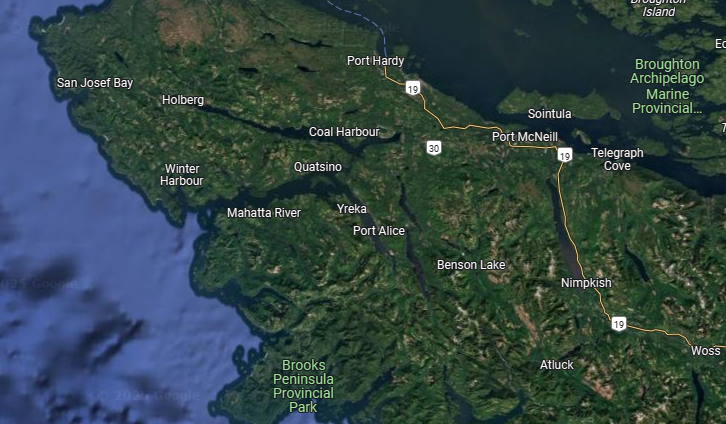
The modern band councils are the Kwakuitl Nation of Fort Rupert, a suburb of Vancouver, which chooses to use an older rendering of the ethnic name Kwakwa̱ka̱ʼwakw, understandably enough in my opinion but I'm just an old fart, and the Namgis Nation of Alert Bay, also speakers of Kwakwa̱ka̱ʼwakw and perhaps a bit indifferent to the larger tribal identification. Of perhaps more importance is the traditional territories of the two nations, which are, respectively, spread along Quatsino Sound on the west coast, and the extended estuary of the Nimpkish River on the east coast of the Island. Both nations may be described as "migratory" in that they moved through their respective territories harvesting seasonal abundances in various littoral environments, and both had "capitals," at Quatsino in the narrows of that Inlet, which is a flat and fertile landscape suitable for camus beds, a rarity in the region; and on Alert Bay, where unlike on the more fluvial terrains of this very wet part of the world, you didn't have to worry about waking up to find your bed floating out to sea. Both peoples commanded passages across the island, respectively the narrows between Coal Harbour and Port Hardy, and the long portage up the Zeballos River and down the Nimpkish, ultimately from the bight of Nootka Sound, commanded from Nuchulnath-speaking Ahousat.
In contrast it is necessary to speak with great caution about the earliest phases of the Iron Age in the Mediterranean, in part because so much of it is so implausible. That is, we have been waiting for evidence that the earliest region affected by Phoenician connections was the southwest of Spain at the other end of the Mediterranean from the territory of these Israeli, Lebanese, and Syrian cities; and that the influence of Greek culture was first wielded (in the Iron Age) by one or both of the classical cities of the island of Euboea off the coast of Boeotia, cities which, afterwards, receded into obscurity as second-, or third-rate powers by Greek standards.
Nevertheless, with centuries of archaeology under our belts by this point, we are unable to reject the priority of Huelva or ignore the wide dispersal of Archaic Euboean pottery. Reversing my way into the question, I propose to problematise it by invoking the Northwest comparison.
Wednesday, November 6, 2024
Gathering the Bones, XXXI: Raven And The First Men
This morning I am thinking about Raven the trickster, creator and king. but I also travelled on the weekend and visited my world-travelling doctor brother and his wife, who in conversation chanced to mention how much better the Pacific Northwest art held at the British Museum is than that shown here in its homeland.
"Raven and the First Men" is a Haida creation myth, here truncated. The second image is a rattle, used in shaman and healing dances. The specific meaning belongs to the owner who commissioned it, but the general theme is the transfer of power, which is another way to understand the creation myth. Deprived of its context by the decision to sell it to an outsider, it remains an eerie symbol of the relationship between Raven and one man, no doubt privileged. I would be stretching nonexistent wings in a ludicrous play at exegesis to go any further (Raven would approve!), but we can reasonably ask how it was made around here.
Sunday, September 1, 2024
A Vacation Week Short That Is Also A Sacred Spring Contribution: Hurrians, Mitanni, and Owning Land
I am just back from a cycling vacation in which I finally rode the Okanagan Rail Trail from Kelowna to Vernon. This turns out to be a trick, because between the exquisitely appointed section in Kelowna and the somewhat rougher but eminently ridable section between Lake Country and Vernon that passes through my childhood summer camping grounds, there is an "unimproved" section that was very rough riding, and quasi-trespassing, as the landholder objects to the transformation of the CN rail right of what through their property into a recreational/highway bypass rail trail.
It turns out that that the landowner is the Westbank First Nation; the parcel is remediated wetland, and I imagine was classified as reserve land because of seasonal bird hunting, which was ruined by the CN's railbed. The contrast between the all-but unpopulated Okanagan-owned parcel and the stretch approaching Oyama just north of it, in which one lakefront property after another evidently had its own private access across the tracks (at least my family settled for a culvert underpass, never used for its intended purpose of watering livestock) is striking. The Salishan-speaking Okanagans left a clear imprint on the geography that their descendants still occupy, but that doesn't make them any less of a marginalised group. You can draw all the property lines on a map that you want; if you don't have the social power to make them work, they are just lines.
Sunday, August 11, 2024
The Early Iron Age Revival of the State, XXIV: Fall and Revival
Sunday, June 30, 2024
The Early Iron Age Revival of the State, XXXII: Safety Pins
Saturday, May 25, 2024
The Early Iron Age Revival of the State, XXXI: Queen of Victory
![]() |
| John Byrne, "Goblin Queen" (From a story by Chris Claremont) |
So the story here is that the Indo-European languages emerge into the light with The Proclamation of Anittas, a unique document on Old Hittite extant in an early as well as late-Kingdom copies, anchoring the use of the Hittite tongue to a c. 1600BC central Anatolian context. And I am engaged here in the fun and low-stakes enterprise of arguing that this is not only the oldest Indo-European, but the source of the language family. Today we're going to go a bit further and single out an individual: Puduhepa, the Queen of the Night.
Sunday, November 5, 2023
The Early Iron Age Revival of the State, XXIX: Lazy Sunday Outline with Premonitions of Mortality
Two things, first, a very late change of schedule; second, a scary moment at the Silver Kettle Lodge as my 92-year-old father seemed to be failing after his vaccination. These mean that I do not have Sunday to work on my postblogging, although I am covering a mid-shift on time change day, and do have some extra writing time. And I am reminded that we do not live forever and I should get my intellectual life in order.
So here's a summary of work to date on Sacred Spring: The Early Iron Age Revival of the State and a brief outline.
Friday, October 6, 2023
The Early Iron Age Revival of the State, XXVIII, With Lazy Public Engagement And Some Reference to the Fifties: Tin and the Resource Curse
This was the view east down Copper Street from the slight height of land that marks central downtown Greenwood, BC in 1906. The mountain slopes up to the right, but Copper Street takes a hard left turn just behind the photographer and descends to the terrace above the creek on which the road down to the Kettle River at Midway follows.
Cross the street and move forward 117 years, and the view changes in two ways:
First, some of the older buildings are gone. Second, Copper Street has turned into Highway 3, because a major interprovincial highway has been run right through the downtown. You would probably see a crosswalk here somewhere if it weren't so easy to jaywalk across the highway. When I made the first of my annual bike trips through Greenwood to Gand Forks in 2017, I watched a family of deer do the same, but the city has picked up a bit in the interim. Oh, yeah, right, "city," because Greenwood's "biggest hockey stick in the world" claim to fame is that it is Canada's smallest city.
The reason for that is that, unlike most of the instant towns of the first copper boom, before WWI, it had a revival. In 1941, a calculating and humane mayor grabbed the one opportunity that the war had so far presented and offered the town as a resettlement location for the Japanese Canadians then being ethnically cleansed from the Coast, and in 1956 the combination of a local workforce and the postwar revival of the international commodities market proved just barely enough to justify reopening the smelter on nearby Phoenix mountain. The ore at Phoenix is, Wikipedia says, "self-fluxing," meaning that whatever fluxing agent is added to the ore at the Trail Smelter, isn't necessary at Phoenix. (The veins have numerous intrusions of "calc-silicate alteration of limestone;" Maybe that's it?) This tidbit led me to Google around for something a bit more serious about the nature of the ores in "the Greenwood camp," which is apparently the technical term for the 400 square kilometer zone of 25 mines centred about half the way up Highway 3 to Eholt summit. Apparently, way back when the entire region was under volcanic hot springs which have produced an estimated 32 million tons of ore including 38 tonnes of gold, 183 tonnes of (native) silver, 270,000 tonnes of copper, 966 tonnes of lead, and 329 tonnes of zinc. The ores are "copper-gold porphyry," which is great, because it's an excuse to say "porphyry."
I regret to report no evidence of more exotic metals, your germanium, your tantalum, or, of course, tin. All I can report is that the smelter closed in 1976, just four years after its last upgrade, relatively painlessly inasmuch as it seems as though most of the workforce took early retirement, being children of the era of the last metal boom, which may or may not be a coincidence, and Greenwood gradually dropped back into its Depression-era sleep. The post-WWII commodities boom was not quite yet obviously dead, and the mills and mines would keep on closing for years yet until British Columbia's former high pressure labour market was decisively over, and my employer could ram through a two-tier contract that basically condemned the next generation to work at near minimum wage for, as it turns out, their entire career. (Unless they took advantage of an escape clause dangled before us in the years around the Olympics. Yay!)
So. Was the Late Bronze Age Collapse a working out of the resource curse? By the way, can we have a round for Investopedia's formulation?
The term resource curse refers to a paradoxical situation in which a country underperforms economically, despite being home to valuable natural resources. A resource curse is generally caused by too much of the country’s capital and labor force concentrated in just a few resource-dependent industries. By failing to make adequate investments in other sectors, countries can become vulnerable to declines in commodity prices, leading to long-run economic underperformance.
Oh, those feckless resource-rich countries, with their "failure" to "make adequate investments in other sectors." The picture, by the way, is from a press release about an event at the Aspers' prize Museum of Human Rights in Winnipeg. I can't even.
Saturday, July 22, 2023
Gathering the Bones, XXIX: Sons and Daughters
Sunday, March 19, 2023
Gathering the Bones, XXIV: The Gardener's Problem and Smith's History of Virginia


.jpg)
.jpg)