Showing posts with label Unsolicited Manuscript of Doom. Show all posts

Sunday, November 5, 2023

The Early Iron Age Revival of the State, XXIX: Lazy Sunday Outline with Premonitions of Mortality


 Two things, first, a very late change of schedule; second, a scary moment at the Silver Kettle Lodge as my 92-year-old father seemed to be failing after his vaccination. These mean that I do not have Sunday to work on my postblogging, although I am covering a mid-shift on time change day, and do have some extra writing time. And I am reminded that we do not live forever and I should get my intellectual life in order. 

So here's a summary of work to date on Sacred Spring: The Early Iron Age Revival of the State  and a brief outline.


Sunday, June 5, 2022

I Would Run Away to the Air: The British Economy, Montgolfier to 727, Part 1


So I thought that scenes of anachronistic hot-air balloons were a B-movie/animation trope. And they probably are, but thanks to the publicists for The Aeronauts, actually finding one turned into a fifteen minute hunt. On the one hand, thanks to Andrei Tarkovsky for putting a balloon into the prologue to Andrei Rublev and Youtube user Eagle Burger for putting it up. On the other, thanks a bunch to the producers of The Aeronauts for spending all that money on spamming the Internet instead of making a good movie.  

The question that I meant to foreground with that interpretation is, "Is there a history of technology answer to the question, Why did the Montgolfiers come when they did?" It's sort of a science fiction question that took me back to the afore-mentioned hunt around the Internet that failed to turn up any cavemen in balloons, an answer, which appears to be taffeta --and not an economically endogenous "free lunch" of pure innovation arising from the-superiority-of-the-White-race-Shit-I-can't-say-that-"culture," as the neolibs would have it. (In an unarticulated way.) Fuckers just won't go away. 

So we can all agree that by 1783, the Industrial Revolution was well along. The steam engine is thoroughly invented, we've had the flying shuttle, we've got the exciting part of the history of railroading in Britain where there aren't any railroads yet. Or if you don't want to riff on a half-remembered joke that you can't even reference, the "Age of Navigations." The authors of the Wikipedia article drag the Montgolfier brothers into the story via the family paper manufacturing business, which seems appropriately modern and innovative. But they made their hot air balloons out of taffeta. The Wiki says that taffeta has been made in France and Italy since at least, well, the Montgolfiers, and that the word itself is from Persian. Fashion history adds the detail that it was first woven in the Attabiya of Baghdad sometime in the 1100s, which seems like it is going to introduce us to a lost history of fabric making, since surely medieval Baghdad had a flourishing rags district and trade, and it sounds like this UNESCO explainer is going there. Unfortunately, it turns out to be purely etymological, going vial Seventeenth Century London swells dressed in "tabby," to slang for the prostitutes they habituated, to the modern "tabby cat." 

This sounds like the kind of anecdote that old time OED editors would enjoy too much to fact check, and is as dead-endy as dead-ends get. Taffeta is a twisted, woven (originally) silk cloth. It looks nice, has as close to zero permeability as you can get with animal fibre, and was still being used for parachute silk in WWII. Like all the other fabrics made in England proper (no Scottish jute mills or Belfast linen makers need apply), it is by definition not of the slightest interest to industrial history. A "quilted taffeta bedspread" turns up in the story of Darnley's 1567 death, at which point the narrative of taffeta as an exotic Middle Eastern import will serve as well as the Queen's Consort being "alive in South America somewhere." By the Montgolfiers' time it had gone native in the silk-producing countries of Italy and France, and I am willing to bet that they had improved the finish in such a way as to make it a better aerodynamic cloth. Could be right about that, could be wrong. It's not like anyone is investigating trivial questions like "who innovated what, where" before launching into Big History projects. 


. . . Which brings us to "Victorian Britain, workshop to the world."

Sunday, May 1, 2022

Postblogging Technology, January 1952, II: Niobium and Zirconium and the Flying Enterprise


R_. C_.,
Shaughnessy,
Vancouver,
Canada


Dear Father:

For those in peril on the seas and skies. Captain Carlsen is back in America receiving a ticker tape parade for staying aboard the Flying Enterprise, but the people who died in the Sandspit and (first two) Elizabeth crashes are still dead, and I am sending this before the details of today's third crash at Newark Airport in three months have a chance to sink in.  

But is there something more to it? As you'll hear below, Newsweek has heard a rumour that the cargo included 50 tons of columbite ore, and columbite is a "niobate" of niobium, iron and manganese, I learn by visiting the science wing and looking it up in a geological dictionary. Niobium is, as Newsweek says, used in the "super alloys" that they use in axial jet turbine compressor blades, and in very small amounts of about 0.1%, which means that even 50 tons of ore is a lot of blades. So it would be quite a blow to aircraft production, but why would it be such a secret, and why was an ore mined in Brazil sailing from Europe? Captain Carlsen's heroics were meant to prevent the rescue tugs from making a salvage claim, and that is certainly important to the owners, but why are people treating him like a national hero? My imagination leaps to secrets so secret they even have to be kept from the British! And, because I am not an atomic physicist, to the fact that columbite contains uranium and thorium and is "radioactive to some degree." That might make it an atomic secret, which we are keeping from the British. And, of course, from day to day we are expecting the super-bomb! Put them together and I glimpse the outlines of some unguessable secret, inadvertently revealed by the half-wits of Newsweek. Sure, it is all made up in my head, but people are trying to keep secrets, they say so themselves! And just to get back to the top, three air crashes in three months at one airport, with one airplane after another just missing schools and orphanages, doesn't exactly fill me with charity for the powers that be. 


Your Loving Daughter,

Ronnie


Tuesday, October 3, 2017

On Thalassocracy, III: Warrior And Wheat

Lake Sidi Ali, in the Moroccan Atlas, 2000m above sea level. So not quite the Sahara Sea.
Thucydides said, early in his Peloponnesian War, that Minos of Crete was first of those to exert thalassocracy, a rulership of the seas. I--

Oh. You're wondering why I'm on about this. October is Thanksgiving month in Canada, and I'm not going to be able to do any techblogging unless I win some time by reusing old material, and it happens I have a grotesquely self-indulgent, 72pp chapter on technology and science and the Nineteenth Century and stuff that I think I can trim down into an interesting post about bonanza wheat lands. Since it also happens that there was a minor flurry of activity around my last "thalassocracy" post, it's a sequel. (Also, I'm eagerly waiting for a "thalassocracy" to make its appearance in Graydon's Commonweal series, so consider this a bit of a fan tribute, even if my take on sea power is unlikely to be his.)


Technology! Maybe someone's riff on the Theseus black sail/white sail myth?

Monday, July 13, 2015

Fall of France, XI: Nimrods All the Way Down


This rubs me the wrong way. I'm not sure the subtext is as pro-Nazi as I perceive it to be, but, for me, the perception is there. 

Now, this?

I'd explain in detail, but it wouldn't be Very Serious and Scholarly. So here's the Wikipedia links. Jump on board if Clobbering Time's your thing. 1, 2, 34.*


No more obliqueness. It's time to Put a Clobbering on Global Warming!

Never mind. That's probably getting too non-oblique, far too many leaps of logic all at once. I'm talking here about counterfactuals of 1940. I've done so before, in a whimsical way. Some time later, I returned to the subject when provoked by one of those books that manages to be usefully and provocatively wrong. The Foresight War is a "counterfactual" of World War II which, inexplicably, gets the British Expeditionary Force out of the Battle of France, while focussing on important prewar changes to the interwar trajectory. You know, like getting it an assault rifle. 

I have danced around the real counterfactual before, although I can't find it in my older posts in the time I am willing to commit to the exercise, and, anyway, it is a really, really simple point that bears repeating.

On 10 May 1940, when the balloon went up, there were 7 infantry divisions under the BEF, plus one in strategic reserve in France, plus one rotated under French command in the Maginot Line garrison, plus three divisions brought over as for construction work, plus one created new during the fighting from reinforcement depot troops. Depending on who you're blowing smoke for, you might get away with saying that the BEF actually present in France on the day that the German offensive began was 7 divisions, or 12. Or, heck, 13. I think it's perfectly fair for a historian of the German army to focus on the latter. After all, some of the attacking German armies were at least as unready to fight as the "labour" divisions called into the line to join the BEF. If, on the other hand, you want to emphasise just how small the British land contribution was, the "7" number is equally useful. Even if the GHQ-bound 5th Division was released to the BEF the moment the fighting started, the fact is that on 9 May, the GHQ in Arras thought that it was going to lose the division to a peripheral fight in Norway, and the details of its return to the fight had a disproportionate impact on the BEF's mobile forces.**

The point being made by the latter strawman is that Britain, because it was "small," or because it had a large navy, or because of Culture or as a Matter of Historical and Political Tradition (Cromwell! Boo!), just couldn't have a sufficiently large army to influence matters on the continent. It was pointless to try, and the optimum strategy in Avalon Hill's Third Reich, which is (I'm told) to send the entire BEF to Egypt to wipe out the Italian Empire in North Africa, actually makes sense.

Enough delaying the counterfactual turn is after the cut.

Wednesday, April 22, 2015

Fourteen Large: Grexiting the Late Bronze Age, 2

First, I've just read Oliver Dickinson's new attempt to synthesise the Greek Bronze Age--Iron Age transition.  Powerfully scholarly, Dickinson first sets the terms: whatever else we know or do not know about the "catastrophe" which ended the Late Bronze Age, there is an irreducible core of facts to consider. At the end of the Palatial Period, "Mycenaean Greek" civilisation was building monumental structures. At the dawning of the Classical Period, "Ancient Greeks" were again building monumental structures. Their nature had changed significantly over the course of 400 years, from spectacular tombs and not-quite-so-spectacular palace sites to temples, but from some kind of functional point of view, their absence in the intervening almost half-millennium constitutes definitive proof that some kind of social caesura had taken place. Call it a catastrophe, or a decomplexification, or a collapse of the Late Bronze Age state, but something.

However, Dickinson feels himself compelled to adopt the version of the thesis in which decomplexification leads to a significant local population decline. He wants to argue that whatever the problems so far invoked with using area surveys to measure populations, we are at the point where we can accept them as evidence. I am not convinced, so, all digressions aside, this post is mostly a disagreement with that. (Spoiler: I continue to be persuaded by the idea that they all went away to live in the hills. Still have to motivate the argument, though.)  

Second, since this is a blog about grass and technology, can a claim that technological exogeneity lies in back of the Late Bronze Age collapse be sustained? That is, for we moderns who worry that robots are about to take our jobs, is there a parallel example in iron axes, presumably taking the jobs, and perhaps lives, of the bronze merchants (bankers-in-bronze?) Or is technology endogenous, with Late Bronze Age society giving way to a new lifestyle which makes iron possible.

Or, even more radically, is technology an epiphenomena of economic growth, in which case the Late Bronze Age-Iron Age transition is an episode of economic-growth-with-political-catastrophe-characteristics? (That would be a contrarian interpretation, indeed.) 

Third, a little buried compared with the force of the anecdote: fourteen grand, in case you were wondering, is, I have just learned, what you pay in student loan-funded tuition to go to truck driver school in Vancouver right now.  All scholarly caution about overly dramatic intepretations of the end of the Late Bronze Age aside, I want there to have been an episode in which the peasants burned down the wanax's palace and went off to live in Arcadia. "By the time we're done, Linear B will be spoken only in Hell." 

There is evidence burning a hole in my pocket, and since this is a blog, and not a monograph, I can spend it. Right now. That evidence is locality. If you read about the Greek War of Independence, you are inspired by events in Bessarabia to land in called Messalonghi. You go on to see a war proclaimed at Arepoli and  Kalamata by the men of Monemvasia and "unconquered Mani" and bold klephts of Arcadia ("On horse they go to church/on horse they kiss the icons/on horse they receive communion/From the priest's hand"), who advance on TripoliNafplio and Ypati.and fight at Navarino and Petra. 

Even granted that we don't know as much as we think we do about the geography of Classical Greece, a striking number of turn-of-modernity Greeks seem to have been living in the wrong place. The hellenophiles of the time seem to have taken it that their contemporary Greeks were a bit degenerate, but that it was something that could be fixed. Greece's new Bavarian monarch chose Athens as his capital in 1834, and promptly announced the restoration of Sparta --the episode out of which this story springs. The people of Laconia of circa 1834 didn't think that Sparta needed to be restored, because although they did not call their town "Sparta," they were pretty clear that  Mystras was the new town to Sparta's old. The ancient Spartans had built a city in a pretty dumb place; the new location was better. 

They lost that argument, as the Peloponnese has been losing arguments with Athens ever since. The question here, if it is not too anachronistic, is whether or not the Greeks of 1830 had a point. Always tiptoeing around accusations of anachronism, we are already in the habit of interpreting the archaeological record of the Greek countryside at the end of the Late Bronze Age in the light of other eras. Why not start at Mystras?

"Botzaris Suprises the Turkish Camp and Falls Mortally Wounded," Eugene Delacroix
(Or Tripoli.)


Thursday, April 9, 2015

The Great Siege: PLUNDER, VARSITY, Gotterdamerung

OPERATION PLUNDER; OPERATION VARSITY; The Twilight of the Gods. Three things, naturally linked.


Except that PLUNDER and VARSITY were real things that happened. The "Twilight of the Gods" turned out to be grandiose fantasy. 

We don't write much about the combined assault on the Rhine by 21st Army Group (including US 9th Army), which led to the greatest opposed river crossings in historys. (In the interests of accuracy i hyperbole, it should be noted that any given assault crossing the Yangzi was probably a bigger deal in terms of water work, but the Mandate of Heaven has not yet been transferred by a modern mechanised army.) That a vast army, supported by enormous logistical preparations, closed the world's eleventh-largest river and fought its way across against the resistance of the army of the world's second largest economy, should be a big deal.


The problem was that it was dead easy, so no-one cares about it, which is why this post is two weeks late. (Apart from yours truly having to deal with a congenital lack of labour in the Canadian economy that somehow does not show up as a "labour shortage.") This is because, as it turns out, "Gotterdamerung" springs from Snorri Sturlusson's head. Gods and heroes heroes may go down in glorious last stands, but the spear carriers have made a discrete departure. 
Germany, ever so quietly, was going from this to this. Germans, actual living Germans, had learned a lesson that the rest of us could stand to remember. "Blood and nation" are not things immanent in us, unalterable and compelling. Trapped by an idea? Defect in your head,  hollow out your will to be a German landser, drag your feet until the tail of the column turns the corner ahead, leave your rifle by the side of the road.
Congratulations: you're a "straggler." Keep it up for eight weeks more, and you'll be a live straggler. It's nothing to be proud of later. Lost causes flourish in romantic legend; not the men who kept their heads down and came home to their families --or made new ones. Spring is coming, the world needs to be renewed, and the glorious dead will make no babies. 

For those who cling to lost causes, the first week of April is bitter. One-hundred fifty years ago, the Confederate States of America collapsed; 75 years ago, the Wehrmacht was vanishing, tens of thousands, perhaps hundreds of thousands of men simply not on the rolls.
That's  the German Fifteenth Army under watch below. 

On the other hand, OPERATION KIKUSUI was 75 years ago. Another of the horrifying moral aporia of the world war, the attack of the floating crysanthenums is not easy for me to parse. The young men who piloted the suicide bombers do not seem to have been particularly traditionalist, nationalist or right wing. It is certainly not very helpful to focus on the supposedly fixed essentials of Japanese character to explain them, and it certainly is possible to frame a narrative around inescapable social pressure to commit suicide, which is pretty horrible in its own right.

The kamikazes flew while the German and Confederate armies were disintegrating. I'm not going to present a half-baked explanation for this, only point to it as a problem. The "national character" thing usually invoked does not convince. I grew up on the Pacific shore, after all, surrounded by Japanese Canadians and German Canadians, and on and on, so I can claim some experiential credibility for my skepticism. So could Californians, which I think might explain why the actual response to the kamikazes proved so ambiguous in the end. 

 I would gesture out at the Pacific and conjure up Owen Chase's arrival in San Francisco on the whaleship Winslow sometime between 1825 and 1827, and notice that while whalers and sealers are already ranging from the Japan Grounds to Alaska and down past the Bass Strait, where "sea rats" and "pirates" took seals for the China trade in cockleshell boats ranging all the way to Middle Island off Western Australia. 

That is, twenty years before San Francisco became American, it looked out on a Pacific where there were already sealing plantations and offshore fisheries off multiple future Australian and American states, one Canadian province, New Zealand, various pelagic nations and "overseas territories," The Empire of Japan and the Kingdom of Hawaii. The process by which the only autochhthonous state formation in a non-state ordered society became the American territory of Hawaii, while New Zealand became a resolutely British nation. How? It's all so slippery. But disintegrating armies have to fit in here somehow..

This is an introduction to a discussion of floating and other temporary bridges.

Monday, October 20, 2014

From Now On, No More Defeats: Until the Morning Sun

Kim Carnes in the heat of the Battle of Berlin. Victory for the men and women of the air defence command of the German land, defeat for Bomber Command going "crazy in the night." Under the winter moons, Bomber Command lost 2,690 men, another 1000 POWs, seven percent of all of Bomber Command's wartime casualties. On 30/31 March 1944, 572 Lancasters, 214 Halifaxes and nine Mosquitos (795 aircraft in total) were vectored on Nuremberg. Ninety-five were shot down. Air Chief Marshal Harris claimed that the losses were acceptable, and Max Hastings mistakenly echoes him, but, incredibly, it was not true. With the full effort of Britain's industrial might behind it, Bomber Command would have to give up its attack on Berlin because it was running out of planes in spite of a monthly output of 250 heavy bombers. That is an unimaginable production run for a heavy bomber both from the perspective of 1924 and of 2014, but it was not enough in 1944. Bomber Command flew shorter missions and enjoyed lighter losses through the spring and summer, gathered its strength, sand came back to "reap the whirlwind" in the Third Reich's last winter. Gloating over the failures of their own nation, a breed of British historians has relished the comparative success of the American daylight offensive, which apparently proves that Britain has too many public schools or something. (Jesus, guys, high school's over.) Actually, the American daylight formula would soon itself fail before the  falcons of Japan, and while I started this post with the thought that --somehow-- I could give a lapidary summary of the failure of airborne remote control gun defences in World War II, it seems like that might be a bit much here

In the heroic version of the myth of Curtis LeMay, it would be that incredibly young general officer, a man of "mixed French and English ancestry" out of a civil engineering  programme in the rusticated Old Northwest who would recognise that, in the special conditions of Japan only, and totally not in Germany, night area bombing was the right way forward for the B-29 force only. You will find the short discussion in the Wikipedia biography of LeMay. Essentially, area bombing was wrong in Europe, where the USAAF did not do it, and right in Japan, where it did do it. The "about face "executed by United States Strategic Bombing Survey says little good about its scholarship, and much about the need to revisit our assumptions. AA defences, and even somewhat less-than-efficient interceptors, in the end, worked --in daylight. It was losses that forced 20th Air Force into the arms of the night, not the wooden, conflagration-prone houses of Japan.  Ultimately, it was also about training hours. Bomber Command was as reluctant to embrace daylight flying in the summer of 1944 because its crews lacked training in formation flying. Eighth could never have shifted to a night bombing offensive in 1943 because it lacked night flying training, and its aircraft were not equipped for it.  Both problems were fixed, at least in the context of 20th Air Force, but a long prewar learning curve that ultimately taught that night bombing was an operational necessity because defences can't see at night is obscured. 

Enough of that, though. The long nights of winter have returned with the lonesome October. The winter-swollen Rhine carries its gold to the sea, and only the Combined Bomber Offensive can range beyond it. Germany will burn until Germans end this war. The boys who look down on the world from their planes that carry images of Hollywood starlets on their noses only want to go home, and Germany isn't letting them, so Germany must be punished. It is an impatient, angry and futile impulse. Germany will not surrender, not until enemy soldiers march into their hometown in a perverse catharsis, a black catharsis, of the wounded passions of 1918. On the other hand, the bombing is intended to stop factories and shut down railways, even if our eyes are fixed on more horrifying results.

On December 19, 1944, cut off on the High Fens in the Forest of Arden, where the old border runs between the Duchy of Luxembourg and the Prince-Archbisophric of Trier and the Wild- and Rhinegaviate of Salm, the 442nd and 443rd Regiments of U.S. 106th Infantry Division surrendered. Six thousand men passed into German captivity, including a former college student turned infantry private, Kurt Vonnegut. He was being held in underground meat cold storage facility Shlachthof Funf in the city of Dresden on 13 February of 1945, when the Combined Bombing Offensive united to destroy the main line of communications supporting the German forces which have just launched a dangerous counterattack against 1st Ukrainian Front's attack into Lower Silesia. Unable to form properly trained infantry cohorts after a long war's brutal casualties, the Red Army needs all the help it can get. 

Whether it needs the help described in Slaughterhouse-Five (1969) is another matter.  The novel, rich with the Zeitgeist of 1969 (the year after Curtis LeMay was defeated in his campaign for the Vice-Presidency for an avowedly segregationist third party) is, as I understand it, defensibly understood as the  autobiography of a man completely dislocated by the  experience of the destruction of the city of Dresden by fire in three raids between the nights of 13/14  and 15/16 February. (So cliched has Dresden become as an emblem of that horrifying winter that Max Hastings uses the attack on Darmstadt on 11/12 September in his Bomber Command. A great many Darmstadts add up to more than one Dresden.)

Before the pinnacle of his fame in 1969, Kurt Vonnegut had the usual struggling writer's career. A job as a technical writer at GE's upstate New York works provided the inspiration for his first novel, which was terrible, but still worth some attention, though not so terrible that it did not inspire a striking tattoo. (At least according to Google Search. I'm not sure I see the connection, but anyway...)
  

Taylor Public Library
Player Piano presents us with a portrait of technologically-driven unemployment in the world of  1950s conformity. Working at GE, Vonnegut heard about a new computerised numerically controlled milling machine that would replace the machinist who had formerly cut the elaborate shapes of the turbine rotors for GE's new jet engines, and jumped into a future where, in factory after factory, the experts came one day, recorded the motions of the expert machinists, and then replaced them with black boxes controlled by punch cards, In this future,  Illium, New York, is divided into neighbourhoods of unemployed, redundant labourers, and upper middle class managers and engineers, who live in a postwar, suburban paradise, because they have jobs. (But with a catch! Palate cleanser.) There's a revolution, as Random House promises, but it fizzles out, and also the Aga Khan talking to the giant computer in the Carlsbad Caverns that actually runs America, although my memory supplies few non-hazy details. It's been a while.

It's also technical nonsense. CNC milling machines do work, but without close supervision from actual machinists, they just produce "scrap at high speed." David Noble's account of the collapse of this first post-work utopia, might not be prophetic of future techno-utopian dreams, but he does underline the extent to which deskilling can turn out to be a social artefact. Who cares if you get rid of the actual machinists if you get rid of their job description and wages? 

As I said before, my first plan for this posting was going to go into detail on the automatic turret problem --which bears very directly on the CNC machine tool problem-- and contrast it with the other way of escorting bombers to their target, 100 Group's electronic warfare aircraft. That, I now think, is rather much as substance, even if it will do for peroration. Technology is doing, and most successful, to this point, in an agonistic setting, and new technology is emergent, not synthesised. That's an elaborate way of saying that when Bomber Command returned to the fight in the fall of 1944, it was with new weapons, forged in electronics workshops and wielded by 100 Group, and that these weapons were sufficient to carry the night bombers across Germany. It also goes to show that the "CNC" revolution that Vonnegut thought he recognised in 1952 was already being overtaken by a digital one, and that it is the"engineers and managers" of Illium, who dreamed of being promoted to Pittsburgh, who were on the verge of becoming obsolete, while the machinists who opened up the black boxes and reprogrammed them to work were glimpsing a future that would work. It is awesome, and there's probably some kind of social commentary here on how the apparent social stasis of the 1950s turned out to be the parent of the countercultural revolution of the 1960s, and even that the most dangerous social moment of the era was not the conformity of suburbs (red-lining racism aside) but rather the moment when Revolution was socialised as a middle class lifestyle.

Friday, July 11, 2014

Towards the First Stakes: Some Prolegemena for Any Possible History of Operation Goodwood


Let's keep our eyes on the prize. It's not a car. It's the Luv Bandit. And by that I mean that if a war of choice is fought, not by the army you want, but the army you have, then a war of total social mobilisation is fought, not by the army you want, but the army that society will give you. It is an army that, however imperfectly, sees the future: and that future is cruising with your buddies in the Luv Bandit.

(Or your children. Your son, anyway.)


Tuesday, December 10, 2013

Postblogging November 19443: Technical Appendix: The Alliance of Thrust and Iron

Wikipedia: The trackless forest of Anderida, where the Royal Navy's gunmakers lived and worked: Unsized because it's so damned evocative.. Obviously it's a bit spoiled by the embedded blog material, but you can go to the original if you like.

Robert Constant opens The Origins of the Turbojet Revolution in the mountains, in the same place that Clint Eastwood opens Pale Rider, with the same powerful vision. Water, under human control, washing down the mountains.

Wiki.
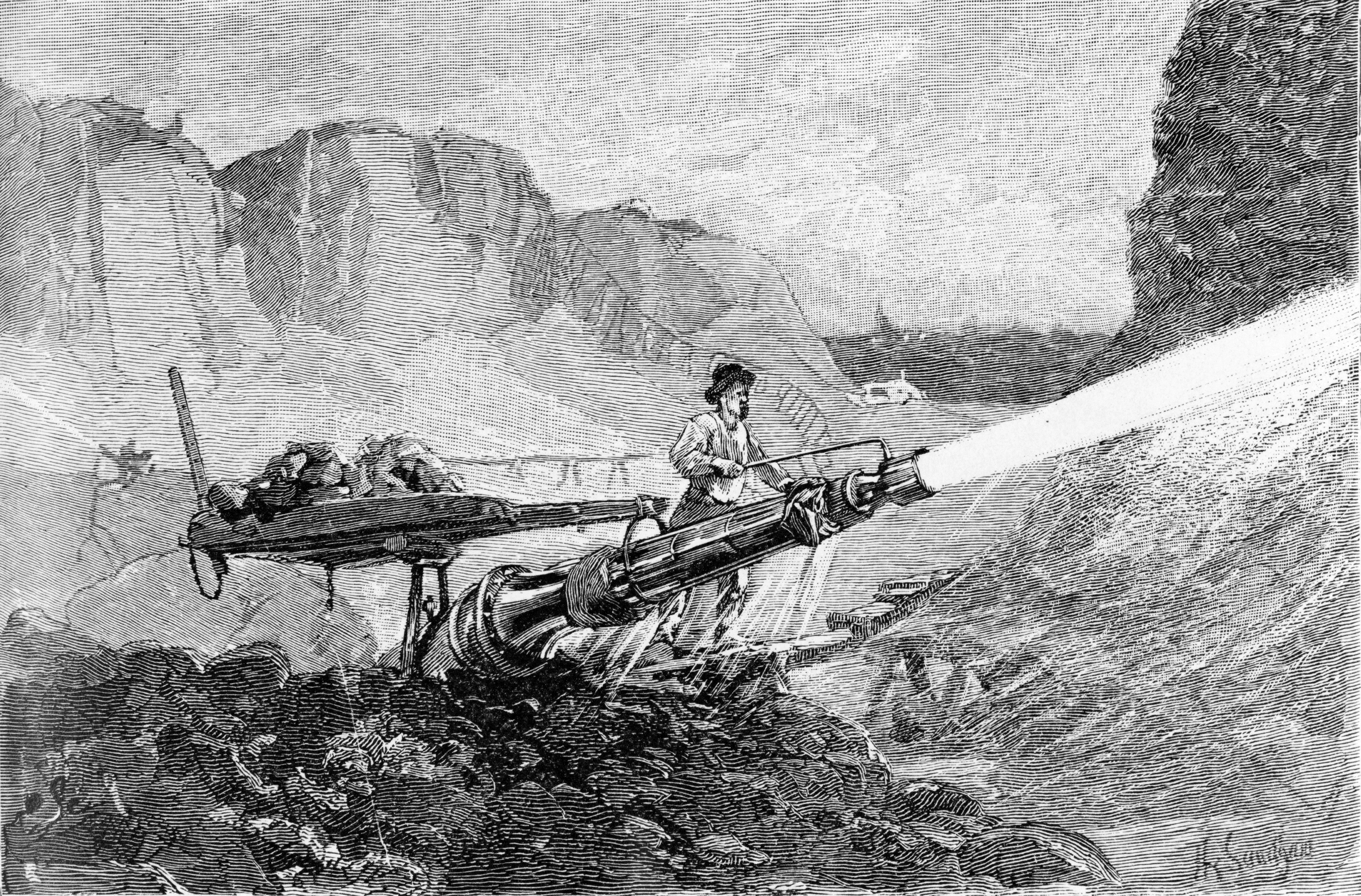
We are in the middle of a mountainside industrial revolution. Not in the Weald, but rather in the Sierra Nevada, this Monitor operator is finding gold with high-pressure water.  In Eastwood's vision, hydraulic mining is an evil thing. The cinematic composition implicates environmental hazard, but the crime that brings the  ghost of death(?) to town to kill all the bad people with guns is that of putting old fashioned panners out of work. In the nostalgic old days, people panned gold in communities. Now the Monitors had come to make their labour obsolete. This part, except for the offensive framing, is hard to swallow at this distance. It is not like panning in hillside shantytowns is a lifestyle that should have been preserved. Worst, behind it, and lurking just below the in-itself-defensible environmental talk is a discussion about  flood control-related public policy in California, where noble, anti-hydraulic mining discourse hides a less benevolent objection to state flood control intervention on the grounds that it would be paid for by taxes on people not directly affected. As time goes on, Pale Rider will be remembered more for Eastwood lifting his story than with an argument over the evils of hydraulic mining that may actually have had more to do with resistance to a. 

Anyway, Constant's take is less the Monitor than the Pelton wheel that was another component of this mining-industrial complex, because if you squint at the facts in the right way, you get to Lester Pelton's invention being the introduction of the "impulse turbine." If you have heard of the Pelton wheel, you have no excuse for being surprised by "the turbojet revolution."


Now, as usual, it turns out that calling it a "Pelton wheel" turns out to make us complicit in patent trolling. I wouldn't push this too far. Lester Pelton might have been inspired by, for example, the Fourneyron turbines rather than by a sudden thought that struck him as he looked at a water turbine made by the Knight Foundry. Again, there does seem to be dark deeds done here. The point of Pelton's improvement was to take business share from Knight. It was in no-one's interest to stop tinkerers in the California gold fields with vexatious patent-infringement suits, and even one's sympathy for Knight ought be measured. Pelton was able to build up a corporate interest that made a great deal of perfectly good mining equipment.


If Constant had started with Fourneyron, or with Charles Parsons, we would have missed a chance to see the Sierra Nevada. That he could have started with them is beside the point. He could have started in a great many places. Arguably, he ought to have started with those poor, sad Brown-Boveri salesmen trying to stimulate interest in their promising, new "gas turbine" concept in 1939.   They are the guys who put the technology of the combustion gas turbine out there on the market in the last years before World War II so that, finally, inescapably, it was obvious that the very near future belonged to turbines rotated by jets of combustion gas driving electrical generators, or powershafts, or compressors. Here is an actual industrial combine working to establish first mover advantage in what it clearly perceives to be a growth technology. The reason that we don't is so obvious as to be uninteresting. Brown-Boveri was a Swiss firm, and had no access to the Air Ministries of the great belligerents in an imminent world war. It was those air ministries that would pioneer the combustion gas turbine, because while Brown-Boveri was thinking of locomotives and ships and power regeneration in oil refineries, they missed the most important technology, the one area where buyers might be interested in something other than economic rationality: fighter jets!

By now we understand the problem. In its earliest stages, a combustion gas turbine installation is not likely to be more efficient than one of the highly-polished precursor technologies it is  meant to replace. A great deal of money is required bring the new technology to the point where a gas turbine pushes a freighter around more efficiently than a steam turbine --and steam turbines have never been that popular in mercantile shipping, anyway. On the other hand, as the speed of objects through air reaches a band within about 20% of the speed of sound, the air that it pushes aside ceases to be compressible and becomes incompressible. The rules of aerodynamics change and, unless the shape of the object likewise changes, its effect on the air changes, too. In a propeller-driven aircraft, this happens first at the tip of the screw, and that is why, in spite of ever more powerful engines, the top speeds of the hottest fighters of World War II top out around 460mph. Propel an aircraft with reaction mass out of a nozzle, and you can go much faster, and the "transsonic" limit will be reached by the plane's lifting surfaces instead, at speeds much closer to the local speed of sound. Your fighter jet will comfortably go a hundred miles per hour faster than its propeller-driven rivals, and getting through the transsonic limit to the endless horizons of supersonic flight is a possibility. 

I am throwing a "Patent Troll" tag on this posting in honour of Lester Pelton, but my tergiversations above will suggest that I am a little uncomfortable with this. I am not an impulse turbine expert, to put it mildly. But he's dead, and I don't think that he would mind developing the context of the posting in this manner because I think that there's an important point here. As long as we look at the advance of technology within the framework of heroic inventors, we belong in a conceptual universe such that the public revelation of the existence of jet fighters in early 1944 (spoiler alert!) is all about Ohain or Whittle having a Big Idea. Now that I have set the context, however, it becomes a little more puzzling. Why these two, heroic innovators. Why not everyone?

Here, then, I take you up into those other mountains, the Wealden fastness, to the lands of the charcoal burners and the ironmasters (and the Anglo-Saxon anarcho-syndicalistic commune of swineherds). It is time to contemplate our oldest and greatest communal technological praxis, to talk about blood and rye and salt and iron


Thursday, May 30, 2013

From Now On, No More Defeats: The Siege, V: Mucking Around in Boats

Once upon a time in America, a union welding job at 1980s wages was such a horrible fate that you became a stripper to earn your way out. 

*

I'm going to throw it out there that there's something toxic going on here, and it is not redeemed by Jennifer Beals ending up in a corps de ballet. Because a few years earlier, welders were "building them by the mile and cutting them off by the foot at places like the Bison Shipyard of North Tonawanda, New York, the pride of the New York Barge Canal (at least in North Tonawanda), and a few years later, people would have been a great deal happier to have a few years invested in seniority in that welding job, even at the expense of happy memories of performing classical dance in front of audiences of desperately signalling would be social climbers. 

I would put up images of the Bison Shipyard in its prime here, but the New York Museum of History is uninterested in reducing its patrimony that way. The City of Buffalo is not. North Tonawanda is, well, not too far from the town that's a bit of a running joke for a certain generation of Torontonians."** 


This is not what it would look like if more people had treated unionised factory welding jobs as good jobs back when they needed to be defended. And I do not say this as a victim of nostalgia for a 1950s that never was. I have a more complicated story to tell, if I ever get it untangled.

The Landing Craft, Tanks built at the Bison Shipyard are only one of a number of wartime shipbuilding projects that featured prefabrication by unskilled ("diluted") labour taking advantage of the fact that with enough solder, you can (temporarily) stick pretty much any piece of metal to any other. And that's entirely unfair, since although it might be taken to imply (correctly) that some Liberty ships, escort carriers and landing craft were a bit of a mess, the rest of them worked just fine and won the war, and that was kind of the point of building them in the first place. The Allies raised very large armies that happened to be on the wrong shore to fight the Axis. A great many boats were needed to deposit them on a hostile shore and make it possible for them to sustain themselves there and even fight their way inland to total victory.

That does not, by even the smallest of margins, however, exhaust the interest one might take in landing craft, because there is a lot of submerged history in these little boats. Which is why I'm going to start by talking about triremes. Of course.


Friday, May 17, 2013

The Plantation of the Atlantic, XIX: Pancakes Versus The Darkest Timeline

*
Two conceits here: first, that economists, or economic historians, often keep their bodies in the real world, while their minds inhabit the Darkest Timeline. For the best of intentions, of course.  Marx said something about how philosophy had hitherto misconstrued its callling as explaining the world, whereas the point of any unclouded perception of the unbearable reality of the world as it to some extent already was, and would certainly become, was to change it. Or, as a victim of anti-authoritarian personality disorder in your life has already put it to you, "Wake up sheeple!"

Second, that the details of the history of technology undermine grand theory. Engels may have said that water mills gave us feudalism, longbows gave us capitalism, but that's wrong, albeit in a productive way. Start getting detailed, and someone else will get more so. Unless I'm misconstruing Freddie, which I could be. Ed Hundert guided me through The German Ideology; Leo Frankowski through Engels.

Details, damn it! Ruminations about the epistemic limits of the historian's craft aside, we lack the necessary full understanding of the past. People keep launching grand theories without trying to first understand the everyday stuff. There's just too many details that, at the rate that academic history tackles things, will require generations to work through.

Today's grand theorist is an economist who has launched a thousand economic histories (the Reverend Thomas Malthus, Whig, Broad Churchman, ninth wrangler, and giant of economics.

Today's detail is buckwheat.

That is to say, an annual grass of family Polygonaceae, colloquially the knotweed family, which contains some 1200 species, including useful ones such as sea grape, rhubarb, sorrel, and many that are not, hence "knotweed," or "sumpweed." The two species of  genus Fagopyrum known to agronomists as buckwheat, or ble noir, were eaten like wheat before they became an adjective describing a particular kind of pancake mix, and a raw material for some delicious dark honeys.

Once upon a time, farmers planted with an eye to attracting bees, instead of just hiring an apiarist. Wikipedia


So what's pancake mix got to do with Very Serious Matters, you ask? Well, patience, I answer. I'm going to try to develop a line of thought I've been developing for a very long time, ever since I watched  Soylent Green in a community centre gym because there was no movie theatre in a region half the size of New Jersey, almost two centuries after the first "white men" over-wintered there. That was a long time ago, but the population outflow from the region that continues today was already well on. It's not that this young boy had any doubts that overpopulation was a thing: it was just that it was a higher thing, with no relationship to the reality that he saw; and that taught him to believe in higher realities all the more.

Now, I am not going to launch into some sophomore's version of logical positivism here. What I am aiming at is "the darkest timeline." When does it paint itself over our more boring reality? I have an ongoing argument with Brett Holman that it is not just fear. Hope and fantasy are bound up in it, in the same way that our emotional reaction to horror movies is more complicated than pure revulsion and fear.

In particular, when an economist triumphantly predicts disaster in the near future "if this goes on," it is very hard to tell whether the prediction comes from fear and revulsion, or from some weird transposition through the coordinates of our m-dimensional dream space into a place where people are getting what they damn well deserve.

....The Darkest Timeline. And I say, well, "pancakes." That is, account for the pancakes first, and then we can have our darkest timeline.


Thursday, April 18, 2013

Old Europe: Puck's Gold

*
Puck says:  "Weland gave the Sword, The Sword gave the Treasure, and the Treasure gave the Law. It's as natural as an oak growing." Apparently, the lesson is that Puck can't be trusted. The Urwald was willow, birch and lime, Puck. You should know that. Why are you lying to these children? Is there something that you're hiding? Probably. The Fey are tricksome folk, with treasure to hide.


Uncle Scrooge has to hide his treasure, too, albeit only from the Beagle Boys. We see him smiling above, but he wouldn't be smiling today. Except that, Scrooge McDuck being Scrooge McDuck, I imagine he shorted gold a month ago or so. (You can short commodities, right?)

Now I should probably motivate this post: half of it comes from listening to goldbugs. Yesterday, I actually got to hear someone ask, on CBC Radio, no less, "Is there gold in Fort Knox?" Apparently, he thinks that all the gold has been shipped to China. Because reasons. Anyway, the point is, unless you've actually bought physical gold coins and hidden them away in a money bin of your own, you'll be very sorry. Real soon.

Also, I was rereading the exemplary David Mattingly, An Imperial Possession: Britain in the Roman Empire (2006), another in the fine Penguin "History of Britain" series for academics looking to read themselves into an unfamiliar period so that they can do a Very Important Project, and not just because it's cool, and, look, Dean, I don't need to justify this to you, because there will be a Groundbreaking Publication imminently. Can haz tenure now? And Mattingly chanced to observe that what we assume to be (since we've all got "informal empire" in the back of our minds) Roman client states in southeastern England minted above a million gold coins in the century between Caesar and Claudius.

A. Million. Gold. Coins. That's 50 tons of gold, less rather than more. (83.5 grains for this one.) What the hell? Now let's motivate the conversation: let's suppose, just for the sake of the conversation, that the Roman Empire, fell, more or less, because its failure to manage its monetary system led its citizens to go Croat[o]an. Someone might say that this has some small contemporary relevance, but I'm not sure what to make of that article. I'm not even sure that "going Croatoan" is a thing, yet, even though it godamn well should be. Take it from someone who supervises a great many hardworking young people who keep taking one vocational course after another just to find themselves with more student loan debt and yet another line on their resume to justify sending out letters to employers that ignore them, because "supply side economic stimulus" means pushing the price of things lower, and why the fuck are we driving the price of educated and skilled people lower in this economy of ours....

Never mind, answered my own question there, I did. Anyway, Rome, informal empires, and gold.


Thursday, March 7, 2013

From Now On: No More Defeats: "Go Light, But Not Too Light:" Kasserine to Medenine


Speaking of light infantry....
*

The Battle of Medennine began 70 years ago today as I begin to write, and ended the night before I posted this. It's the least of Monty's North African victories, and given the man, we should count ourselves blessed that at least he managed not to say that "The [Germans] came on the same old way, and we beat them the same old way." Gibb's unfortunate composition (look, one Highlander is so tired of being told Don Quixote is worth reading that he's having a lie-down!) is pretty mild compared to the story to Bernard Cornwall's version. The French form up in bad old columns to attack the British with medieval bayonets, while the British use noble, heroic lines to defeat the French with rifled firepower. I think Tom Macaulay wrote off the Sharpe books as "too Whiggish" in a recent Edinburgh Review.

Anyway, from 5:10: "Le Garde recule!" 


Well, you might, too, if you had to attack up hill through the mud of the Coalwood with the Prussians coming on strong from the flank. There's a reason that this land lies beyond the frontier of the sown and the salus. And here's  the same old corrective. 


What's this got to do with the battle for Tunisia? It's a good question. After all, who remembers Tunisia? It might have been a defeat for the Axis on the same manpower scale as Stalingrad, but all we really remember is an American army's "dawn."  phrase. The Americans were shattered at Kasserine, and then recovered miraculously, perhaps when Patton took command. Novus ordo seclorum and all that. Dawn is always rising over America. 

As I've telegrapher above, I am taking aim at an alternative narrative. You might, if you were not Richard Atkinson, construe an alternate view of events, in which the American position only recovered with some British stiffening, and in which the British handily repelled a continuation of the German spoiling offensive a few weeks later at Medenine. Medenine is like Kasserine, or like Waterloo in the sense that whereas Napoleon's driving columns (Vive l'Empereur!) can smash through the conscript armies of Europe, the rifle volunteers of Britain always "defeat them the same old way." That is, with technology and with Britishness.  Eh, what, cousins?


Tuesday, March 5, 2013

Old Europe: Always Falling: A Technical Appendix


This is the Rhine, the river that breaks the rules of the old Ionian School geographers and flows out of the Hercynian Forest away from the equator. (Via Wikipedia.)

Here's another look at it:

Floodmaster Intranet
According to the experts at Floodmaster, who might make a little too much use of Google Translate, the governor of Transalpine Gaul did a remarkable job in 38BC in founding what would become in Vespasian's time the capital of the new province of Lower Germany, Colonia Claudia Ara Agrippinensium,

"[I]s located just downstream of the middle Rhine and [is] one of the most of flood prone cities in Europe. The old part of the city is located at low altitude and object to plain floods, especially in winter time.
The mean water level in Cologne is 3.21 m, corresponding to discharge of 2000 m³/s. The lowest water level recorded was 0.80 m in 2003, with a discharge of 630 m³/s. The last hundred year floods (HQ100) in Cologne were the floods in 1993 with a water level of 10.63 m Cologne level and in 1995 with a water level of 10.69 m and a discharge of 11000 m³/s. The high water level of 1995 flood was due to a number of flood surges coming down the Mosel, leading to long-lasting flooding. The highest water level ever measured (HHQ) was 13.55 m in February 1784.


If this were in the west of North America, where dykes and ditches have barely even begun to unlock the managed potential of the landscape, Cologne would not meet the river with a neat concrete-and-masonry wall. Those are, you may have heard, not natural formations. Okay, that's my natural facetiousness coming out, but this technical expansion of my last post is not going to make much sense if I don't spell this out. Again, if Cologne were a half-settled townsite on the edge of a major river that is unaccountably not developed because there just aren't enough people (and these places exist in my part of the world), it would not have that embankment. It would not look like that. The flats down by the river would be overgrown in rank grass and, the voyageurs would probably have called it the "Greasy Grass." The phrase is out of the French to the English in a way that was never intended to communicate the point I am now trying to make, but the point is clear nonetheless. This kind of place is not to be called that because it is thick with grass, but because it is where the grass makes fat. By which I mean to ask you to set aside our common nearing-middle-age concern for the thickness of our middles and to remember the good grease that gets on your fingers and dribbles down the chin at a good old-fashioned cookout: butter on corn, butter on salmon, baron of beef dip, shrimp chips carried cradled from home in tupperware to impress the white kids.

 Okay, technical stuff:


Wednesday, February 6, 2013

Gather the Bones, XVI, 2: The Work of Eanna


"When Enmerkar was lord in Uruk, and the heavy barley drooped in the sun under the weight of the dew, and the black haired folk grew fat on the carp flood, then all the land west of the Euphrates belonged to the Amorites, whose kings lived in tents."


Sounds nice. But then came wage slavery.


*
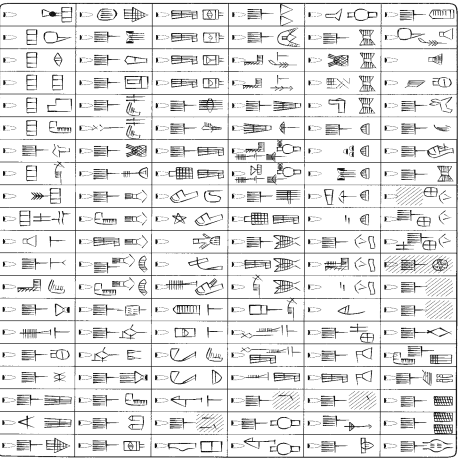
And you thought your job sucked. These guys (defensibly just guys, I think) worked for specified amounts of, we think, other interpretations being possible, bevel-rimed bowls of cheap mass-produced pottery filled with grain rations, a certain number of rations per position. The bevel-rimmed bowls are one of the signature archaeological markers of the Uruk Expansion and speak of a widespread social organisation, even if the scribes whose work Robert Englund is compiling in this modern reconstruction recalled it, perhaps six centuries later, as an organisation handed down by the sky god Anu as one of his "Me" of civilisation, and stolen from sacred Eridu in the holy lagoon and carried off to upstart Uruk by sexy, sexy Mother Eanna, at least by the interpretation of sacred text presented by Paul Kriwaczek

That insistence, that failure to remember a glorious history, is a good reason for thinking that Uruk was ever the capital of an empire, as Cuzco was of Incan Tawatinsuyu. The same objection may be made to the idea of Cahokia as the capital of an upper Mississippi empire, similarly delineated by a characteristic mass produced pottery speaking to some kind of social-organisational function. Conversely, the survival of a genre of document that seems to originate in Uruk IV, and the attachment to it of a new explanation speaks to ideology, and I do mean ideology in the careful "German Ideology" way that Paul Hundert taught me to say it, for a change. Of course, you think. It's about food/rations/pay, in a way that makes it comprehensible to the citizens of the southern alluvium about 3200BC, perhaps as early as 3800BC. It's going to be ideological. But do we understand just how ideological?

What's the southern allulvium? Well, in my tradition of going to left field for my sources, here's Playfair (Mediterranean and the Middle East) illuminating the point:

(i) Floodtime near Habaniya Air Base, on the road between Fallujah on the Euphrates and Baghdad on the Tigris in the spring of 1941:


ii) The theatre of operations back from that time when the RAF bombed the heck out of their clients allies for having the temerity to back the wrong side:


As you can see, the area around Habaniya was very wet during flood time. What can't be imaged here is that this is going to be a transient condition. The region gets as hot and dry in the summer as it is wet and chilly in the late winter/spring, and as the historian of the last British (well, Indian, really) campaign in the region points out, all the fodder and animals are going to disappear, and if you think that  you're going to store food in a way that lasts through the summer around here, forget it. It's just way too damn hot for anything but the local traditional technics, not that anyone actually knows how it's done, given that the foreigners traditionally clear out for the mountains, along with at least some of the herds, when it starts to get hot.

Hot. That's the word. In 1925, documentary makers will follow the Bakhtiar tribe of, they say, 50,000 people and 500,000 head as they cross the lower Karun on their way to winter pasture in the mountains. It's an ancient and unchanging struggle, the documentarians say, against heat in the low country and snow in the high. Only probably  not, because, at least for the moment, on the dubious basis of pollen and sediment studies, I am going to go with the thesis that there was a radical expansion in human-curated forests during the Iron Age. Which is another way of saying that we can at least assume that low-forage climax forest on the Zagros heights were replaced with high-forage mast forests by people with iron axes in the period after 800BC. No less in the Middle East than in temperate Europe, the disruption of iron technology must have been socially transformative.

But that's for later. There were certainly livestock in the Middle East of 4000BC, and some, at least, were going to the mountains. This thing we're talking about was an economic unit. What thing? Well, some call it Mesopotamia, because of course you use Greek names for Arab places, and some call it the Fertile Crescent, which, for me, raises spectres of Seventies style geopolitical fantasies, and some call it Iraq, and it certainly would be awesome if it turns out, as Kriwaczek suggests that "some" say, that Iraq comes, via Erech, from Uruk.

Still, we're talking about an economic unit here, and I have a map, crassly lifted from Robert Englund (1998) Texts from the Uruk Period just like the table of occupations above:


Englund offers a somewhat fuzzy view of the key 400mm isohyet, but the basic geography is easily described. The Arabian plate is ramming Eurasia, raising an orogeny around the leading edge of the plate that lies within he Warm Mediterranean climate zone of wet winters and dry summers. The orogeny sheds winter precipitation in a spring flood and creates a zone of relatively high precipitation low land that hugs it in a gentle crescent. Mountainwards of the isohyet, dry farming is practical. Below it, there is a zone of archaic settlement remains indicating an early phase of agriculture petering out towards true desert. Or, as the ancestral cattleman in me calls it, "range."

So from the map, we know what the southern alluvium is: desert. Or range, if you prefer. Not in the spring, to be sure, when the rivers are in spate, when the Tigris, carrying the freshet of the Zagros, rises in its deeply dissected gorge to the height of a four story house, and the much more mellow Euphrates, descending from the Taurus at a gradiant of perhaps 6 inches in a hundred miles, leaks under its natural levees to create the landscape of the picture above, where it is nearly as wet on the landward side of the levee as on the riverside, and great lakes pool in depressions in the midst of a landscape of intractable mud. But later: in the summer. When it's hot.

Did I mention that it gets hot then? That's why it is range. Of course, that's not what it is used for. It was farmed, perhaps beginning about 5000BC, or perhaps a little later, and still is. Irrigation serves as a better-than-substitute for rain, and as a result cities sprouted on the southern alluvium at an early date. Breaking historical insight: irrigation is key to early civilisation!

Except, well, yes and no. The only major Iraqi agricultural  exports that manage to bear up against the tides inflooding that unhappy country are dates and wool. Yes, the country produces a great deal of cereal, but it is a net importer of wheat and grain, and the agricultural ministry's current main concern is getting the 17 million palm trees that line the Shatt al'Arab back into full production. And this should be no surprise given that the average date palm produces 100kg of fruit/year, and that 178g of pitted dates yields 500 calories. If I were a Stone Age economist, in fact, I would strongly recommend that southern alluvium subsistence-challenged fellow flint nappers focus on dates as their food source, not grain.

The only problem with this that I can see is that the date harvest takes place in four tranches, each harvest being necessary to prepare the tree for the next. The earliest pick is in June, the same time as the cereal harvest, shortly after the sheep are shorn/combed out, and the main harvest begins in August. Did I mention that it's awfully hot on the southern alluvium in August? In a world where all the good land is already taken up, I can see the logic of lounging through the July heat around Uruk waiting for the dates to fruit.

So I argue, a lot, that major civilisational changes reflect the long, slow, positive feedback loop of technological change leading to higher regional population bearing leading to investment in a deeper economy of knowledge making new technologies possible making for higher population densities. If the Uruk Expansion is defensible as a transition to a new social mode of organisation, perpetuating ideological statements that survive another six hundred years to be found as scribal exercises at the dawn of the next era, do I see a new technology, or, more clearly, a new economy of knowledge?

You damn bet I do: Andrew Sherrat's "Secondary Products Revolution" is already closely correlated with the beginning of the Uruk Expansion period. The idea, not to get repetitive here, is that about 4000BC, human society moved from using its domestic animals (closely hunted prey?) for secondary products such as milk, wool and traction as well as for meat. This is not "invention;" it's not, pace the geneticists currently at work on the subject, due to a sudden mutation that made adults capable of consuming lactose. People put far too much trust in claims about the scientific origins of the diet fads of the moment.** It's about labour. To use wool and milk and traction successfully, you have to feed and care for animals more closely, and you need plenty of labour to process the products. Above all, you need textile workers.

I am not proposing the rise of a commodity textiles industry in alluvium cities here. That would be crazy. Dressing a person in wool takes the product of one or more animals, and the full shearing season labour of one individual, plus the work of another. We are still in an age when people wear mostly hides and rely on staying out of the sun a lot. I am proposing a much larger scale of textile production, and actual social takeup somewhere between the extremes of Paleolithic-people-trading-shells-hundreds-of-miles-inland and everyone-wears-undies-made-in-Manchester. This will serve as a model for understanding the extent of population concentration in Uruk that aligns it with Cahokia at one extreme and Cuzco and Teotihuacan at the other.

But I still haven't explained the empire, or dates, or the logic of cramming people into the southern alluvium, or the ideology that I see in those list of occupation plates. Again, out of left field, early modern military history irresistably suggests the parallel. If there is anyone who is as weirdly insistent on publishing tables of ration compensation by office, it is the scribes of the Perpetual Diet who tell me, and anyone who goes into the Kriegsarchiv in Vienna and looks up late Seventeenth Century administrative documents, exactly how many additional rations for man and horse every man and officer  receives in pain de munition and horses worth of fodder, as well as their pay in good silver gueldern. 

Prince Eugene of Savoy, in right of his position as Reichsgeneralleutnant, gets the rations of 300 men, by the way, and 300 horses. Not because der Edle Ritter goes to war with a train of 300 mounted servants, but because he's doing a fine job as commander of the Reich's armies, and deserves to get rich.

The question that we tend to ask is, "Why this cumbersome triple compensation scheme?" And the answer, it seems to me, is ovious: ideology. This is how the Age of Grass organises wealth. We live in the Age of Oil, and we think differently.  Well, the scribes of Uruk are men ofo the Age of Grass, and they' are talking about rations. But, in my humble opinion, they aren't talking about rations as rations per se. They're talking about wealth.

What's the difference? Well, the first rule of animals is that they live and grow on what they eat on their native ranges, but they are fattened for sale at a feedlot. In general (and I aim this snotty shot at people who talk about the Roman annona and elide into "bread and circusses" talk), people way underestimate the extent to which the alleged subsistence rations of antiquity were paid, not to the starving poor, but to rich feedlot ownerrs, to fatten up cattle for the market, rather than the poor for their own good. Call me cynical, and I'll cop to it. I can't imagine how I got that way, but that's the way I see it.

So here's the logic of the Uruk Expansion as I see it: massive circulation of population to and from the southern alluvium because that was the only way of circulating real wealth, in the form of something that mattered: sheep and cattle. The "new" focus on the date palm as the wonder crop of the southern alluvium? It's not because it feeds people. Dates might be a dietary staple, but they're only a dietary staple. It's asking a lot of the average human digestive tract to deal with an all fruit-sugar-and-fibre diet, and that's a lot of pits to remove. Sheep and goats, on the other hand. . . .

Empire, I'm suggesting. It is the product of a new economic system required to organise mass animal movements across paths that we may have lost sight of insofar as they ceased to make sense in the Iron Age. It is an empire that makes the southern alluvium worth colonising, and one that drives economic intensification there, and, incidentally, administrative intensification that makes itself visible in the form of the first texts, and, somewhat later, the first (and unhelpful) history.

Taking this back across the Atlantic, and I am going to suggest that if economics organises empires, than the collapse of the pre-Columbian economy, instantiated by the very appearance in the New World of Old World techniques and domesticates, ought to have dissolved New World empires, at, just after, or even before explicit contact. New techniques call for new modes of organisation, so why put up with the inequities of the old?

(I will leave it out there, for now, that the main use of the Oregon Trail turns out to have been to run sheep to and from the Oregon and California pastures to the mutton packing plants of Chicago, and that two significant concentrations of the somewhat mysterious surname "Nottke" are in Illinois and Washington state.... The idea that some of the Nottkes were originally "Nutkas" barely qualifies as a hypothesis, but the two decade long era of mass sheep drives on the Oregon Trail legitimately count as lost history. )

That is not the world of 4000BC.
*This is actually a composite of Uruk IV lexical lists of occupations, appearing in and, I guess, created by Robert K. Englund, or an unsung assistant. Englund (1998): 104, fig. 32
**Imagine how our history of civilisation will change after some impressionable historian reads a book by a gluten-free diet faddist!