Bench Grass is a blog about the history of technology by the former student of a student of Lynn White. The main focus is a month-by-month retrospective series, covering the technology news, broadly construed, of seventy years ago, framed by fictional narrators. The author is Erik Lund, an "independent scholar" in Vancouver, British Columbia. Last post will be 24 July 2039.
That's the Danube on the left, the Sava on the right. Since that might be confusing, here is Google Earth, picking out the route from Venice to the White City:
And now that we're oriented, here's the town and its rivers, with the road from Venice coming in from the left:
At this scale, you can see the Sava entering the Danube from bottom left, and the course of the relief canal that cuts out the meander on which Belgrade sits. I would imagine that if you descended the Danube in flood three hundred years ago, it would be a matter of choice whether you found the city on the blue Danube at all.
It is night on the glassy seas where Álvaro de Mendaña de Neira, half-maddened by the horrors of a sixteenth century Pacific crossing, thought he found King Solomon's Mines, the long-sought link between Inka west and Holy Land that American blades have been seeking ever since, often in more probable locations. Peace will last an hour or yet, because no-one's trolled the fanboys yet. I'll get on with that in a minute.
Rear-Admiral Norman Scott of Indiana, Academy Class of 1911, is a man with a future, graduate of staff and War College, and recently attached to Nimitz's staff. He is here on the lee shore of Guadalcanal, and, as yet, smells only tropical flowers and tension. The Emperor's men are coming. "If I go away to sea, I shall return a brine-soaked corpse; if I go to the mountains, a jungle sward will be my tomb." Heavy cruisers San Francisco (flag) and Salt Lake City, along with light cruisers Boise and Helena and destroyers Farenholt, Duncan, McCalla and Laffey are closing heavy cruisers Aoba, Furutake and Kinugasa, accompanied by destroyers Fubuki and Hatsuyake. Scott knows that they're out there. Admiral Goto (cue hilarious progamming joke) is walking into a trap.
What can I say? Samuel Eliot Morison got to set the tone for writing about the long series of naval battles on the approaches to Guadalcanal that gave the name of "Ironbottom Sound" to the waters between that island and the volcanic cone of Savo. Morison wrote colourfully at the best of times, and, for him, this long struggle was the Anglo-Dutch Wars of the American Republic: the nation's true baptism in the fire of naval superpowerdom. It's a good comparison. If Arleigh Burke is the closest that the USN could come to finding a fighting admiral-hero, that probably has some connection with Scott's death only a month later in the first night of the Naval Battle of Guadalcanal.
For all that, Two-Ocean Navy is pretty short with the Battle of Cape Esperance. Scott had two heavy cruisers, two light cruisers and five destroyers with which to engage 3 heavy cruisers and 3 destroyers, a heavy preponderance of fighting power, even taking torpedoes into account. He had the advantage of surprise, better radar, and a chance to exercise his task force before the battle. These were advantages that Dan Callaghan and Willis Lee lacked, or, in Callaghan's case, threw away, before the battle. He should have won, and were I being tendentious, I could make the case that he ought to have won more.
But I'm not being tendentious. I'm writing in the spirit of purply, 1920s-style pulp-prose, trolling and leaning heavily on Japanese stereotypes, things never before done on the Internet.
Since time began, men have longed to destroy the Sun.
Wait, no, that's just an ancient Simpsons reference to an even more ancient TV show, taking us down into a search for lost time. What I meant to say is that since time began, men have longed to build a repeating missile weapon. Exactly why isn't too clear given that we're talking about a weapon that by definition either puts large numbers of missiles in the same place or disperses them across a set field. Neither project sounds like a winner compared to shooting bigger missiles. Especially once cannon came along to allow the firing of grape and case shot.
What if you have a cannon that has been improved to fire conoidal rounds down a rifled barrel? Now case and grape shot don't work so well, and artillery brigades can no longer be all Napoleonic and "charge" the enemy (and the longer-ranged Krupp steel guns), since they can't defend themselves against infantry counter-assault. So maybe you want to take one of those "machine gun" concepts that has been gathering dust and turn it into a battery close-in defence weapon. Which is where you're at if you're a French ordnance officerin 1866. Warning: not only will an American patent troll steal the popular credit, but gales of uncomprehending, derisive laughter and ethnic stereotyping will be elicited by the failure of a few hundred support weapons to win the war single handed.
This taught ordnance officials two very important lessons: i) until such time as the US courts start treating foreign patents as something more than treasure-laden galleons a-ripe for the plunderin', it might be for the best to have an American figurehead for your invention; and, ii) it might also be good be if the next generation of machine guns didn't have the same column space requirements as a field piece.
Fortunately, American trolls can't practically steal inventions if they can't actually be made in the United States, yet, and no-one cares about chemistry. Chemistry is for girls. So when someone invents a smokeless powder that can drive a recoil mechanism, you can put your American on top of a gun that fires the standard rifle round, which generates more than enough momentum for a tiny, delicate mechanism to chamber another round. Use a chain belt feed and find a way to carry heat off the barrel faster than the gas adds it, and you can have a marvelously compact weapon capable of keeping up a continuous stream of fire, potentially for hours on end.
Now, to be sure, I'm cheating here in my search for irony quotes around "compact." The Russian version of the Maxim machine gun went with a gunshield, which made it too heavy to be manhandled, which led to the wheeled undercarriage and tow bar. It's perfectly possible to push the weight of the first generation machine guns under 50lbs. Throw in a tripod, ammunition and its bearers, and a few sandbags, and you get a weapon that can be carried in a single wagon, set up in a small nest, and served by four or five men. With 800+ men to an infantry battalion, you can easily squeeze two-to-four of these weapons into the organisation without squeezing the all-important riflemen out of the table of organisation. A French infantry division of 1914, for example, can manage 24 machine guns and 36 75s and still have 9,600 Lebels with which to thrust bayonets into the squirming, sauerkraut-loving Boche.
But that's not enough: is it, Mr. Prime Minister? "Take Kitchener's maximum; square it, multiply that result by two - and when you are in sight of that, double it again for good measure." This is one of those quasi-apocryphal Lloyd George quotes, in that he said it, but probably not in 1914. As John Terraine points by 1918, the machine gun battalions of the British army actually did have 64 machine guns by 1918, but the number is ludicrous for an infantry battalion. It is, of course, open to be argued that it's a waste to put infantry behind bayonets instead of Vickers, all other things being equal, but a moment's attention to the crew and logistic requirements of a 64 gun unit will show that you can't have both. As Lieutenant Colonel Laure, source for my last count (via Army Quarterly 16 (1927), 2: 411-12), points out, by 1917 a French infantry division mustered 2800 rifles, 48 guns, and still only 72 machine guns.
That's not all, however. Laure adds in 324 "light machine guns" (and 27 "trench mortars.") What, you might ask, is a "light machine gun?" One answer is that it is what you get when you ask an American inventor to "add more lightness" to one of the big old Hotchkiss/Maxim/Vickers monsters. Certainly it was the lightness that everyone who used the Lewis Gun liked about it, because it wasn't anything else about the design! Lightness, however, was not an inconsequential virtue, and the French went their own way, introducing the Fusil-mitrailleur Mle 1915 CSRG "Chauchat" in a not-entirely successful attempt to improve on the Lewis, although the French-made Chauchat was never as bad in French service as the American-made version, and if you think I'm harping on this whole "the American arms industry wasn't up to snuff in the world wars" point, wait 'till next week.
So it is the Chauchat that Lt. Col. Laure is talking about when he refers to "light machine guns," even though the translation is more accurately "automatic rifle?" So what's the difference, you ask? We go now to Youtube to completely miss the point!
At one level, the point is that the whole reason that the BAR remained in American service through 1960 is because of the supposed value of being able to fire it at the walk. This is most definitely not what the z.B. 26 was designed, for, nor any of its descendants, whether the Chatellerault or the Bren gun.
The other point is that 1914-18 has changed the nature of the Nation in Arms.
The Electric City is in danger! One of those unconsciously revealing snips of history, from 1914.
"The inventor of the Lewis gun was not the only American who played an inconspicuous but none the less important part in [this first campaign of World War One]. A certain American corporation doing business in Belgium placed its huge Antwerp plant and the services of its corps of skilled engineers at the service of the Governmen . . . . This concern made shells and other ammunition for the Belgian army; it furnished aeroplanes and machine-guns; it constructed miles of barbed-wire entanglements and connected those entanglements with the city lighting system; one of its officers went on a secret mission to England and brought back with him a supply of cordite, not to mention six large-calibre guns which he smuggled through Dutch territorial waters hidden in the steamer's coal bunkers. And, as though all this were not enough, the Belgian Government confided to this foreign corporation the minting of the national currency. For obvious reasons I am not at liberty to mention the name of this concern, though it is known to practically every person in the United States, each month cheques being sent to the parent concern by eight hundred thousand people in New York alone.
Incidentally it publishes the most widely read volume in the world. I wish that I might tell you the name of this concern. Upon second thought, I think I will. . ."
And that's American war correspondent E. Alexander Powell's account of the Bell Telephone Company's part in the defence of Antwerp in his instant book, Fighting in Flanders, uploaded here at what appears to be a stranded web page, so that I don't know how to credit it. It was a defence, Powell has to admit, that did not go as well as hoped. Unbelievably, defences as strong as these
Photo by Donald Thompson: Source: Wilson's History of the World War**
weren't strong enough. Perhaps it was time to rethink things a bit.
No, not the spicy Laotian dish made with ground rice, meat, lime and fish sauce, which sounds delicious (thanks, Wikipedia disambiguation!). The breed of nerds that likes to dress up in fantasy or period costume and pretend to fight each other, which is not, well, delicious. More exactly, it's like Talk Like A Pirate Day, only embarrassing. (See how I cleverly insert a reference to Talk Like a Pirate Day, which this post missed the actual celebration by two days? I'm going to talk about ...that.)
So I guess I don't have to bring any sentient readers up to date on the major news story of the day. Besides, I might be linking back to this post in a year or two, and we'll laugh and we'll laugh. Suffice it to say that Mitt Romney of that Name, Republican candidate for President in 2012, pushed forward with The Campaign From Dunning-Kruger by furthering his reputation as an out-of-touch rich person.
You know, the guy from a small-denomination Protestant church in America's most-out-of-touch state, who is running against the Harvard Law graduate with all those University of Chicago connections. I'm not going to argue that it's not the way things are, here in the fall of 2012, but I am going to suggest that there is an anomaly to be explained.
So, this: from the start of history, Julius Caesar's Commentaries on the Gallic Wars (6:24ff):
"And there was formerly a time when the Gauls excelled the Germans in prowess, and waged war on them offensively, and, on account of the great number of their people and the insufficiency of their land, sent colonies over the Rhine. Accordingly, the Volcae Tectosages, seized on those parts of Germany which are the most fruitful [and lie] around the Hercynian forest. . . . The breadth of this Hercynian forest . . . , is to a quick traveler, a journey of nine days. . . . . It begins at the frontiers of the Helvetii, Nemetes, and Rauraci, and extends in a right line along the river Danube to the territories of the Daci and the Anartes; it bends thence to the left in a different direction from the river, and owing to its extent touches the confines of many nations; nor is there any person belonging to this part of Germany who says that he either has gone to the extremity of that forest, though he had advanced a journey of sixty days, or has heard in what place it begins. . .
. . . .
And from its end:
It is time to talk about forests.
If you've poked around in Caesar's Commentaries long enough to cherry pick his description of the "Hercynian Forest" long enough, especially with reference to the ongoing debate over Edward Luttwak'sGrand Strategy of the Roman Empire thesis, Caesar's agenda comes clear. The reason that the Hercynian Forest is endless east-to-west. but "nine days journey" north-south is that it functions, as forests and "wilderness" always function in Classical writing, as a boundary rather than as the new continent aching to be discovered that it has come to imply to the North American imagination. Thus, too, the discovery that the battle of the Teutoburger Salis wasn't an ambush deep in some dreary, trackless forest, but rather on a road that picked out its path between sandy hill and marshy clay bottom, as roads in this part of Old Europe were wont to do.
Of course, the boundary of merit here is between the known and knowable part of the world where rivers flow south (as Aristotle apparently pointed out, per good old Wikipedia), and the deeply spooky, beyond-liminal parts where they run north. I've suggested that the actual boundary is picked out by the latitude where much less biotically productive conifer forests come to predominate over the European temperate broadleaf forest ecosystem; and, what do you know but that "Hercynian" seems to derive from Perkunos, "Indo-European" god of oak and thunder. (Scare quotes to signify that I've gone to annoying-ass Dumezil country.)
Moving forward, or back, as the case may be, geologists picked up the word to designate the middle-European component of the Variscan Orogeny of the Old Red Aeon. This orogeny raisedsome, but not all of the relict series of mountain chains that extend around the North Atlantic from Morocco to Scandinavia to Greenland to Georgia. Specifically, the Hercynian component is the one that begins with the Taunus Mountains of Hesse, between the Main, Rhine, and the Lahn; then vaults the Rhine at Koblenz to become the Hunruck up to the Moselle, then becomes the Eifel, which terminates in the High Fens in the north and the Ardennes country of Belgium and Luxembourg. Which, in turn, gives way to the "Coal Wood," a series of (very gentle) hills rolling across southern Belgium/northern France to the coast at Boulogne-sur-Mer, crowned and tangled and impenetrable from the oak and beech old growth forest that, in recent historic times, came down to the very gates of Bruxelles.
The mountains of the Variscan Orogeny are typically slate overlaying mineral deposits, primarily of coal and iron, but also of the copper group in places. That isn't actually embarrassing mineral richness, except...
Well, the Coal Wood is even less mineral rich. The heights are formed by old sea bottom sand that has rolled up over the landscape over the past many glaciations and then been uplifted by the postglacial rebound. The country below is where the clay forms its mucky, impermeable beds. At the boundary of sand and clay is the stream line, where the waters that the Atlantic so bountifully showers on maritime Europe find an end to their rapid downwards percolation through the sand and have to bed and pool and cut to find their way the rest of the way to the sea.
It's a lot of rain: 55" annually on the High Fens, the highest annual precipitation of the continent. Even as a Vancouverite, I enjoy significantly less than that down at work in Richmond, albeit a little more (60") on the famously rainy North Shore when I visit my family there. And it really has to work to get to the sea.
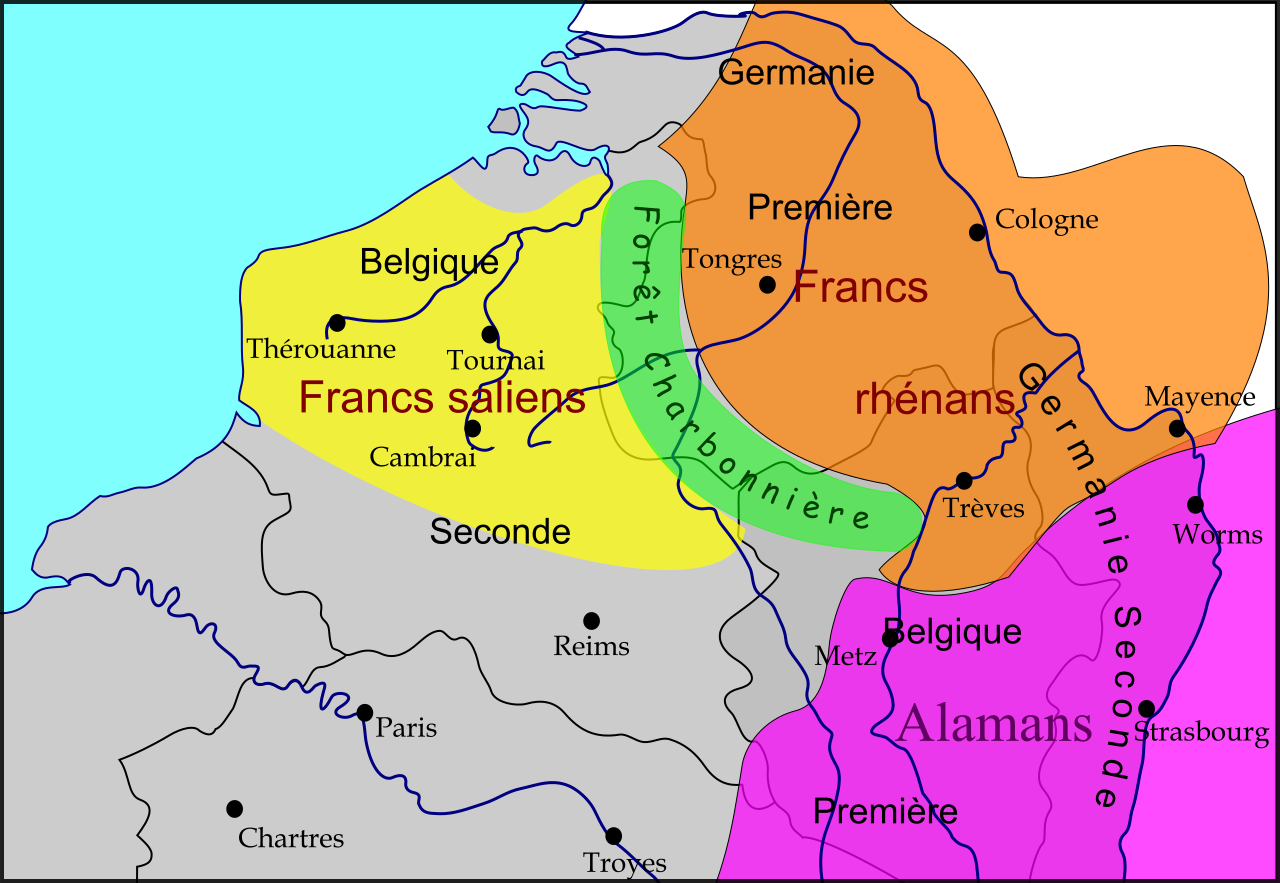
Okay: what have I done here? First, let's orient ourselves with a map:
Wikipedia: And, yes, I remembered to make my contribution this month. Still have to pay my credit card, though.
The map here instantly locates us in historic times, with the division between "Salian" and "Riparian" Franks. You know who else divides Belgium into two? Everybody. In one version of the story, which might even be in the Wikipedia article, the incoming Germanic Franks-becoming-Vlamands drove the Romans-becoming-Walloons out of the low country into the high woods, where they lived like free men, raising pigs and smelting iron. The map, which has at least some of the virtues of geographic clarity,makes this claim a little hard to make out. Fortunately, I'm not as interested in the details of the intersection of ethnology and Belgian constitutional history as Belgians (for entirely forgiveable reasons) are. What I'm interested in is this claim:
"A great Roman road forming a "strategic axis"[6] linked the Rhine crossing at Cologne with Maastricht, where it crossed the Maas at the head of navigation. Skirting the northern edges of the Silva Carbonaria, it passed through Tongeren, Kortrijk and Cambrai to reach the sea at Boulogne."
It's not that the "Chaussé de Brunehaut" didn't exist. On the contrary, as the (French) Wikipedia article linked to suggests, there has been a route between Cologne and Boulogne-sur-Mer since prehistoric times, and Roman itineraries make it clear that it existed in Roman times. In a sense, it was a geographical inevitability that a road would follow the terraces between sand and clay, between the tangled forests above and the equally tangled gorges below. Brunehaut actually had many roads. The Romans, unfortunately, don't make much of a fuss about the Silva Carbonaria at all. One very late Roman writer (Gregory of Tour) gives us permission to think of the Coal Wood as stretching all the way to the Rhine, but, for the Romans, it's all the "Ardenuenna Silva," not surprising when emperors lived in the middle of it at Trier, and the great poet Ausonius writes an elegy to its second river, the Moselle, incidentally telling us how the Romans exploited its greatest natural resource with a marble-cutting saw mill running in the stream of the Kyll, which falls from the high and inaccessible Eifel down into the Moselle at the Imperial city itself. The Moselle is beautiful, full of plentiful vinyards and (supposed, I think) marble quarries, a land of horsemen fit to ride beside an Emperor --and in the middle of this great forest that marks the change of the world to north-flowing rivers.
So, if, as I've blithely suggested, the Coal Wood is a pretty small deal compared with the true Hercynian ranges of the Variscan Orogeny, inflated by Belgian folk history and political squabbles, why am I making a big deal of it?
Good question: remember that I've been reading about the early fighting of WWI a great deal. It's in Army Quarterly, of all places, and this last month, no less, that I first heard about the "Silva Carbonaria." And the phrase that stuck there had nothing to do with the Ardennes or ancient geology. It talked about the old Roman road that formed the front and axis of so much of the fighting in the fall of 1914, the road that stretched from Cologne to Boulogne, gradually climbing as it went.
Gradually climbing. From Cologne. To Boulogne. See? This is what I like about the everyday history of technology. Facts this basic about the world just blow my mind away, even if I have to wait 'till I'm 48 to learn them. (As it turns out, it's true even at the most basic level. Cologne is 37 meters above sea level, while the citadel of Boulogne is 63 meters.)
Oh, right: a map:
Add caption
the scale's a bit big, but you get the drift.
Here's another way of looking at it, from a contemporary, pictorial history of WWI, from which we'll hear again.
Here's another way of looking at it. As my dead old military writers point out, as you follow the summit of the Coal Wood north and west, you come on the headwaters of one stream after another. The Escaut, the Lys the Deule, finally the Aa. This is how rivers start in Belgium. Even the Yser rises on the isolated height of Cassels before running through Ypres to Nieuwport, where the great sluices control the flooding of Flanders and let the water of the Yser out to the sea, simultaneously making Nieuwport a port, Vlamand Flanders dry, and Nieuwport the citadel anchoring the Allies' flank on the Flanders front during the Great War.
The heights above Boulogne shown so dramatically by the illustrator are the source of the farthest westward of these little rivers, the Aa. In the map of the Silva Carbonaria above, notice that "Therouanne" is given as the major city of western Belgium. This is because, once, long ago, when the flats were marsh from north to south, it was. This was where St. Omer came to build his cathedral in the mid-600s, where he preached to the local Gallic tribe, which was either pagan or backsliding, depending on the source. St. Omer became famous enough that eventually the port town on the Aa, St. Omer, was named after him. Not, one would think, that a port town in the marshes just over the hills from the great Roman port of Boulogne would have amounted to much. At least, you would think. One of the morals of the "gradual ascent" from Cologne to Boulogne is that it tells us why the town was so important to the Romans for so long, and why this road is apparently the axis of connection between fourth century Britain and the imperial residence city of Trier (in other words, arguably, the reason that Britain remained in the Empire so long, and that Roman culture there collapsed so utterly in paradoxical rebound when the empire withdrew from Trier) is that there aren't exactly many other places where Roman civil technology could reach the Atlantic shore in this latitude.
It was to here that, in 861, that the eighteen-year-old former mother-in-law of Alfred the Great, Judith, eloped so that she could marry Baldwin "Iron Arms" of St. Omer in defiance of her father. Nowadays, the old cathedral of St. Omer is as obscure as Therouanne today, eclipsed by the three towns lined up at the edge of the estuary of the Aa where land meets sea: Calais, Gravelines and Dunkirk.
Do the names put a shiver down your back? They do mine: The Dunkirkers are out! Judith outlived the outrageous imputations of immorality imposed on her name by the snakepit politics of Wessex to become the mother of a dynasty, a nation, perhaps of modernity itself: Judith of Flanders. Her husband, first Count of Flanders, founded and named Bruges, albeit on the site of another old monastery. Long before Judith's direct descent in heirs male expired, as is the way of dynasties, Flanders was the richest province of the north, and home to its greatest port, one of the greatest in the world.
I know that I harp on the point a great deal, that the Aa's way to the sea, like that of the Yser and even the Escaut to the north, should not be taken as something given by nature when it was so obivously, rather, built by the hand of human society. Places like Dunkirk and Nieuwport could not have been the fortresses they were without the control of water made possible by human engineering skills. Nor could they have been the ports they were, had it not been for those fortiifications, which allowed them to defy hostile interests to landward and create a privileged place where, yes, piracy, but also smuggling and simple tax evasion could flourish.
What makes this post worth doing is the revelation of the Coal Wood. That, behind the water-filling, sand-choked coast lay hills that, however low and underwhelming by comparison with the greater forests inland, furnished the charcoal, later coal and iron and oaken lumber without which these ports could not be built, their sawmills supplied, and the ships built. The Coal Wood was a dominating feature of Roman geography because the road that linked Ocean to Emperor had to skirt it. Insofar as the Romans understood it in its own right, it was a realm of mystery and wonder. Something not quite in their authority, which instead ran at the boundaries between zones of inaccessibility, from which the indigenous folk, by some magic that the Romans exploited without understanding (hint: money) fetched out pigs and cows to feed the great and the good.
It was the dominating feature of the medieval geography of Judith and Baldwin for quite another reason; because it was the source of the tools that remade the Lowlands into rich, productive country, and cut a path from them to the sea to make their commerce flourish. A commerce inseparably linked to piracy, of course. But, from upland of pigherding bandit to sea of corrupted pirates, are we looking at a feature, or a bug?
I say 'feature,' and distinguish this difference between the Roman and the nuptial bed of Judith the runaway bride and her iron-armed suitor: commerce, credit, and money. The Romans let that go, and lived in the midst of a vast and trackless "Ardennes Forest" that gave way to an even more mysterious Hyrcinian forest beyond the Rhine. The House of Flanders did not, and lived on the slopes of the Coal Wood.
(Warning: not a single scholarly or musically redeemable link above the fold. Plus a repeat!)
Seventy years ago, more or less, Alam Halfa is over. Egypt is saved, or so they said. It's a battle that turns on tanks charging tanks. But was it a cavalry battle?
Or Kipling, a bit more mawkish than Tolkien letting an old man rise from his dotage to redeem the world, and himself:
By the brand on my shoulder, the finest of tunes
Is played by the Lancers, Hussars, and Dragoons,
And it's sweeter than "Stables" or "Water" to me--
In Walter Scott's "Bonnie Dundee," Graham of Claverhouse rides out of Edinburgh when the Convention condemns him, and no-one dares to challenge him. That's the riding. (And what Ned Stark should have done.) When it comes to fighting, Scott's back with to "on foot should be all Scottish war," than which no dumber advice has ever been given to the lord of Lothian. "Before I own an usurper, I'll crouch with the fox," and so the "wild war cry of Bonnie Dundee" fades away into the old, romantic Scottish scenery.
Whereas Bonnie Dundee shattered the army of the Convention with a wild cavalry charge at Killecrankie, but you've got to be a real Celtic Renaissance diehard to revive "Killekrankie," and, as Scott would smugly remind us, he died doing it. Good man, wrong side of history.
Or was he a bold sabre, with no-one to take the battle in hand after he fell, sabre in hand?
Seydlitz, they say, was riding across a bridge with Old Fritz, when the King asked him what made a good cavalryman. "First, he must never be taken," Seydlitz answered. But aren't you taken now, Frederick asked? And in that same moment, Seydlitz took his horse over the rail of the bridge, plunging twelve feet into the water, only to emerge a moment later on the bank of the river and ride off. That's the other side of things.
So was Alam Halfa really a cavalry battle? The outline story is that whie the Antipodean infantry matched Axis counterparts passively in the north of the El Alamein position, the Afrika Korps and the Italian 20th Motorised penetrated the minefields in the south and tried to hook around the flank of the Commonwealth position, only to run into the mass of the British armour, dug in along Alam el Halfa ridge. The Afrika Korps' wild charge broke against the position, and the Axis forces, short of fuel, withdrew back along the tracks through the minefield. Battle over, Egypt saved, Montgomery's "grip" on the battle demonstrated.
But what kind of cavalry receives a charge at the rest? Bad cavalry, that's who. Monty just didn't get it. Like the men who had the temerity to defeat Napoleon or Lee in the field, Monty's victories will always be presumptively illegitimate.
Yeah, whatever. This blog speaks to the substructural history of strategy. Cavalry has a substructure, too.


.PNG)