Bench Grass is a blog about the history of technology by the former student of a student of Lynn White. The main focus is a month-by-month retrospective series, covering the technology news, broadly construed, of seventy years ago, framed by fictional narrators. The author is Erik Lund, an "independent scholar" in Vancouver, British Columbia. Last post will be 24 July 2039.
Popular Posts
- Gathering the Bones, 18: Hew Down the Bridge!
- Postblogging Technology, October, I: Forest for the Trees
- The Bishop's Sea, III: The Real Presence
- Postblogging Technology, November, 1943: Caesar's New Clothes
- Postblogging Technology, November 1950, II: Platypus Time
- Postblogging Technology, December 1950, II: Christmas Corps
- Postblogging Technology, March 1944, I: Pulling In the Horns
- I Would Run Away to the Air: The British Economy, Montgolfier to 727, Part 1
- A Techno-Pastoral Appendix to Postblogging Technology, October 1950: The Chestnut Plague
- The Bishop's Sea: Fine Corinthian Leather
Sunday, August 28, 2022
Summer Trip and a Book: Reza Aslan's Zealot In Ranch Country
Wednesday, August 17, 2022
A Technological Appendix to Postblogging Technology, May 1952, I: No Fatigue Yet
I am leaving for my annual bike ride across the mountains to Grand Forks, the improbably remote location of my hermit Dad's old folks home, on Saturday, 20 August. I will be returning to Vancouver on Sunday, 28 August. Because of flooding damage, I will be riding the historic but for the most part determinedly unscenic but historic Highway 3 (Crowsnest) again. Check out the defensiveness of the Wikipedia article about the Falls of the Similkameen at Wikipedia. No, really, you can see most of the Falls from one specific point on the highway if you keep your eyes peeled.
I mean, I guess. If I remember, I will post some pictures of the Osoyoos-Bridesville leg as I go. "Anarchist Summit" isn't nearly as historic a name as you might think (no Doukhobor cult leaders murdered by bombs on this route), but it's a fun name and a great biking challenge.
And by that time, I will, like a heavily-worked thin section of 75ST aluminum, I will be fatigued. Hopefully, I will not have a crack propagation problem.
Sunday, August 14, 2022
Postblogging Technology, May 1952, II: Turbo House
Shaughnessy,
Vancouver,
Canada
Dear Father:
Your Loving Daughter,
Ronnie
Sunday, July 31, 2022
Postblogging Technology, April 1952, II: Staydown Strike!
Shaughnessy,
Vancouver,
Canada
Dear Father:
Your Loving Daughter,
Ronnie
Sunday, July 24, 2022
Postblogging Technology, April 1952, I: Metal Fatigue
Saturday, July 16, 2022
A Technical, But Not At All Technological, Appendix to Postblogging Technology, March 1952: Pound Sterling But Also Energy
So much for more talk about the Comet this week! (After a planned week off from work collapsed due to labour churn, before which it was going to be April, 1952, I, possibly with Flight and Fortune.)
Economists talk funny and never agree about anything, so you can probably just ignore them and watch Demi Moore do a full-bikini strip tease to the Eurythmics, "Money Can't Buy It," instead. If only the real world worked like that. It's kind of like how no-one explores what impact the tens of thousands of British military in the Canal Zone might have had on the citizens of Cairo in discussing the events of 1952. Apparently all that rioting and guerilla warfare was motivated by "nationalism" and "fanaticism," and the fact that the Sweet Water/Ismaili Canal, in spite of being the main source of drinking water for Canal Zone cities, was deemed to polluted to drink, isn't worth having a serious conversation about.
Saturday, July 9, 2022
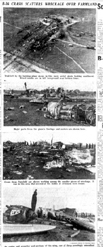
A Technical Appendix About Airplane Crashes and Revisiting the Great Siege With Derek Leebaert
Per Wikipedia: Derek Leebaert is an American technology executive and management consultant who writes books on history and politics, which evoke insights on leadership. He is the winner of the biennial 2020 Truman Book Award and also one of the founders of the National Museum of the United States Army.
I'll admit to being a bit surprised. I was alerted to Leebaert's 2018 Grand Improvisation: America Confronts the British Superpower, 1945–1957, by a highly positive review on H-Net last month, and have been picking my way through the book, which is peppered with references leaving me with the impression of a long-time foreign relations specialist putting a book together from an eclectic selection of notes the author no longer has time to check. (In particular, many references to articles in Time are surely taken from clippings rather than a skim of the 650 issues covering the period from the end of WWII to the Suez Crisis, easy enough to do in a library or online.
With that and a few other petty caveats, and after the de rigeur jurisdiction policing (it's okay for historians to invade technology and archaeology and linguistics, but the favour is not to be returned!), I will endorse the H-Net reviewer, and, apparently, the New York Times, this is a pretty good, if not always convincing book. Okay, there I go with the caveats again, but I honestly do not think that John Snyder was the eminence grise of the Truman Administration and single-handed architect of the postwar order. I just don't.
Leebaert's main argument is directed at the "rise of the American empire," which he wants to postpone from 1945 to 1957. Inter alia, that requires arguing that Britain was a much more significant presence on the world stage in this period than most accounts allow. To get even more specific, he has a brief with Peter Clarke's "last thousand days of the British Empire" thesis that brings the curtain down, not with Indian independence, but with the financial shenanigans of the next year. Without going so far as to actually read Clarke (the horror!), I'm going to guess that he is using "thousand days" loosely. Whatever. The key point is a call to re-evaluate the "end of the Great Siege" waged by Germany against Britain, to see its end at Suez rather than the 19 September 1949 reduction of the exchange rate of pound sterling from 4.08 USD to the pound, to 2.80.