Bench Grass is a blog about the history of technology by the former student of a student of Lynn White. The main focus is a month-by-month retrospective series, covering the technology news, broadly construed, of seventy years ago, framed by fictional narrators. The author is Erik Lund, an "independent scholar" in Vancouver, British Columbia. Last post will be 24 July 2039.
Two things, first, a very late change of schedule; second, a scary moment at the Silver Kettle Lodge as my 92-year-old father seemed to be failing after his vaccination. These mean that I do not have Sunday to work on my postblogging, although I am covering a mid-shift on time change day, and do have some extra writing time. And I am reminded that we do not live forever and I should get my intellectual life in order.
So here's a summary of work to date on Sacred Spring: The Early Iron Age Revival of the State and a brief outline.
"Sabre Dance" is a movement of the final act of Khachaturian's Gayane (1942), crossing over to mainstream popularity in 1948, and a perennial favourite of figure skaters and, more recently, "sexy violinists" ever since. I'm not 100% sold on "sexy violinist" Youtube videos, but it's pretty hard to make money in classical music these days, so whatever. Subsequently, "Sabre Dance" was a bit of low-hanging fruit when the various aeronautical eccentricities of the North American F-86 Sabre became apparent at the height of its technological, pop-cultural, and, yes, political fame over MIG Alley three years later. It's not quite in the moment. These things often aren't. I've also referenced Chuck Berry's Run, Rudolph, Run in connection with the F-86, and it came out in 1958. It's hard to keep things historically grounded. The things you might imagine, happened together, are actually off a few, critical years.
On the other hand, politics makes and unmakes connections as it will:
On the one hand, the (Canadian-born, UBC-educated) "Father of Supply Side Economics" died last week. On the other, December of 1950 saw something of a peak in the American commitment to a (Keynesian) managed war economy. It won't long survive Robert Taft's passive-aggressive resistance, but for the moment we are absolutely throwing money at aviation.
Which brings me to the other thread I want to pull on here, which is the continuing flowering of the Buck Rogers moment of the Second Elizabethan Age, and why, in a childish show of disrespect, I am recycling my triumphalist Farnborough spread above, and not giving you the late Robert Mundell. I mean, I'm sure that Dr. Mundell was a great guy, but can he compete with the Canberra?
No, he can't. Thanks for asking.
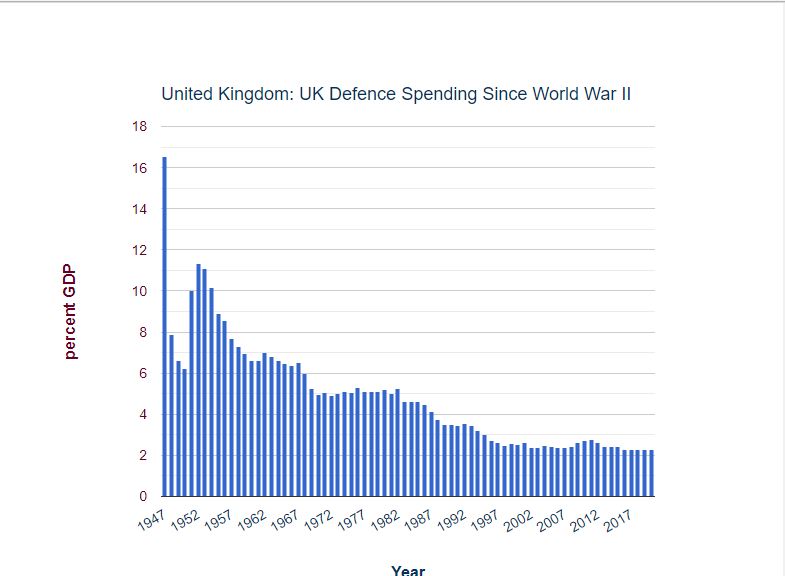
So December of 1950 is when "defence mobilisation" kicks into high gear. The Atlee government is putting together estimates that will almost double British defence spending, Above is a chart I stole from UKpublicspending that illustrates the steep upward curve beginning with the Estimates tabled on 6 March 1951, and here is a link to Arthur Henderson introducing the Air Estimates of
£328¾ million. This is an increase of £105¾ million . . . net increase of £95¾ million. The Estimates themselves are based on the £3,600 million programme which was drawn up last summer and do not provide for the additional expenditure that will result in 1951–52 from the further measures recently announced by the Prime Minister . . . .
. We tend to think of high British defence spending and all the fancy planes as natural companions, but it seems that the planes come a good eighteen months ahead of the emergency. In fact, as far as one can tell, it is all downhill from here! Okay, that's not exactly true unless your view of aviation is drably utilitarian and focussed on airliners, but even here the downward slope is not at all far away. Specifically, the story of the VC7 airliner will serve as my eulogy for Dr. Mundell.
(Aeneas dumps Queen Dido, founder of Carthage, and goes off to found Rome instead, two separate 'Ver sacrum" episodes.) So she kills herself, and leaves her ashes to be exhibited at Templeton Hall, the fictional counterpart to Cooper Hall in Cooperstown, New York. Two obscure literary references for two separate blog obsessions!)
I seem to have an extra week in my monthly schedule, so I will leave MacArthur, the Korean War, jets, approximately a million different "early computers" and the horrors of mid-century medical research till next week and pick up the glove. Can I summarise where the "Sacred Spring" is going? Yes. Can I do it succinctly? Not a chance. Oh, well. First you indulge. Then you cut.
This one is going to be rough, a progress report, not exactly what you'd call "edited," but also an attempt to engage (or re-engage) with some material rather than gesture at it.
I'll start with the title. I know that we're supposed to click on all the hotlinks for sources and to be self-promoted at, but this only means that I am a bad Internet person and I'm probably not the only one. The Ver sacrum is a an "ancient rite of the Italic peoples" in which
. . . [A] vow(votum) to the godMarsof the generation of offspring born in the spring of the following year to humans orcattle [is made] . . . [Those] devotedwere required to leave the community in early adulthood, at 20 or 21 years of age. They were entrusted to a god for protection, and led to the border with a veiled face. Often they were led by an animal under the auspices of the god. As a group, the youth were calledsacraniand were supposed to enjoy the protection of Mars until they had reached their destination, expelled the inhabitants or forced them into submission, and founded their own settlement.
George Dumezil sees this as one of those Indo-European myths that he's always on about, this one referring back to the ancient migrations that preceded their domestication. Me, I just like the phrase. I'm not sure that the gruesome subtext of human sacrifice is necessarily warranted. It is licensed by the ancient Roman authors, but they were about as far from actual Early Iron Age conditions as we are. Let's face it: "Sacred spring" sounds cool, and, at least to my ears, is inherently optimistic, and we could all do with some more optimism in this day and age.
I usually append "the Early Iron Age Revival of the State" to posts under the "Sacred Spring" label, referring to the collapse of the archaic states of the Late Bronze Age that was, naturally enough, followed by a revival of the state in the early Iron Age. Politics therefore comes first. In the Marxian analysis that appeals more the older I get, politics is the art of extracting surplus value and showering it on the dominant class. Marxism has its limits, and seems to have missed the role of sacrifice as the core of Ancient political economy until it collapsed of its own absurdity at . . . well, at the end of Classical Antiquity. Talking about the role of sacrifice in Antique politics implies a conversation that is not going to be able to escape technological praxis, ritual and even the history of ideas, so a political discussion more-or-less demands a parallel discussion of bronze-casting, horses, and cosmology. Even in a recap post this seems like a lot of material for a short summary, so I'll get to it below the jump.
That said, the actual examples that interest me are all new states, where there is less to say about ideas and rituals because most of our information is archaeological. One of the most striking facts of the Early Iron Age is that urban civilisation spread rapidly through the Western Mediterranean basin in the Early Iron Age, after having been present in Egypt for above two thousand years without inspiring an earlier wave of urbanisation. Similar episodes of urbanisation on virgin ground occurred in Cyrenaica, the Gangetic Plain. In the case of proto-states like Venetia and Seville that do not come into focus until well into the Roman Empire, we really are at the mercy of the archaeologist; but even early Rome and Carthage escape capture by the historians of Antiquity, for all that they pretend otherwise. Perversely, the most influential book ever covers the rise of the Judaean state Jerusalem. Similar claims, which I do not believe are warranted, are made for the early states of the Gangetic plain, while China is perhaps somewhere in the middle.
Having conjured with Rome, Confucius and the Bible, the case would be made that the Early Iron Age was a watershed moment in human history. However, while preparing for writing this post, I happened to crack open Barry Cunliffe's magnum opus/beautiful coffee table book, Europe Between Two Oceans, and was reminded that he has an entire chapter on the Early Iron Age enttitled "The Three Hundred Years That Changed the World, 800--500BC." While Cunliffe for just this moment avoids the issue, this is perhaps the most clearly defined programmatic claim for technology mattering before the modern age. It's the Iron Age, after all.
As a history of technology blogger, I could hardly ignore it even if the programme around here weren't the restoration of the cavalry to its roll as an exogenous driver of technological change. Although the history of equestrianship is controversial, perhaps more so than it needs to be, this is quite clearly the era in which cavalry first appeared. More than that, there are some related technologies that are profoundly important, if poorly covered in mainstream historical sources. iI debated reviewing the highlights of technological change in the Early Iron Age before the jump, but found myself leaking mush all over the page as I tried to deal with what I've learned from antiquarians meandering through the pages of Engineering. So I'll leave it for below where I don't have to strive so hard for brevity.
Beyond that, a case can be made for the Early Iron Age as an episode in the history of ideas, and particularly religious ideas. As I have already said, this brings us back to politics forthrightly, but there is material here that cannot be reduced to ideologies of domination. Spreading technology requires teaching, and pedagogy emerges as the central concern of the earliest recorded thinkers. Whether that is accidental or not, it is important. Beyond that, many of the great founding sages of modern religion and philosophy appear at the end of the Early Iron Age. Some of the most important, such as Jeremiah and Zoroaster, appear in the role of prophets, and while the prophet is arguably a universal, psychological type, we need to remember that the earliest intellectual projects were efforts to put prophecy on a rigorous and scientific basis, and that the Iraqi solution to this stands at the origin of the Antique political economy of sacrifice. As debatable as the actual historicity and interests of the teachers of the Axial Age might be, the traditions that place their activities in this period are insistent and formative.
Circling around Athens and Jerusalem, it might seem that this hasmuch to due with yet another new technology, the alphabet. The alphabet and coinage are both important new inventions of the era and symbolic systems with a great future ahead of them, but the changes of the Early Iron Age clearly predate them, and the Chinese parallel makes the case that they are not necessary to the full unfolding of the social changes of the Early Iron Age. Lacking the powerful new symbolic system of the alphabet, the Chinese improvised their cumbersome writing system into a tool that could memorialise Confucius. It is the impulse to memorialise, not the method adopted, that matters.
Lastly, religion is not the only window through which we can observe the past that pivots around Iraq, the still centre about which the world history of the Iron Age revolves. Zoroaster stands sui generis as the sage of the ancient Iranians, while the Buddha is located in a longer Vedic tradition, both seeming to Nineteenth Century historical linguists as something close to primordial sources of the great family of Indo-European languages. Whether one is using this as a point of departure for a racist or quasi-racist larger story of wandering "Indo-Europeans," or as a scientific fact to put at the centre of historical linguistic scholarship, the Early Iron Age is a seminal moment. Seminal! Primordial! Centres of world history revolving! As you can see, I'm going for Significant with a capital "S" here, somehow avoiding the Holocaust, and in general drawing the kind of premature Big Picture that cries out to be tested against the facts. Language stands apart from the technological pretensions to detachment that I managed above. It appears that you cannot talk about the historian of equestrianship without taking a stand on "the Indo-European" question, and the question also comes barreling into politics. We are in the absurd situation of having dates for the Zoroastrian moment ranging from 6000BC to 600AD (with the actual, historical Zoroaster most likely a figure of 600BC). One might think that the foundations of a science that relies on the dates of the Zoroastrian scriptures are therefore built on shifting sands indeed --but no! (To be fair, historical linguistics as actually practiced does a pretty good job of quarantining the Indo-European arguments methodologically, but there's still the question of whether Indo-European is a good model for language family development or not.)
A final question for the historian of technology concerns their place as citizens of the modern world. Did all of this happen on its own, or do we need some kind of explanation? If the latter, what does it say about technology policy in the modern world?
First impressions come when they come. I read G. C. Edmondson's 1965 The Ship that Sailed the Time Stream and its sequel, 1981's To Sail the Century Seas at a very young age (too young, apparently, to pick up the casual racism and sexism), long before my callow transformation into a young Reaganite, of which the less said the better. All the more wonder that I still and so vividly record the protagonist realising that he had returned to 1970s San Diego waters when he picked up one of the local radio commentators. The vividness of the memory probably has something to do with the author's palpable disgust for paleo-conservatism. Whatever: It is a first impresson.San Diego=appalling, hateful, racist, anti-communist conservatism. Got it!
Nuance is surely badly wanted, but this technological appendix isn't about politics --well, it's not going to escape labour politics, but that's another matter. It is about the San Diego-built Consolidated/Convair PB4Y-2 Privateer. such as, for example, "Turbulent Turtle." BuNo 59645 belonged to the "secret Special Electronic Search Project," but was attached to VP26, then stationed at Port Lyautey, Morocco, was sub-detached to Wiesbaden for a ferret flight along the Baltic coast of the Soviet Union, during which it was shot down by a La-11 of the PVO on 8 April 1950.
This material largely revisits earlier discussions, but if I restate, I hope that I do so more clearly, and lay down the cards upon which I hope to win the hand.
Struggling with a labour shortage is not a new thing for my employer, but the last time was before the 2010 Vancouver Winter Olympics, and I do not recall it being anything like so bad. We were having problems finding cashiers, then, and "not enough cashiers" is a very, very different problem from not having the staff to open departments. So, even though last week's post was motivated by a probe of the old soap making industry that led from glycerine recovery boilers to the potash and soda trades, it was the idea of talking about the Early Iron Age recovery from the Late Bronze Age Collapse that inspired me to take a hand. On the one hand, if "secular stagnation" is a recurrent phenomena, perhaps something that happened repeatedly in the earliest states on very short timeframes, as James Scott and Norman Yoffee have argued, then there is something to be said for interrogating past episodes of recovery.
This is a particularly interesting episode. Historiography has never been entirely comfortable with a clean slate beginning, even if it has to elide into cosmogony. So even though we might think that we are to be left with archaeology, there is always some kind of accounting, and this is particularly true, and particularly interesting, for the Early Iron Age.
From Dido and Aeneas: A Choreographic Opera: The art credits "Reuben Willcox, Virgis Puodziunas, Michal Mualem," which is interesting, considering that they're all boys, and I think I see a girl, something I'm actually fairly good at doing, male gaze and all that. (On the basis of the IMDB credits, I think she might be Clementine Deluy?)
When a civil war needs to be funded, piety has to take a back seat; and a civil war that has no end, has no resolution, because there is no state to resolve it. Not until Adad-nirani succeeded to the throne of his father in 911BC did a state arise to trouble the nucleated, strong-man ruled cities of the Middle East, each with their vague spheres of influence. I do not doubt that I am putting things too strongly, but it does remain the case that for two and almost three centuries, human society in the Mediterranean basin had done without the states that had arisen in the Late Bronze Age to make war and diplomacy against each other. I also do not doubt that this stateless era was something short of a paradise.
I do, however, know that I am going in this afternoon to work the third of eight shifts in a row at a grocery store that can no longer open its produce department with its own staff during vacation weeks. Nor can I complain about my shift to a manager who is called in during her own vacations. Since this is a grocery store situated square at the University of British Columbia's gates, and dependent on student labour for decades, I would be inclined to point a finger at my alma mater's deceptive enrollment practices, were it not for hearing the same complaints from Control Temp people and the Frito-Lay sales rep. Either we find a catchy label to reconceptualise our times and make our problems go away, or we loot Pharaoh's tomb and call it a country.
I'd strain at some kind of argument about how an era doesn't recognise its pyramids until they're pointed out by foreign tourists, but instead I'll just post another picture of the Vancouver School of Theology-turned-School-of-Economics. Even back in the day when I used to look at the back side of this place from my Gage Tower window, VST mainly subsisted as a residence hall for people kicked out of the official UBC system. Since they were usually disciplinary issues, living at what was ostensibly a theological college, the mind boggles, the more so since I actually knew some of them. Since I don't think that UBC Residences can afford to have disciplinary cases any more, it's understandable that the Administration would want VST off their land. The president's statement in the linked press release has the familiar tone of "we need a new asset portfolio as we moves into the not-actually-existing phase of our institutional existence," which is not an uncommon problem in these sad, latter days. On the other hand, obviously the Economics Department deserves to hang out in a cathedral in the "theological area" of campus. Good God, guys.
Or we could solve the problem. Given that that seems unpossible in this diminished day and age, it's look at one place where it was solved. Just to simplify things, and to use some reading I've done anyway, since the whole point of belabouring my work schedule is to rationalise a time-saving post, let's look at Provence, from the last third of the Eighth Century to the late Fifth. (730--480BC, more-or-less.)
That means that I'm cheating, inasmuch as there is no pre-existing state order in the area to reconstruct, but of course I'm cheating. This post is not going to get done if I linger. (Possible LBA/EIA proto-states in Provence: (1,2, 3).
Lots of caption here, because credit where credit is due. This is Abdelratif Reda's fresh goat cheese, served with apricot jam on a bagel in the medina of Rabat, Morocco.. The photograph is by Eloise Schieferdecker (imputed c. 2015), and appears in an article by Zoë Hu, running in the online lifestyles magazine Zester Daily
Did Rome have a crisis? The basic outline of the rise and fall of the Roman Empire is Decadent First Century-Golden Second Century-Third Century Crisis-Fourth Century Dominate-Fifth Century Fall-Sixth Century-
Cliche, but good point. Let's just stay the heck away from the Byzantine Empire or whatever it is.
The confusing thing here is that the crisis comes in the middle. There's an elaborate theory of politics in which governments pass through cycles of development. Domitian's government is a "Dominate," replacing an earlier "Principate." Yes, the restored empire is a different, and lesser thing, rather like the old Chinese Western and Eastern dynasties, but it is restored.
In this analysis, it is all about politics. A number of specific factors make the Empire politically infeasible: the government is badly structured; The location of the Roman capital is bad; it is overspending to buy army support; changing elites mean that new groups will have to seize control of the imperial office, whatever the short term cost of political stability. Etc. Not a single mention of cream cheese for breakfast!
Since I am on record as arguing that the collapse of the Roman Empire in the west is due to a breakdown in long-distance trade causing a shortage of money and local deflation in the far west, it might be time to go through the long, long list of emperors and usurpers and highlight the factors that, I think, make a purely political explanation inadequate.
I have a point when I talk about how the early settlement of the Atlantic took place in a "bishop's sea." It is, in the first instance, that before there were states or even capitalists, there were bishops promoting the settlement of remote places and the Christianising of faraway pagans. The second point is that in the English-language historiography, we tend to handle bishops with far too much kindness. We choose not to see them, as German historiography sees them, as politicians and statesmen, often bloody-handed and always liars and cynics. If we allow full reign for dark and bloody acts of politics, and then suppose that the worst of these acts are swept under the rug for the Good of the Church, we create a darkness and a mystery in which smaller and more human histories can be hidden.
C. Wellwood Beall, of Boeing. In spite of his importance to Boeing, contemporary fame, large fortune, and extensive family, he does not have a Wikipedia article. It's almost like the family doesn't want to call attention to itself for some reason.
When I went into this question last time, it was with a blog post entitled "Christ Stops at Kingcome." In his 1945 memoir of his Fascist-era internal exile, teaching in two remote towns in the mountains of southern Italy, Carlo Levi promoted a powerful, although, as James Scott points out, actually fairly stereotyped idea. The idea that "Christ stopped at Eboli," the terminus of the railway on the plains far below, is that not Christianity, nor morality,even history itself, had penetrated any further than the last railway station. Substitute the names of assorted tribal communities of upland South Asia, and you get the old saw that Scott is criticising in his History of Not Being Governed, and, as fresh as the idea may have been to Levi, he could have picked it up in casual conversation in any Qing commandery of the south, or in the palaces of any of fifty or so of the "paddy states" which have now been swept into Assam, Burma, Laos, Vietnam, Cambodia, Malaysia and Thailand. Mostly Thailand, actually.
In my experience, oblivious to Scott, you can take this literally without your head exploding. An old Italian navy officer I knew in my MA programme, did. He would lustily explain that the fires of the high mountain villages visible as you sailed in and out of Taranto were lit by inexperessibly primitive people who never came down to the plain, and who presumably still spoke Samnite and worshipped Mars and Saturn, although in the last bits I am putting words in his mouth, and I am not all sure that the Samnite branches of Italic were ever spoken that far south. The point is, it didn't hurt Tullio Vidoni's historical acumen any. When he wasn't reminiscing about the old days, he had quite a sophisticated take about how the Viking voyages out of Greenland could only have been going "south," by their understanding of geography, and so needed to be understood as part of the genre of wonder stories about Africa and the tropics, and not about some New World which did not, yet, conceptually exist.
Or you can accuse Levi of being unserious, show that the people of the Basilicata were actually thoroughly involved in the life of the lowlands, as Horden and Purcell do. Fair enough, but my point in substituting the old Catholic mission station on Kingcome Inlet for Eboli.
I'd doff my hat to an old Simpsons reference, but I can't find it.
Try again:
In the spring of 1940, a British army in France failed to stop the Germans. The consequences were horrifying, the failure abject.
On its face, this is a subject for military history; but the military-historical counterfactual never seems to turn on the fighting, where the crucial question (the BEF's decision to abandon the line and retreat on an evacuation point) is treated as beyond discussion. Instead, it focusses on David Low's point. The conclusion often drawn is that, had Britain spent more on machines in the 1930s (or perhaps, for much longer than that), things would have been different. It's all quite strained. If you had a car, you wouldn't have missed your flight. Martin Wiener, Correlli Barnett,Winston Churchill and your Dad all have explanations for why you don't have a car, but they're not very helpful for catching the next flight unless they come with a $30,000 cheque.
I disagree. There is a much less strained counterfactual than the idea that Britain could have been, oh, say, six years "more advanced" than it was, had public school boys been forced to do maths instead of Latin. The fact is that the 10 infantry divisions of the BEF were scheduled to be joined by its first armoured division in the third week of May, and that an entire fourth infantry corps was to come over in June. The Battle of France was a near enough thing that these additional forces would probably have been enough to change its outcome. You wouldn't have missed the train if the power outage hadn't knocked out your alarm clock. Set your phone's alarm next time, and you're set.
So forget fancy analogies and drive by sneers, and drill down, with laser-like focus, on one, simple fact. The BEF may have been as little as one month late in getting enough troops into the line to change the course of history. This is, mind you, ten months after a parade in London described by The Economist as featuring 28,000 marching representatives of the two million men and women who had so far volunteered for national service in the defence of the United Kingdom. It sure looks as though Britain had built up quite the war machine even before the fighting started.
But, on the one hand, two million. On the other, short four divisions. It seems to me that the gap between these two numbers is worth exploring.
Why did Neville Chamberlain not set his phone alarm? What were his reasons? I ask this because Neville Chamberlain, Chancellor of the Exchequer in 1923 and again from 1931 to 1937, and Prime Minister from 1937 to 1940, was more than any other individual the face of an era described by Harvard economist, Alvin Hansen, as one of "secular stagnation." The connection here may not be obvious, but Hansen himself claimed that the "secular stagnation" thesis was just another name for Keynes' "underemployment equilibrium." We broke out of that equilibrium during World War II. The best explanation for that just is WWII, and the question we should all be asking is whether we can have the outcomes without the consequences. The buildup to World War II gives us perhaps the best taste of what WWII would look like without the fighting. (There is also the interesting question of whether and when the impetus of the WWII faded away.)
So the questions are:
-How big was the actual 1937--39 build up. How real is the "two million"?
-What data do we have about the immediate consequences of this buildup?
-How did this buildup fall short of what was needed?
-How do any failures identified reflect back on the persistence of "secular stagnation"?
Four questions, two economic, two military, all worth exploring. (I guess I've telegraphed my answer to the question of whether the one-time impetus of World War II "faded away." It's here, if you're into ghost towns.)
It's summer! God speed the plough! Unfortunately, with the hand of every good man and woman turned out to bring in the mangelwurzels and vetch, there's no-one to staff the university library on Sundays. (The alternative explanation, that the university needs to save money, is self-refuting nonsense. The objection that there is an acute shortage of actual researchers using the library, although supported by notoriously unreliable visual evidence, is equally crazy. We're spending enough money on the research-education infrastructure that we must be getting results.)
The "I. K. Barber Learning Centre." It used to be the boring old Main Library used to stand, but we got rid of the stupid stacks in favour of a "state-of-the-art system [which] drastically reduced space, which allowed for the integration of classrooms, offices, informal learning environments, group rooms, reading rooms, and even a climate-controlled vault for rare books." Which is nice, I guess. Well, not nice in the sense that automated retriveal is anywhere near as good as open stacks or in the sense that a schoold with declining enrollment needs more classroom space. But nice in the sense that the university gets to build a Real Big Building. Otherwise, it would be stuck with only building all of the other Real Big Buildings that it is building. Oh! Oh! I have a theory about where the decline in consumer spending might be coming from!
St. George's School charges $20,000/year in tuition, and is a bucolic fifteen minute bike ride from Main Library. Does "bucolic" mean rain-drenched forests? Maybe not. Not many buildings in sight, is what I'm saying. In a city where a detached home on a city lot is going for seven figures. Oh, well. Whatcha gonna do? Develop the 2000 acres of Pacific Spirit Regional Park? Then where would Vancouverites go to get back to nature?
Shorter ironically couched rant; the library was closed on my last day off, and that's why this is a recap.
So you might have expected the second part of June techblogging about now. Up until 12:16, Tuesday afternoon, so did I. That's when I was asked to give up my Victoria Day statutory holiday because my company can't find someone else to do my job in the city of Vancouver for one night. For those funny-looking foreigners who don't celebrate the name day of Victoria of House Saxe-Cobourg-Gotha, it's on May 24th. Don't worry, though. I get my May 24th statutory holiday next week! You know, after we celebrate Canada Day. As for my Canada Day statutory holiday --further bulletins as events warrant.
As I have said before, you would think that this would reflect a "labour shortage," in that there is a shortage of "labour" to do the job. (Lots of jobs; not just mine.) You would, however, be wrong. In so far as I understand this "economics" thing, shortages cause prices to go up, and the price of (my) labour in this city is not going up. It's going down.
I know, blah blah globalisation. But you can't outsource a neighbourhood grocery store, and we already hire every immigrant we can. Something else is going on, and I am not sure how well we understand it.
The bright side of this is that I get to link a post about the distant past to current events. It's a hot take! The disadvantage is that it's hard to write about what you don't know, if you don't know what you don't know. (Or you'd think it ought to be hard.)
I, for example, do not know why the house at 7249 Cartier Street, theoretically worth seven figures, is sitting abandoned, and looks like it was abandoned more than ten years ago, well before the current "red hot housing market" started --perhas going back to the last boom. Maybe they have fled the oppressions of modern life to live up some BC sideroad! Haven't we all dreamed of "going off the grid" that way?
Much more likely, the owner went "off the grid," by going into a nursing home. There's lots of ways of going off the grid, including not existing; but, also, from the point of view of the economy, by not working, or not working very hard.
When the library is on summer hours, it is probably not a good idea to hang around the apartment until quarter to two if you need to do five or six hours of work to write a postblogging post. Just sayin'. And so much for last week.
Fortunately, a rich and famous blogger posted something that I felt I'd like to respond to in a way that won't take up too much of my now-blown time here. He's a Berkeley economics professor in his secret identity, and obviously I could name him, but then you wouldn't feel "in the know" for guessing his secret identity. (Hint: he's not the Eighteenth Century Pennsylvania fur trader, George Croghan,)
As we have argued elsewhere, to a truly remarkable degree all United States citizens today owe that framework to the one single individual who may have made a significant difference in American political economic history, Alexander Hamilton—although even he needed his followers and successors to make a durable impact.
But, before there was a Hamilton, before there was a United States of America, there were earlier deliberate shapings of the economy of North America-to-be. These shaping were carried out by the colonial powers who ruled North American: Spain, France and Britain--and, in the end, especially by the British politicians who decided on the form that the British colonizing effort in the Americas would take.. Their plans and powers resulted in a pre-revolutionary American economy that was quite different in where it was located and how it was organized from what nature--also known as economic geography—-would appear to have intended.
Back in the 17th century the British government made the decision that its colonial policy would be to bet on populating the Atlantic seaboard--at least the Atlantic seaboard north of Virginia--with colonies based on staple agriculture and yeoman settlement, rather than with colonies based on treasure theft, on forced-labor mining, on slave-plantation agriculture, or on long-distance trade:
To some degree, this was a matter of necessity: Britain being late to the American colonial enterprise, It had to take what was left over.
To some degree, this was because the British government was not an absolutist one with Bastilles available, and it seemed wise to try to diminish domestic tensions by subsidizing the emigration of especially-vocal malcontents--whether Puritan, Quaker, or Catholic.
But mostly this was a matter of policy . . . . The English settled the wrong, eastern, Atlantic coast. Ships probing upward along the rivers soon encountered rapids, and beyond the rapids came the mountains: the great Appalachian Range. The Spanish and French built their port-forts on the proper, southern, Gulf coast of America. From that base broad navigable rivers allowed rapid, cheap, and easy movement inland; culminating, of course, in the unique Mississippi-Missouri-Ohio River. Spain had, of course, known about the Mississippi Valley since Hernando de Soto's thousand-man expedition of 1540.
Gulf of Mexico-based settlement provided a major advantage. The settler agricultural economies possible in the seventeenth, eighteenth, and nineteenth centuries were far from self-sufficient. Their spearheads required the weight of full spearshafts behind them, in the form of a steady supply of largely hand-made manufactured goods--high-tech for their time--from Europe.
Thus the southern, water road to the most fertile and valuable parts of agricultural America was the obvious and optimal one. A simple glance at the map of where U.S. agriculture is today tells the story. America's prime agricultural resources are in the watersheds of the St. Lawrence, Mississippi-Missouri-Ohio, Sacramento-San Joaquin, and Columbia Rivers--not east of the Appalachians. . .
So, anyway. . .
Our blogger has a huge and important point. State intervention in the economy is not un-American, but rather baked into it from . . . Well, our blogger vacillates. The hero of the monograph from which this is extracted is Alexander Hamilton. He's big right now, I hear. And a hero for the times, too! The problem is that Hamilton arrived on the scene of a society already very different economically from the French and Spanish North American colonies. Our blogger also supposes that the English colonies had the further disadvantage of being in the wrong place, hemmed in on the shallow East Coast, basically between the fall line and the sea. Surely the right place to build a proper cameralist police state was in the midst of the Old Northwest, scene of the main indigenous North American experiments in state building, and the heart of modern American agriculture.
The last thing I want to do is contradict the main lines of this thesis. Sign me up for a Hamiltonian moment! That said, he's wrong from the get-go, when he characterises the British American colonies as not being plantation economies, because they were exactly and perfectly plantations. It's their success as plantations that make the history of the northeast coast different.
There you go, some contrarianism, to be developed below the cut. At least you can be glad that I am not going to lay it off on differences in relief and the neglected role of animal husbandry in economic history. Or will I?
After hanging fire for so long, the Canadian espionage story has finally broken; and, with it, the FBI's tacit admission that it has something. The rumours we hear, and probably you, is that she is a female Washington civil servant of loose morals who used to carry confidential documents for a number of people in President Roosevelt's circle. Including, it is darkly hinted, someone "largely responsible for Bretton Woods." Dark hints of that kind are probably best discouraged. One just does not know whether to kill them with obscurity, or with endless, boring talk.
Probably obscurity. People seem, to have a limitless appetite for the tedious when it is dressed up with secret agents and national secrets.
Anyway, this is what we hear through the (former) "Miss v. Q.," who is now to go back to Washington with another batch of Naval GRU cipher texts. --which we will be charged with obtaining. I have made it very clear this time that we are not to hear from the Soongs, and that the FBI and the Navy are not to involve the Engineer, accordingly. Whether they respect my wishes is another matter, but if they can find a more readily disavowed burglar than Wong Lee, they are welcome to try. Uncle George tells me that he has some Italian friends. . .
Proceedings towards Bikini proceed apace. Ensign Wong is already there, setting up shops for some grand new robot scheme. A robot tank was used at the last atomic bomb test, although not very successfully. At this one, they are talking about a robot plane. Your youngest son is competing for a chance to operate one, and your eldest is providing Allied expertise in the matter. He is also keen to get his feet wet with all of this atomic stuff, which, he says, is probably the future of naval propulsion. First, no black gangs. Now, no oil!
You may be glad to hear that Queenie has found accommodations for herself and the baby. "Miss V. C." has decided that she will stay in the city during the summer, pursuing research for her senior thesis, and will be moving into Professor K.'s anthropological coach house until "Miss v. Q." returns from Virginia. The professor and his wife are pleased, because they think that she is a good influence on young "Miss K.," who is otherwise overly inclined to take refuge in her books and away from society. I am just happy that there will be people around "Miss V.C." while she does her research. Yes, the Oregon scandal was a long time ago, but that does not mean that there are not dangerous secrets. Why, as we learned last year, there are older secrets than that which are not entirely innocent today. (You will notice in the latest news someone poking Uncle George's friend with a stick.)
Alvin Hansen famously said that one of the reasons that secular stagnation was happening was that technological innovation had stopped.
In 1938. He said that. It seems a little . . . odd. Although no odder than attempting to make the argument that technological change is coming to a halt right now. Don't we live in an era of ever-accelerating technical change, catapulting down the runway?
So that's an experimental gunpowder catapult launch of a Vickers Virginia in 1931.
In case you didn't get a good enough look at it in the video, here's another view of a Vickers Virginia.
High tech, circa 1924! It's got a metal frame, two Napier Lion engines, and can reach 5000ft in only 10 minutes. Technically, the service ceiling is 13,800ft, but it's not like you can expect to be able to bomb German steel plants from such science-fictiony altitudes. I mean, what about low cloud cover? You wouldn't be able to see them! And forget navigating when you can't check your astronomical fixes against ground features and calibrate air to ground speed with drift sights.
Replacing the Vickers Vimy in 1924, the Wikipedia article says that some of the 124 Virginias produced in the 1920s were still in "front line service" in 1938. It appears to have been predeceased, if anything, by the 97 bomber-freighter-transport variants of Victorias and Valentias. It also says that the Virginia was "somewhat accident-prone, 81 being lost in service."
You say "accident-prone," I say "widow-maker." Not the plane I'd choose for experiments in catapult-assisted takeoffs. That being said, the job of a "heavy" bomber is to carry more bombs, further, and one of the best ways of doing that is to increase the all-up-weight so that it can carry more fuel and bombs. Catapults are a means to that end. Below the fold, I'm going to talk about the goofy, goofy ways, that people tried to do that in the 1930s so that there could be commercial air service across the Atlantic, and reach for a comparison with the frustratingly long and sorry story of the introduction of colour television.
It's a comparison that, I think, has some relevance to the problem of technological innovation and seculary stagnation. Specifically, I am going to compare and contrast a couple of relevant developments in an attempt to show that what's important is not "research and development" taken in isolation, but the broad shoulders of the state, carrying the economy forward, where and when it is willing to be the investor of last resort. Once the research and development problems that could be solved without the state, were solved, all that was left was . . Well. All that's left is everything that still needs to be done in 1939.
And that's why Alvin Hansen was actually right!
After the jump, some kind of hand gesture in the direction of trying to make the point.
This blog is not about public engagement. It made an exception for the Canadian election, because, well, it's a Canadian blog. American elections are American business, and, besides, it's almost certainly moot at this point.
However, this blog's cute-as-buttons niece was feeling the Bern hard when the blog had a birthday lunch with her three weeks ago -- three months late, but the blog can be that way, sometimes. So the blog feels some vicarious, avuncular enthusiasm. The Sanders campaign was in trouble --and this is also old news-- last week for taking all-too seriously Jerry Friedman's recent claim that a good dose of government spending, as promised by Democratic Presidential candidate Bernie Sanders would produce GDP growth rates which are deemed by others to be too high.
Obviously, the blog has no comment. The blog doesn't understand all the math-y bits in economics.The blog's "gentleman's D" in partial differential equations enjoins silence. That being said, economics also trades in facts, and facts happen in history, and history is the blog's wheelhouse. More specifically, the blog has done quite a bit about a period in history in which government spending had a pretty significant effect on the Anglo-American GDP, and the blog can certainly talk about that. And drop the fancy-pantsy third-person elocution while the blog is at it!
Also, something like that would be quick to write, and wouldn't require library time, which is the whole point of doing recapping posts. Who knows, it might even people who are not my bubbly, optimistic, 18-year-old niece with a bit of confidence in the future. It might give my niece a future where she can teach music theory and history instead of swotting her way through medical school.
So I don't like doing this, but I lost another writing weekend this week, this time to eldercare issues: I'm going to see if I can write both November tech blogs next week, because, you know, it's only Christmas. This week, because I cannot do anything substantial, again, I want to tackle some recappable issues. Without ruining immersion, it's hard to say more than that tackling postblogging from a contemporary, local perspective makes it hard to step back and say, "Oh, wow, look what I found out!" That can be a little tricky, and never less so than when I discovered Alvin Hanson, somehow transmogrified into "Richards Hansen" in my last recap.
By the way, for the vanishingly small number of readers of this blog who might have heard of, much less seen, the City of Kelowna, new retirement/recreation/medical care centre of the southern interior of British Columbia, the mad, out-of-control building along the highway will be memorable.
A little bit of local history: British Columbia is on the edge of development on this continent, and it has suffered some setbacks have left a very peculiar pattern on its landscapes. The First World War, and the perhaps not-entirely unrelated crash in copper prices left its mark on the countryside.
The crash of 1929 led to a fall in property values and incomes that left our cities more-less unbuilt for thirty years afterwards. The highway through Kelowna from W.A.C. Bennet's floating bridge north towards Vernon led, in my childhood, through neighbourhoods of tiny old bungalows on drainage ditches so wide as to be practically canals. Much further north, it went by an airport with a terminal building approximately the same size as a one-room schoolhouse. By my 20s, the open ditches were gone, but the airport was still the same size. Today, north of 50, I am beyond astonished by the expansion of the airport.
However, our route to the laser surgery outpatient clinic took us up Sutherland, the next major traffic artery south of the highway:
It turns out that the bungalows aren't gone, and, although I hadn't the patience to find it on Google Streetview, one of the ditches is still there, too. The houses look to be ninety years old, and old Kelowna's canal-sized drainage ditches are still open, although no longer large enough to have boats moored in them. Having lost three days off this week to various ramifications of our ongoing demographic crisis (NB: Author's Opinion), I may be seeing ominous signs where there's nothing to see. That Kelowna's topsy turvy development along the highway strip has not penetrated three blocks in is one of those Ominous Signs.
Alvin Hanson was right, we have a problem, we should fix it, and the key to fixing it is to be found in the economic history of the war and postwar era. Etc, etc.