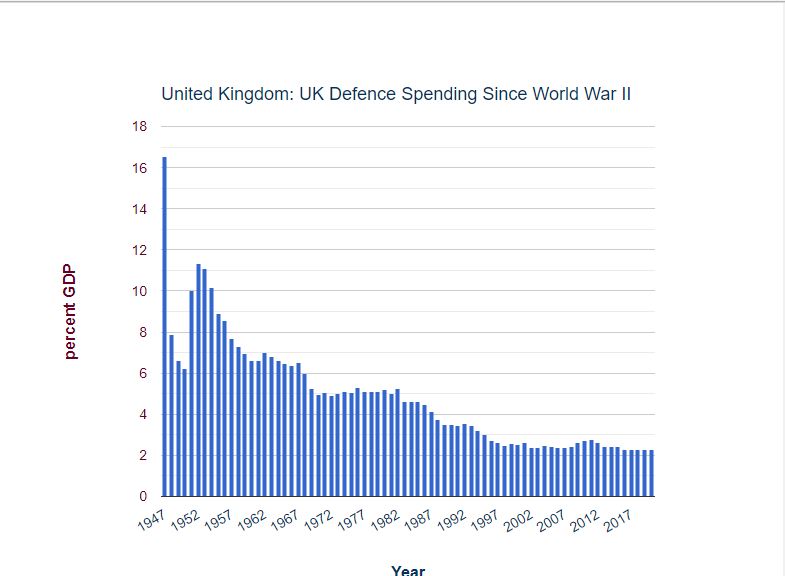
On the one hand, the (Canadian-born, UBC-educated) "Father of Supply Side Economics" died last week. On the other, December of 1950 saw something of a peak in the American commitment to a (Keynesian) managed war economy. It won't long survive Robert Taft's passive-aggressive resistance, but for the moment we are absolutely throwing money at aviation.Which brings me to the other thread I want to pull on here, which is the continuing flowering of the Buck Rogers moment of the Second Elizabethan Age, and why, in a childish show of disrespect, I am recycling my triumphalist Farnborough spread above, and not giving you the late Robert Mundell. I mean, I'm sure that Dr. Mundell was a great guy, but can he compete with the Canberra?No, he can't. Thanks for asking.So December of 1950 is when "defence mobilisation" kicks into high gear. The Atlee government is putting together estimates that will almost double British defence spending, Above is a chart I stole from UKpublicspending that illustrates the steep upward curve beginning with the Estimates tabled on 6 March 1951, and here is a link to Arthur Henderson introducing the Air Estimates of£328¾ million. This is an increase of £105¾ million . . . net increase of £95¾ million. The Estimates themselves are based on the £3,600 million programme which was drawn up last summer and do not provide for the additional expenditure that will result in 1951–52 from the further measures recently announced by the Prime Minister . . . .. We tend to think of high British defence spending and all the fancy planes as natural companions, but it seems that the planes come a good eighteen months ahead of the emergency. In fact, as far as one can tell, it is all downhill from here! Okay, that's not exactly true unless your view of aviation is drably utilitarian and focussed on airliners, but even here the downward slope is not at all far away. Specifically, the story of the VC7 airliner will serve as my eulogy for Dr. Mundell.
Saturday, April 10, 2021
Robert Mundell is Dead: A Mixed-Economy Recap to December 1950 with a Look Forward Six Years



Friday, April 2, 2021
The Early Iron Age Rise of the State: From the Sublime to the Perishable?
You know the pattern by now. We have two weeks of drilling into the peak of the last, decaying maxima of the past-present wave as it moves through human chronology (seventy years ago plus three months, I have decided), two weeks to play around with what we've got. Alas, I can't quite discover another technological appendix in the story of the last two weeks. Everything is consolidation and amplification of things already explored. Project Typhoon is yet another analog computer; We had a bit of radio astronomy; the Savannah "H-bomb plant" again, with just a hint of the toxic politics of race in the American South under a thin veil of technocracy; Yet more on the automation of the cockpit, almost as interesting as the recently increased frequency of business machine ads that remind us of the central importance of Campbell-Kelly's insight that the computing revolution had precious little to do with computing; and titanium, always good for some exotic thrills.
(Disney+ is being sticky about uploading scenes from The Falcon and the Winter Soldier, but I thought it was kind of cool that Isaiah Bradley dismantled the Winter Soldier's original, titanium arm "on the peninsula" in 1951.)

Saturday, March 27, 2021
Postblogging Technology, December 1950, II: Christmas Corps
R_. C_.,
Shaughnessy,
Vancouver, Canada
Dear Father:
I write, curled up in an alcove overlooking the front, replete with a post-Christmas breakfast that I hadn't the heart to refuse. This "eating for two" malarkey is hard to fend off when the food is so good! You're right to say that Uncle George is in a better mood than I have seen him since he was a teenager. He is holding forth on the back verandah right now on the Hungnam evacuation, giving his eyewitness version of the sight of the US burning, breaking, and back-shipping the entire logistics base it just set up while the indigenous Koreans tried to get out any way they could.
You will see a bit of his old cynicism leaking through. Right now he is as "amazed as a man can be" that Americans are letting so much old-time anti-Semitism leak through into their anti-Communism. Is it the return of the Taftites? The rise of Israel? Or are the brains of the men who fought WWII going soft over Korea?
I don't know. I'm just a girl, and I mainly think that Uncle George is funny. Not as funny as Uncle Henry, but the difference is that Uncle George knows that he is being funny. Uncle Henry probably thinks he can build a fleet of Flying Boxcars at Willow Run.
By the way, if you're wondering about all of the Roosevelt County, Montana content, it's because I think it's funny. As no-one else will, I probably should explain. I've been through there, taking Route 2 from Coeur d'Alene to Winnipeg while I was housesitting there in '47, long story involving maybe meeting Reggie under Aunt Grace's nose, short. So when I saw the story about the Roosevelt County Selective Service board threatening to refuse to send out any more call-up letters unless the US threw some atom bombs I had Uncle George on race on my brain, and remembered the drive through Fort Peck Reservation. If the Selective Service is really calling up Sioux boys while letting all the rich kids science their way out of Korea, things will not end well!
I guess I taught that joke what for, beating it to death like that. My next will reach you from Formosa and the far-off days of January 1951.
Your Loving Daughter,
Ronnie

Saturday, March 20, 2021
Postblogging Technology, December 1950, I: Crisis!
R_.C_.,
Shaughnessy,
Vancouver, Canada
Dear Father:

We will probably know quite soon how America responds to an extended stalemate in Korea. I don't know. How seriously are we taking this? On short wave the only thing I get out of America is Phil Harris, and it doesn't seem that serious. Or maybe there's a sinister subtext?
Your Loving Daughter,
Ronnie
Friday, March 12, 2021
Gathering the Bones, XXII: A Lacustrine Civilisation?


The Great Pyramid at La Venta is 2400 years old, give or take. The fact that it is a clay mound erected in a lacustrine setting makes it very much reminiscent of the much later Monk's Mound at Cahokia. Based on the archaeologically reconstructed building technique at Cahokia, Martin Byers links Monk's Mound to a springtime "World Renewal Ceremony" in which a gathered community celebrates the end of the spring freshette by carrying newly deposited river silt up to the top of the mound and plastering new layers each year. The archaeologist cannot tell whether this prehistoric activity is linked to the "Earth Diver" story. Having been properly skeptical about the role of the Earth Diver story in the Ohio-Mississippi Valley of the 1100s, we're left being all the more cautious about an epoch another thousand years distant and farther away. Nevertheless, the fact that the Olmecs built their pyramid in clay rather than in stone like their more immediate successors in the Mayan regions, Oaxaca and the Valley of Mexico is a standing invitation to speculation. Bombs away!
Friday, March 5, 2021
A Technological and Scientific Appendix to Postblogging Technology, November 1950: Little Neutrons

Between 1959 and 1969, old time science fiction writers Frederick Pohl and Jack Williamson collaborated on three loosely-connected novels set in Hoyle's steady state universe, eventually collected as The Starchild Trilogy. Here's a review that characterises them as bad books, but "odd . . . [and] offer[ing] a remarkable level of wacky fun." The conceit is that all of that hydrogen spontaneously appearing out of nothing in interstellar space is food for space-coral called "fusorians," which are the basis of a deep-space pyramid of life sustained by biologically-mediated nuclear fusion. By which I am probably being too kind to the amount of handwaving involved in Pohl and Willliamson's "science." Still, this was my first exposure to the steady state universe, and Pohl and Williamson incidentally put a lot more emphasis on the Hoyle/Chandrekesar theory's potential for explaining the synthesis of the heavy elements than most accounts of their cosmology do. The synthesis of the heavy elements is a bit of a problem in most cosmological models. It is ascribed to the more esoteric kinds of deep space collisions these days, which is certainly more likely than monocellular space-life synthesising plutonium out of spontaneously-generated protons, given that neutron stars actually exist. That being said, it might actually be more plausible than the notion that the universe's entire supply of heavy elements was produced in as many neutron star collisions as a fifteen-billion-year-old universe has had time for.
Time's coverage of Steady State cosmology in the 23 November issue is a better jumping off point here than strange science fiction novels, but Steady State is, we now know, drawing dead. On the other hand, Bruno Pontecorvo's September 1950 defection, gets into the 6 November issue, brings in the neutrino. Not only that, we have the veiled announcement of the Savannah River Plant. It was at this just-opened nuclear reactor site that Clyde Cowan and Frederick Reines would confirm the existence of the elusive beast in the 1954 Cowan-Reines experiment, published in Science in July of 1956.
Saturday, February 27, 2021
Postblogging Technology, November 1950, II: Platypus Time
R_.C_.,
The Peninsula,
Hong Kong
Dear Father:
Your Loving Daughter,
Ronnie
The Peninsula,
Hong Kong
Dear Father:

Yours truly has caught up with events, so I am writing just days after I received my magazines. Which means that as I write I have no idea how many of the Marines are going to make it back down the Chongjin road, if any, and my anger is burning. I know that you did what you could last month to bring the dangers home to Washington, but I guess it was all futile, wasn't it? And even if not a single Marine makes it home, Time will just wave the bloody shirt and make it an excuse to drop a few atom bombs on the damn, dirty Communists. (In fact, having cheated and paged a few issues ahead, I can spoil the suspense and tell that that is exactly what those bastards did.)
So, no, before you ask, I'm not moody!
Your Loving Daughter,
Ronnie
Subscribe to:
Posts (Atom)