Wednesday, February 29, 2012

Dreaming of Cavalry, III: Seeing Death


Cavalry, again. Specifically, what the Encyclopedia Britannica's designated expert thought it was going to be doing in the next war, as of 1909. Interestingly, it's not (operational level) reconnaissance. Today I'm going to pursue the point, and lay some groundwork for talking about Jutland next week.

A professor emeritus at Toronto reported conceived an interesting, if self-indulgent project when I was a graduate student there. He assessed the Eleventh Edition of the Encyclopaedia Britannica, once considered  an epitome of knowledge and latterly, if I may put it politely, an artefact of its times. His conclusion was that the latter reputation was somewhat overstated. The past was not a safety school.


 As an owner of a copy of the Eleventh Edition, I basically agree, but then there's Frederic Natusch Maude, editor of an awful translation of Clausewitz, as well as tracts more fully explicating his social Darwinist creed, and, of course, the Eleventh Edition's article on "Cavalry." (Lifted from here, corrected, without too much guilt after I noted that the author didn't edit out Maude's explanation of why Catholic cavalry is inherently inferior to Protestant)*:

Imagine an army of 300,000 men advancing by five parallel roads on a front of 50 m., each column (60,000 men, 2 army corps) being covered by a strong advance guard, coming in contact with a similarly constituted army moving in an opposite direction. A series of engagements will ensue, in each of which the object of the local commander will be to paralyse his opponent's will-power by a most vigorous attack, so that his superior officer following him on the same road will be free to act as he chooses. The front of the two armies will now be defined by a line of combats localized- each about a comparatively small area, and between them will be wide gaps which it will be the chief business of the directing minds on either side to close by other troops as soon as possible. Generally the call will be made upon the artillery for this purpose, since they can cover the required distances far more rapidly than infantry. Now, as artillery is powerless when limbered up and always very vulnerable on the flanks of the long lines, a strong cavalry escort will have to be assigned to them which, trotting forward to screen the march will either come in contact with the enemy's cavalry advancing with a similar object, or themselves find an opportunity to catch the enemy's guns at a disadvantage. These are opportunities for the cavalry, and if necessary it must sacrifice itself to turn them to the best account. The whole course of the battle depends on success or failure in the early formation of great lines of guns, for ultimately the victor in the artillery duel finds himself in command of the necessary balance of guns which are needed to prepare the way for his final decisive infantry attack. If this latter succeeds, then any mounted men who can gallop and shoot will suffice for pursuit. If it fails, no cavalry, however gallant, has any hope of definitely restoring the combat, for against victorious infantry, cavalry, now as in the past, can but gain a little time. This time may indeed be worth the price at which it can be bought, but it will always be more economical to concentrate all efforts to prevent the emergency arising. After the Franco-German War 'much was written about the possibility of vast cavalry encounters to be fought far in advance of the main armies, for the purpose of obtaining information, and ideas were freely mooted of wide-flung raids traversing the enemy's communications, breaking up his depots, reserve formations, &c. But riper consideration has relegated these suggestions to the background, for it is now evident that such expeditions involve the dissemination of force, not its concentration. Austria and France for example would scarcely throw their numerically inferior cavalry against the Germans, and nothing would suit them better than that the latter should hurl their squadrons against the frontier guards, advanced posts, and, generally, against unbeaten infantry; nor indeed would the Germans stultify their whole strategic teaching by weakening themselves for the decisive struggle. It follows therefore that cavalry reconnaissance duties will be strictly local and tactical, and that arrangements will be made for procuring strategical information by wireless telegraphy, balloons, motor cars, bicycles, &c.,

So you thought that cavalry was for reconnaissance? That's silly. That technology stuff will rise to its steampunk occasion. Or, at least, it had better rise. The cavalry is needed for its real work: charging, if necessary, "great lines of artillery."

This is, I think that we can agree, bugnuts.
Photograph by Dan Alex, hosted at www.militaryfactory.com
Again, this is the M.1897, the French field gun, adopted by the United States Army, thanks to which rootwebs, of all places, hosts the service manual. Also, Craig Swain's discussion.

This is transformational technology. If I could just communicate the importance I sense in the incredible range of technological developments from the 1870-1895 generation that you are seeing here in field operational condition, you'd probably mistake me for Ray Kurzweil's grandpa. You've got your nitrated cellulose, ancestor of all modern plastics, albeit still a little more flammable than might prefer; nitroglycerine, the first true explosive, by the technical definition of having the brisance needed to shatter rock and thus make the Suez and Panama Canals possible; the first forged-steel made in industrial processes on Siemens hearths; a little revolution in precision engineering (in the recoil system) that will lead in short order to the machine age. The result?  A fully recoil-compensated gun that fires a 16lb round charged with 290 shrapnel balls (actual shrapnell, not shell fragments) out to 7500 yards. A good crew can get off two rounds a second. But I'm not going to argue that the "pre-Singularity" (work with me here, I'm playing with a trope) happened because of the incredible culmination of multiple strands of technological development that is the Soixante-Quinze. I'm arguing that it was the reaction to it that made some vital bit of modernity real.

The sheer magnitude of technological change inherent in this weapon is, however, Colonel Maude's excuse. He might be a bit of a second-rater (search the name if you want to find out why he's "already accepted"), but if he'd really assimilated what this gun could do, he would surely have realised that he'd just come up with a tactical solution to the problem of there being too many horses in the world.

Why? I'm going to focus on two other aspects of the Modele 1897 that rise to my attention: the aiming telescope, and wooden wheels. I'm not going to be able to put them together as smoothly as I'd like below, but they both represent, in different ways, a revolution in our relationship with the landscape, our understanding of what information  might be. It's all at once, a great leap into the dark. We'll do it in the context of the state's full-throated preparation for a great power war a little more than a decade away, where we will test our understanding of the synthesis by throwing a few million lives away. And then we'll stand back and wonder what we've done, and how we've changed the world, when it's already changed and we don't even quite know how.


Wednesday, February 22, 2012

Dreaming of Cavalry, II: Riding the Land

So this is about the question, raised elsewhere, about whether the cavalry are a useful weapon of war or the  lifestyle of the landed elite. The answer, as it always turns out to be, is "Both!" Which you may have heard framed in terms of the aristocracy treating war like a fox hunt. Which it did.

And now I'm going to try to rehabilitate that way of thinking, and also let another corner of the profession (and the Eurasian continent) be heard from, in my own feeble way.

First, though, an apology. Sometimes I really envy my colleagues who have built up awesome databases of notes and references. Then I remind myself about all the effort that they sank into climbing the learning curve of dead software. Then I go back to envying them when I realise that I've failed to source some key anecdote. Such a time is this.

The point here is that I'm pretty sure that the following anecdote comes from Joanna Waley-Cohen, highlighting material to be published in The Sextants of Beijing. I don't know, because I didn't note the work I encountered it in, and Sextants is understandably on permanent one hour loan from the course reserve at the University of British Columbia library. (Though this might be an argument for buying a copy.) This is my excuse for flying free.


The anecdote goes like this: one day, the Kangxi Emperor (1654-1722) went out on a ride with his squabbling advisors. The emperor was known for riding his advisors hard during frequent inspection trips, although I do not find this criticism in the Wikipedia article, so take it for what it is worth. In this case, though, he had larger problems. The dynamics of court relations often pitted the proponents of various wisdom-teachings against each other. (Cf. Rites Controversy.) The Kangxi Emperor, who had a country to rule, was prone to getting impatient with this crap. So, as I say, he went for a ride with advisors, probably including a member of the Jesuit Mission to the Qing court.

They reached an open field on the outskirts of Beijing, where the Kangxi Emperor posed a series of questions to his advisors. This is where memory fails  me, because I don't remember how Professor Waley-Cohen formulated them, if, indeed, it was she. That being said, maybe my version clarifies my point better. Anyway, the fundamental question: how much rent could this field yield under the benevolent rule of the emperor?

The classic way in which the story would then be related would have the Emperor going around his circle. What does Confucius say about this? Buddhism? Taoism? What of the Jesuits? Here, however, the emperor did not pose his questions. Rather, he pulled out the astronomical sextant that symbolised the Jesuit learning. However, instead of training it on the stars, the Emperor rode around the field, taking sitings on various landmarks. He measured the area of the field, its distance from the city gate, its elevation with respect to the nearby river, and the height of the hill between it and the river. From these, the Emperor was able to calculate whether the land could be irrigated, and what its yield might be under various arable crops.

So there's my obsession with hydraulic control creeping into my version of the anecdote. It goes with older obsessions: about China's relationship with science; about the Jesuits' relation with science; about the Jesuits'  relationship with Eastern religion; about the Jesuits' relationship with Christianity. Or we could go another direction and highlight the way that this episode reinterprets the classic notion that astronomy belongs in the quadrivium because of that whole "great chain of being" thing where "as above, so below."* In the Emperor Kangxi's example, studying astronomy doesn't make you a better landlord because it elevates your mind with the contemplation of the higher things. It's because once you've learned astronomical technique, you can guess the rent of the land you're riding across by taking sightings on landmarks and doing approximate trigonometry in your head. Which is something, I think, that anyone who agree with the whole "great chain of being" model of the universe would take as self-evident, but which kinda makes my head explode.

But here, according to a smart person is where we should really go.


The actual question ought to be "What's this 'China' you're talking about?" Avoiding that fascinating but off-topic question, I will come back to the the picture, and a very small portion of Crossley's supporting argument.

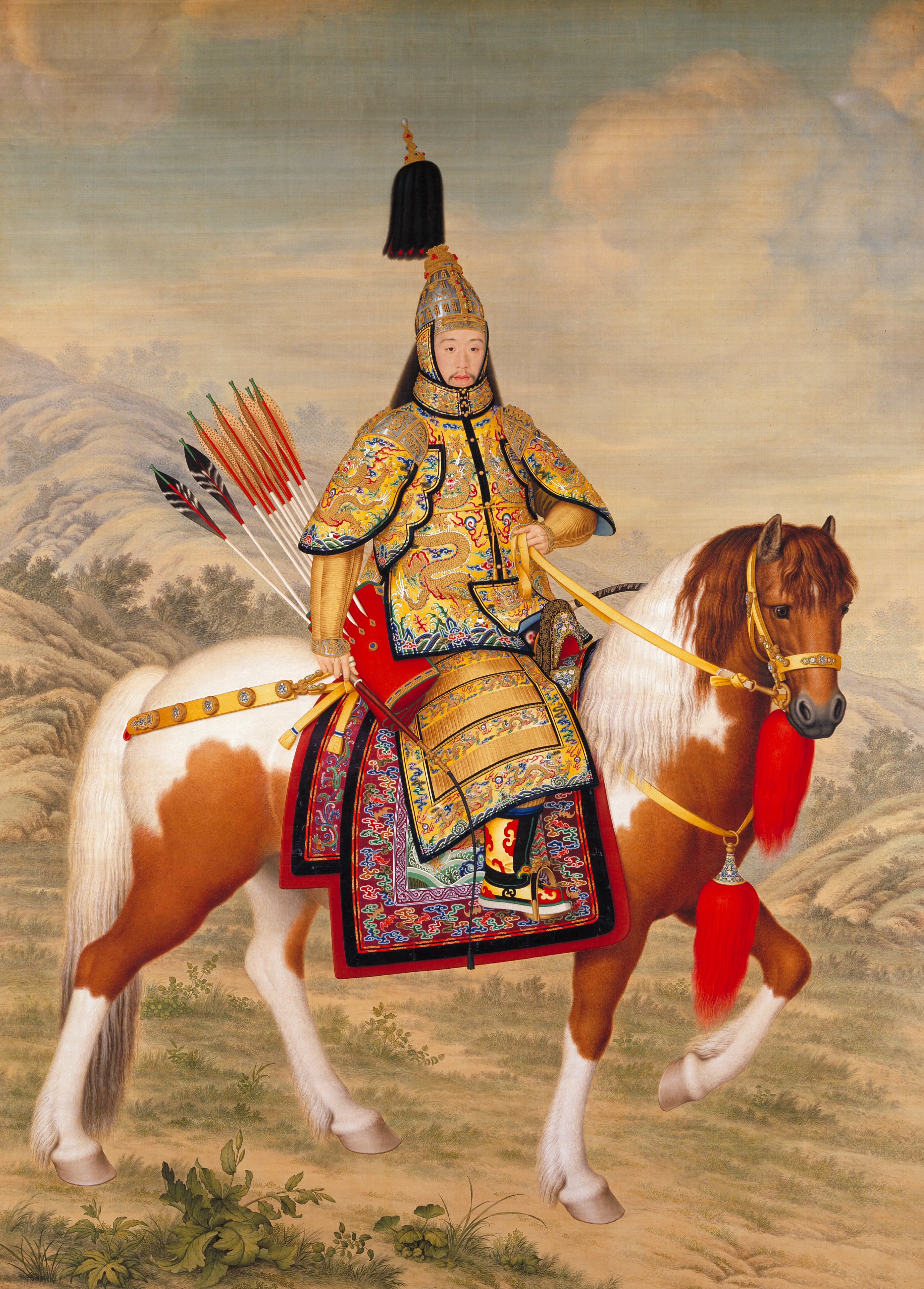
It's Giuseppe Castiglione's Qianlong Reviewing The Troops. The Qianlong Emperor was the Kangxi's grandson, and Father Castiglione was a member of the Jesuit Mission at the Qing court. With that, the context and intention of the canvas falls into place, although if by chance you haven't seen it, I refer you to Titian's Charles V at the Muhlberg, here.


There are lots of interesting similarities and differences in these two takes on a mounted man as iconic emblem of rulership in the Western tradition of the painting as an eye of the lens. I'll confine myself (having already narrowed Crossley's sweeping thesis to a minor point) to a minor element of the composition: the choice of weapon: bow and arrow versus lance. Again, the (Holy) lance pretty much explains itself. So, on to the bow and arrows: Why does the Kangxi's grandson, wishing to express rulership in the realm of ideas**  in the idiom associated with the Jesuit learning,** do so with a bow and arrow? Because they're a classic inner Eurasian expression of rulership. The arrows sweep the scene, signifying the rider/ruler as hunter, possessor of the land, the agency that shoots volition.

Gaze, venery and control; geeze, I'm talking like some Nineties feminist thinker. (That being said, I maintain my right to an uncomplicated masculinity with that old chestnut about the ambiguity of the hunter/hunted roles.) The anecdote turns out to be about surveillance, real estate, hunting and seeing. Now I shall return to the  Abendland home of the Jesuit wu jen and see where these themes take me.

("Spear and magic helmet?" For the second time today, I ask, "srsly?" And not just because it reminds me of a girl and a vanilla latte.)


Thursday, February 16, 2012

A Dream of Cavalry, I: Galloping

People dream of flying, and of going fast. In childhood, there were those golden days when we could just run on the green, or pedal our bikes as fast as we could as we coasted down hills towards improvised jumps. As teenagers, we got to do the same thing with roaring gas engines, enjoying their incredible responsiveness on the twisting curves.

And everyone who is reading this now actually survived that pleasure. I know, amazing, right? The exhilarating feeling that comes from going as fast or faster than the ground will support is pretty universal.  
 I have, for example, a clear image in my mind of what the turn-of-the-century "electric city" was like, one that might  bring home my mangled analogy between Antwerp and its ring fortresses, and London with its ring airbases. I just so want to write about it in a way that brings together the sayettries of Lille and siege  of 1708 and the gaslit age and the Battle of Jutland* and Fourier transforms and the Breech Loader, 18 Pounder. There's a reason that the manuscript that I've (mostly) written about these subjects runs to over 2000 pages, and it's not because that's what I think the readers want. It's because I'm going too fast. Discipline, Erik, discipline.

Or maybe there's too much discipline, sometimes. Sieges may be won by the triumph of method, but there are times when  plodding is its own form of deception. That's my main point in this posting, which is caught schizophrenically between a case of someone being wrong on the Internet** and my desire to get into a discussion of cavalry, speed, and the landscape. I've done some research in the lesser point, and need to dig up my work on the second, which will take some time. So in the interest of economising my own time, I'm going to try to segue from one to the other. I gather that it's not so much whether you clear the fence as that you're willing to try. 

Now, I'm not saying that the Birthers were appalling, mind you, So apologies to Erik Loomis if he notices or cares but in the interest of getting all historical about Birtherism, he links to this the site, which lets an expert (Philip Payne) execute misdirection by plodding. Consider that none of us disagree that Amos Harding (b. 1764-d. 1841) was Black, because all of us are black per the ridiculous One Drop Rule, or that he went ethnogenesis as an American in this little episode that I like to call "the American Revolution." And I'm not waving my hand at probabilities either, since Warren G. Freaking Harding conceded the point of his non-White physiognomy himself. (So did the GOP, when it used the accepted "Romanesque" codeword for Indian ancestry, but that's by the by, and check this link out.) The salience of the matter is solely that Amos Harding's particular great-grandson, Warren, had the non-issue emerge as an election issue in 1920. Election. You know, when swift-boating happens. And yet Professor Payne manages to write an entire post on the accusations that manages to avoid mentioning the Committee to Elect James M. Cox.*** Instead, the whole thing becomes horrid ooze from beneath the foundation pavings of American civilisation dug up and flung at us by a single crazy professor. 

Sorry, but that ain't gonna fly.  Check out a good book on the subject if you're interested in the question of Warren Harding's race and the election of 1920. In fact, it could even be a longer book, but it leaves out key details like a prize fight booked for the slightly-down-at-heels town of Toledo, Ohio on the 4th of July long weekend of 1919. 

See, the thing is, boxing was in the doldrums in 1919. College football, now that was a sport. Harvard was on top, having seen off the challenge of Jim Thorpe and his Carlisle Indians. Sure, to some, the Crimson Tide had a few too many vicious giants inclined to intimidate their way to victory, but if a good big (White) guy beats a good little (Indian) guy, that's just the way the ball bounces. It's going to be a few years yet before Harvard gets such a heaping serving of karma that it retreats from competition entirely.**** Still, I'd call football the Republican sport and boxing the Democratic one. No wonder that Governor Cox decided to let the Toledo fight go ahead.  


(Don't blink. Kid Blackie lands the decisive punch at 0:04


Oops! That's a guy who happens to be "Cherokee on both sides" dishing out one of the most vicious beatings in boxing's history to the guy who beat Jack Johnson in a fixed fight. Just as Warren Harding is about to inflict an epic electoral beatdown on his cross-state rival. There's all kinds of stories about how Jack Dempsey soaked his fists in lye to "harden" them, but, as far as I can tell, they just made him even more popular. Hugely more popular. Jack Dempsey saved American boxing, and perhaps the American star system, and he did so by beating the original "Great White Hope." Bizarre.

It's bizarre. When Johnson won the title in 1912, Representative Seaborn Roddenberry of Georgia responded by proposing an anti-miscegenation amendment to the United States Constitution. I don't which part is more eye-popping: someone proposing a "one drop" anti-miscegenation constitutional amendment (oops; you can't get married, because your great-great-grandfather fooled around!), or the contrast between Seaborn and the only other Rodenberry who must spring to mind when you read that. Eight years later, as far as I can parse the electoral returns, Governor Cox's swiftboating campaign left Senator Harding more popular in the border states. 

Either sports are colour-blind and the Wilson Administration's unpopularity broke the "solid South," both of which I doubt, or there's something more than meets the eye to the culture of Jim Crow. And that's all I'm going to be saying about that. I'm not nearly the social critic I'd need to be to take that on. I'm just galloping through the internet this week, hot on the scent of something that's probably going to turn out to be inedible to start with. 

My favourite seventeenth century manual on fox hunting stresses that it is a scientific sport. You can't just ride through the countryside pell-mell after a fox, leaping every obstacle as you go. You have to ride pell-mell and be constantly aware of the lay of the land and subtle signs that the scent track isn't going where you expect it to go. Science tells us that spider webs are an indication of damp ground that won't hold a scent; so watch your hounds closely. If they back and hesitate for a second, before following the ridge between the hollows, look for spider webs downslope. That's a sign that the fox has thrown the hounds off the scent by going down into the damp.You can't catch a fox without speed and attention to detail. 

That's the cavalry spirit: charge recklessly, and mindfully. You have to master the terrain. Sometimes, you have to put aside your diffidence and claim your authority. I'll leave it there for this week, and come back next week and talk about the Kangxi Emperor, optics, surveying the land, artillery and horses.


*Down to forty bucks on Amazon, so I bought a copy. And then, since I was there, I bought this and this and this. I think it might be time to admit that I have a problem.
**Woops. per Internet tradition, I was supposed to link here.
***Worse, if you check the link out, you will see that Governor Cox is one of those notorious press barons that we often leave to shape their own personal history at our own risk. Just fight the power, Professor Payne.
****You were expecting a reference to Jeremy Lin there, right? Done. Now, about a midwestern Catholic Irish university that actually predates American Catholic Irish and which is dedicated to the Corn Maiden. Er, I mean, Virgin Mother....

Friday, February 10, 2012

Fall of France, V: The French, V: Building Security for the Electric City


I'm a little groggy this Wednesday afternoon as I begin to type (but not finish), for various reasons,* but Robert Farley has restored my drive to write! Blah blah A-10s are awesome, sending airplanes to shoot at tanks is a good idea. The USAF is wrong a bunch of stupidheads to think otherwise. (Not a stupidhead. This is what a stupidhead on this subject might look like, if he were actually a dumb historian, as opposed to an excellent scholar who just happens to be wrong about this one thing.) So I am going to talk about sieges, and fortresses and how technology changed them in the age of the electric city until air power became the only substitute for human waves. 

So the argument, in the end, is that the  German Air Force of 1940 just precisely was a siege train, and not a "close air support" arm. But I have a great deal of material to work with, so I can afford to meander my way towards that conclusion. Today, I am going to try to  link urban development to the Somme. We'll see if I can do it.

Sure, that's just another apology in advance for meandering. I'm going to need it, because this trip towards the debacle on the Meuse begins with an anecdote about David Lloyd George, and not a funny or an interesting one, either. It just goes like this: one day, while preparing for his son's marriage to an heir of the large British construction/civil engineering firm Sir Robert McAlpine, Limited, he hid from the press at a newly built home owned by one of his supporters, who specialised in turning farm estates around London into mixed-used residential/golf course developments. (This might be the golf course in question, although, if so, it doesn't mention the related housing development or the developer.)

One might take as rather gauche an investigation of the way in which big money backers affected the policies of the great politicians of old. I've already trod on FDR's feet by gesturing to the odd conjunction between a family interest in a naval technology firm and major military purchases of their less-than-fully-proven boilers, and I certainly don't want to get into the question of whether Lloyd George was a lying liar here (but more below!). That being so, the triple conjunction of modern civil engineering, urban development and public policy pretty much defined the way that we live today. If I point out the conjunction between "Concrete Bob" McAlpine and the national security apparatus, it's to make some kind of point for the purposes of my inquiry.

As far as London and McAlpine go, that point is pretty basic. Garden suburbs, aircraft factories, and air fields sprang up together along the major new commuter rail lines being built to serve Greater London during the Edwardian era. Hatfield is going to be my first example here. Twenty miles from King's Cross on the East Coast Main Line of the Great Northern, later the London and North Eastern Railway, Hatfield's station served as the collector point of two minor radial lines. The town grew up around the nucleus of the Marquess of Salisbury's country house and was De Havilland's home from 1930 into the 1960s. That doesn't quite take us back to Lloyd George's time, but the line also served Enfield, and the Oakleigh Park Estate (an 1866((!)) suburban housing play). Still no air base, so how about Brooklands, the "motor raceway" turned WWI airbase turned interwar airport near Weybridge on the London and Southwestern Railway? LSWR is the line that famously delivered the BEF to Southampton Docks with a troop train running like clockwork every six minutes.** The enthusiast's Wikipedia article manages to turn a company that was ever-so-slightly a laggard in branch electrification into a pioneer, but the point remains that they were electrifying even as the war began, with work beginning in 1913, and the first electrically-powered train running in 1915. That's Edwardian industrial progress, for you. Weybridge still has two feeder lines so that commuters from even deeper in suburbia could reach their places of employment in Kingston-upon-Thames, notably Hawker-Siddeley. I'll talk about Halton below.

All of this, of course, is about an electric city that was never really fortified. I could talk about British politics and odd fortification projects,
or I could make a case that the air-and-factory complex around London is what a modern fortress, circa 1940, looks like. But to get there, I will start with another great electric city, the last true fortress city to actually stand siege: Antwerp, the place of the hand-taking. It's a bloody and sinister legend for a town with a sometimes dark and sinister past, although that's not the worst that I think of when I think of the Red Hand.


More funny than sinister until  used by marching thugs to justify violence in the name of prejudice. That being said, it is time to bring tired and frightened Prussian reservists marching on Louvain, and carry things forward through a foggy dew settling over Dublin till dispersed by long range guns. 

Tuesday, January 31, 2012

Fall of France, V, The French, III: The Emperor's Daughters

(Edit: I'd let this stand, as I have other things to write, but it's just too darn rough to go without a little polishing.)

It's amazing how quickly a day at the library goes. There's a lot of things that I'd like to talk about. Some of the sillier notions of pre-war aviation history got aired again last week in the even sillier context of a call for a lunar colony. I'm still circling the problem of getting a handle on the transatlantic horse trade. (This  book looks like it needs a look.) In the end, though, I went with trying to draw out a picture that I've already formed from books that I've already read.

This is one doesn't start chronologically. Eugenia Kiesling's purpose here is pretty clearly spelled out. How much can you plan for future wars? It's an interesting question, but not a big concern for me. I like her Arming Against Hitler for its explication of the obstacles between planning and implementation. And by that I don't mean all of the debates over periods of service or frequency of cohort uptake or the problems of dealing with politically unreliable conscripts. What I mean begins with a little story about mobilisation centres.

Kiesling (88) notes the ideal of 509th Tank Regiment, whose depot was Mobilisation Centre 509 in Maubeuge, with a backup Mobilization Centre 513 at Rouen, which had no indigenous regiment. So every new conscript inducted at Maubeuge who meets the 509th's requirements (of which more below) goes to that regiment. If that wasn't enough, MC 513 could send along a few more men. The 509 is staffed from a coherent region. At the end of their service, the men go back to Maubeuge or Rouen, ready to be called up to serve in "their" regiment when the balloon goes up. But consider the more common case of Mobilisation Centre 503, which sent men to the 507th, 508th and 510th Tank Regiments, while the 503rd Tank Regiment received men from rear Mobilisation Centres in yet another four regions. How did things get so confused? I'm sure that there is a complicated, amusing bureaucratic story to be told, because we are talking about complicated bureaucracies that do amusing things. I would say that it is no way to run an army, except that pretty much all armies are run this way, which is why my eyes glaze over at so much of Kiesling's heroic research. Prove that things weren't equally screwed up on the German side, and she'd have a case.

That being said, another of her examples is just awesome (89ff). She has looked at the papers for the  Lille Mobilisation Centre. Obviously the old fortress-and-sayettrie centre turned grimy industrial town didn't send men to a single tank regiment. It sent men to the infantry, chasseurs à pied, Zouaves, Tiralleurs algeriens, Tirallieurs tunisiens, armoured units, "mechanical support units" for armour, horse cavalry (again, resident Africans were segregated into the chasseurs d’Afrique), motorised cavalry units, horse-drawn artillery, mechanised artillery, railway artillery, fortress infantry, AA troops, chemical weapons units,* training establishments, engineer units including sappers, mechanics, electromechanical engineers, and telegraphists, supply companies, horse-drawn and motorised, clerical and other administrative units, medical, balloon detachments, the navy and the air force. Clearly the preference for regions of recruitment conflicted heavily with the need for specialists. This is because, to an extent, Lille was just big, but there's more to it. 

For example, armoured regiments didn't take just anyone. They required that 15% of their inductees to be skilled metal workers and 10% to be woodworkers (this is Kiesling's translation, and I suspect that if I were writing about the British army of the period, I would say "fitters and riggers," and be just as mysterious). Twenty percent must have driver’s licenses. 

The tankers go on. They want Radio operators and painters. They also want bootmakers and saddle makers. Now this seems a little strange, but they go on to specify "other suitable candidates for training as drivers." So having a militarily useful trade makes you a better potential candidate driver? Maybe it has something to do with recruiting within pay rates? Meanwhile the cavalry remount depots also wanted the boot and saddle makers, with more reason. More specifically, they accepted only these trades, plus accountants, blacksmiths, tailors, and, once again, woodworkers. Tradesmen with other certificates across a wide range of other skills were certified by their employers and distributed with regard to need (riding, driving, music, mechanics, nursing, piloting, navigation are noted). Bakers, butchers, cooks, masons, painters, and so forth were distributed according to TOEs.
 At the other extreme, there were unwanted men. Les Joyeux, illiterates and non-Francophones were supposed to be sprinkled around to maximum targets. The cavalry wanted no more than 5% illiterates, but when, say,  22.5% of the inductees in the Limoge, for example, were functionally illiterate, this was a challenge. Kiesling notes that some mounted units in western France had 50% illiterates.
Now, the theory of the nation in arms is that each man (parliament argued about conscripting women, and concluded that it, like a  national labour registry was impractical in peace) goes to camp, is trained, and returns to civilian life. Every once in a while, he gets a refresher, and as his cohort ages, it graduates into newer, lower effectiveness reserve units. So 1st Infantry of Ville Ordinaire is backed by the 101st, 201st, 301st and Too-Old-For-This1st that garrisons the citadel. But if a man goes away from town to be a tanker in the 509th, and comes back to Ville Ordinaire. His unit is supposed to be the 1509th, all the way across the country, which is not very practical to start with, and raises the further problem that there have to be tanks for him. If there is no 1509th, for lack of tanks or whatever, the old soldier is sent to the local infantry –with no infantry training! (94). In theory, 20 armoured regiments that train 1000 men every year have encumbered the country with 200,000 veterans with no infantry training after 10 years!

I wouldn't overstress this problem taken in isolation. Maybe if the awesome Nazi war machine crossed the border hours after mobilisation in a vast attaque brusque, it would be important. If it's an  "iron spearhead on a wooden shaft" that does so eight months after the declaration of war, not so much. Yet the same circumstance can apply to anything from the cavalry to the railway service and I do see a more subtle problem.

Consider: how many eighteen year old inductees are skilled mechanics? Bootmakers? Accountants? Butchers? Very few: the system is based on the premise that these eighteen year olds can be turned into riflemen quite as good as anyone's, but the armed forces' are only 39% infantry, a figure that the British Army Council could only look at with envy, hampered as it was by the India garrison) In a shooting war, the riflemen will die a lot, and there will be need of a large cohort of replacements, but that's not the point. The point is to staff the regular units that will train everybody. This is easily accomplished with rifle companies, but not so much with units that are presumably looking for eighteen-year-old mechanics. Not that the army can afford to be the trade school for the nation, even if one can imagine how it might be accomplished. (Are surplus Grande Ecole men going to be kidnapped and forced to study a trade?)


The point of the requirements of the cavalry depot is that this isn't exactly a new problem. There's probably a  transition point where the main issue goes from horses being relatively scarce to war being all new fangled and stuff. But, heck. Let's not sweat the "probably." Let's look at other books.


Tuesday, January 24, 2012

Plantation of the Atlantic XVI: Nantucket Later: Or, if you have to ask to see it, you probably know the answer

There was a young man from Nantucket/.... It's as though I started with "Nantucket Origins," but the other way round. That's because we're starting with a very famous early American, who kept his cards close to his chest. We've been straining to pretend that he had nothing to hide for two centuries now, because that's kind of what politics does to you. 

It's funny that as I wrote the title of this piece, I had to reflect on the President's birth certificate instead of  the hapless Mormon dude and his tax returns. That's the thing with secrets. They're secrets. Even when we make them up in our head. The proof of the conspiracy is that there's no proof. So what if the scales fall away, and we still pretend that there's a mystery? Sometimes, things have to stay secret even when we know that they're not.

Honestly? I searched Youtube looking for a better clip about secrets than this one, but it's got a guy with a secret identity, a prank, and a mysterious envelope, so it's at least vaguely relevant. The real point of today's audiovisual aid is that I've become a Community fan of late. I have no secrets from you. Well, maybe one.


Wednesday, January 18, 2012

Fall of France, V: The French, II: Why "Manoeuvre" Instead of "Maneuver," apart from me trying to hit you over the head with how Canadian I am?

I'm going to double down on this whole "[Prussian*-]German way of war" thing today. Two contexts, the historiographic being Robert Citino's recent book, The German Way of War: From the Thirty Years War to the Third Reich and the historic one Pappa Joffre kicking Potsdam United's butt  in a test match  held between the 5th and 12th of September, 1914. If you've read Citino, you know that his argument is that Prussia-Germany, as an often weak, central power, sought the rapid resolution of its wars in pre-emptive, decisive battles, an argument not to be rejected solely because it suffers from being advanced by morons (context; more context). This is pretty deep military historiography that could get us talking about Clausewitz (j/k!), even if the immediate callback is to good old Jomini.

Citino, however, takes it at a different level. The pursuit of decisive battle determines the conduct of the "operational" level of war, as well: seeking decisive battle, Prussian-German armies specialised in the war of manoeuvre, Bewegungskrieg, using daringly swift and fluid operations to set up decisive battles that ended wars before they started. Attention to the "operational" level of battle is something else altogether. I would, for the moment, trace it to Mellenthin's Panzer Battles, a 1948/1955 book that celebrated the nimble, outnumbered Germans in their victories over their stolid Russian (and British, if you want to talk about the DAK) enemies.

I've used some links here that suggest that I don't take all of this too seriously. It's true that my sympathies lie with Joffre, and that the whole "I'm more anti-Nazi than you" thing is an easy out when you're talking about the Wehrmacht, but I present these concerns upfront because I think that there are very real problems with the Citino thesis. It's not that the masters of Bewegungskrieg kept losing wars of manoeuvre, or that we really do glamourise Nazis, or that Mellenthin often overstates the Russian numerical superiority in bog-standard callbacks to the worst of Orientalising military history.

It's that things are more complicated, and that by pursuing the complicated, we go delicious places. I see the "German way of war" is a heuristic. It is simply not-self evident that the Prussian-German armies were about manoeuvre. They conducted sieges, fought colonial wars, conducted amphibious operations, and served as corps within larger coalitions, and fought many other kinds of wars, as well. One can findexamples of Prussian-German armies conducting daring manoeuvres, and examples where steady and stolid battle discipline was so much their forte that their Habsburg enemies had to resort to their superiority in ...the war of manoeuvre. (Also.)

You don't however, argue against a heuristic with counter-examples. It is not to be preferred logically. It is an analytical tool that allows us to say something more relevant. Citino wants to explain how the Germans won the battles they did win without making an essentialist argument. I want to explain the same victories with my "substructural history of strategy" approach. So I say that, "on the contrary, it was the French, with their fortresses and their railways and their guns, who were, of the two armies facing each other on the Marne, the true masters of manoeuvre war," So I'm making a claim, too. 

And since this is  my blog, I'm going to go historiographic on Citino, and then get historical on my claim.

 Well, historiographic by a very generous stretch going back to the fall of 1987, and a young man's encounter with

Courtesy of Boardgamegeek

Back in the day, before it dissolved in 1996, after what I am sure was one final, cathartic, soul-satisfying group atomic wedgie,* Game Designer's Workshop was one of the leading  marquees in table top boardgaming, and in 1983, it released Assault, Frank Chadwick's game of platoon-level tactical combat in modern Europe. Like the better-known Squad Leader before it, Assault used isomorphic hex maps, standard orders of battle, and lovingly detailed weapon effect charts to allow players to pit onrushing Soviet Red Army forces against Americans, and latterly German, British and Dutch (whatever) forces in "typical" central German terrain. As long as you could handle autobahns and rivers going in circles, it was a lot of fun. Unlike Squad Leader, Assault is a historical curiosity nowadays, on account of that whole World-War-III-Not-Happening thing. (I know. I'm as disappointed as you are, and I don't think that the Gulf Wars were a satisfactory substitute.) 

On the other hand, the platoon level action allows for less tortuous detailed counters and tables while still giving a good impression of what Frank Chadwick thought a war with Abrams, Challengers, Leopards and T-80s would be like. That's Assault, and we'll leave it be, because I'm talking about Boots & Saddles.

The second module in the series  introduced rules for rotary wing aviation and provided a new set of counters. Division 86, the paradigm ("doctrine," whatever; I'm linking to the 1993 revision, anyway) with which the United States Army entered the 1980s, puts a lot of rotary wing combat aviation into the standard United States Army corps, and that's what this game supplies. The concept overlaps that of providing the "cavalry" formations of the main American army, because there were supposed to be two squadrons of attack helicopters in the divisional cavalry regiment plus two attack aviation regiments to form a full divisional cavalry brigade, plus a corps-level armoured cavalry brigade to screen American mechanised corps, each with an attack aviation regiment as one of its four manouevre elements, plus one full attack aviation brigade allotted per corps, although these units did not  have "cavalry" traditions. That's a lot of attack helicopters --and a lot of "cavalry."

Tradition isn't destiny. These guys don't dig many saps these days. It's some kind of metaphor, but the cover art for the game took the implicit metaphor to town. And so did I. Cavalry, the game and the doctrine suggested, existed for a reason. Cavalry has a mission, or rather, missions. It screens, reconnoiters, and provides flank security. A general may throw masses of cavalry at the decisive point, and, it's a lot more exciting to throw a regiment of AH-64s at a Red Army column on the move than to try to plot an artillery stonk on them. Mobility, perhaps to a jaunty cavalry air, has its appeal. I know that some guys think that Everything Went Wrong with armoured warfare once we start thinking of tanks as "cavalry," but for that Pole, I can always cite another who thinks that the problem with Allied tankers in WWII was that they didn't have enough cavalry spirit. Richard, meet Roman. Fight now!