Monday, February 11, 2013

Running Away to the Air, VIII: Go Big, or Go Home

*


Lutz  Budraβ writes that interwar aeronautics couldn't really get it together until government-funded research into dirigible design gave them a mathematical basis for building heavier-than-aircraft.


So of course when Claude Dornier sat down to design a --transatlantic, I guess?-- passenger liner in 1924, it turned out to be bigger than a dirigible. The Wiki article says that the Do X weighed 56 metric tons, I assume all up, and was meant to carry 66 passengers on transatlantic flights. But then it also says, after admitting that it took nine months for the Do X to fly from Hamburg to New York, that it was the Great Depression that prevented Dornier from selling any more planes.


Technology enthusiasts are what they are. Facts, especially when they sound like pessimistic old people facts, have difficulty penetrating their invincible carapace of optimism. For every Do X in the past, there's a Mars Direct in the future. 


C'mon! It'll be cool! 


Wednesday, February 6, 2013

Gather the Bones, XVI, 2: The Work of Eanna


"When Enmerkar was lord in Uruk, and the heavy barley drooped in the sun under the weight of the dew, and the black haired folk grew fat on the carp flood, then all the land west of the Euphrates belonged to the Amorites, whose kings lived in tents."


Sounds nice. But then came wage slavery.


*
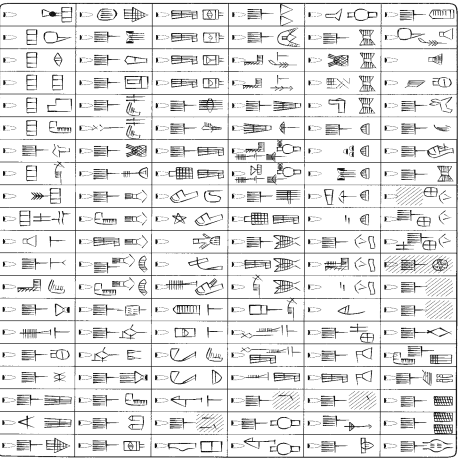
And you thought your job sucked. These guys (defensibly just guys, I think) worked for specified amounts of, we think, other interpretations being possible, bevel-rimed bowls of cheap mass-produced pottery filled with grain rations, a certain number of rations per position. The bevel-rimmed bowls are one of the signature archaeological markers of the Uruk Expansion and speak of a widespread social organisation, even if the scribes whose work Robert Englund is compiling in this modern reconstruction recalled it, perhaps six centuries later, as an organisation handed down by the sky god Anu as one of his "Me" of civilisation, and stolen from sacred Eridu in the holy lagoon and carried off to upstart Uruk by sexy, sexy Mother Eanna, at least by the interpretation of sacred text presented by Paul Kriwaczek

That insistence, that failure to remember a glorious history, is a good reason for thinking that Uruk was ever the capital of an empire, as Cuzco was of Incan Tawatinsuyu. The same objection may be made to the idea of Cahokia as the capital of an upper Mississippi empire, similarly delineated by a characteristic mass produced pottery speaking to some kind of social-organisational function. Conversely, the survival of a genre of document that seems to originate in Uruk IV, and the attachment to it of a new explanation speaks to ideology, and I do mean ideology in the careful "German Ideology" way that Paul Hundert taught me to say it, for a change. Of course, you think. It's about food/rations/pay, in a way that makes it comprehensible to the citizens of the southern alluvium about 3200BC, perhaps as early as 3800BC. It's going to be ideological. But do we understand just how ideological?

What's the southern allulvium? Well, in my tradition of going to left field for my sources, here's Playfair (Mediterranean and the Middle East) illuminating the point:

(i) Floodtime near Habaniya Air Base, on the road between Fallujah on the Euphrates and Baghdad on the Tigris in the spring of 1941:


ii) The theatre of operations back from that time when the RAF bombed the heck out of their clients allies for having the temerity to back the wrong side:


As you can see, the area around Habaniya was very wet during flood time. What can't be imaged here is that this is going to be a transient condition. The region gets as hot and dry in the summer as it is wet and chilly in the late winter/spring, and as the historian of the last British (well, Indian, really) campaign in the region points out, all the fodder and animals are going to disappear, and if you think that  you're going to store food in a way that lasts through the summer around here, forget it. It's just way too damn hot for anything but the local traditional technics, not that anyone actually knows how it's done, given that the foreigners traditionally clear out for the mountains, along with at least some of the herds, when it starts to get hot.

Hot. That's the word. In 1925, documentary makers will follow the Bakhtiar tribe of, they say, 50,000 people and 500,000 head as they cross the lower Karun on their way to winter pasture in the mountains. It's an ancient and unchanging struggle, the documentarians say, against heat in the low country and snow in the high. Only probably  not, because, at least for the moment, on the dubious basis of pollen and sediment studies, I am going to go with the thesis that there was a radical expansion in human-curated forests during the Iron Age. Which is another way of saying that we can at least assume that low-forage climax forest on the Zagros heights were replaced with high-forage mast forests by people with iron axes in the period after 800BC. No less in the Middle East than in temperate Europe, the disruption of iron technology must have been socially transformative.

But that's for later. There were certainly livestock in the Middle East of 4000BC, and some, at least, were going to the mountains. This thing we're talking about was an economic unit. What thing? Well, some call it Mesopotamia, because of course you use Greek names for Arab places, and some call it the Fertile Crescent, which, for me, raises spectres of Seventies style geopolitical fantasies, and some call it Iraq, and it certainly would be awesome if it turns out, as Kriwaczek suggests that "some" say, that Iraq comes, via Erech, from Uruk.

Still, we're talking about an economic unit here, and I have a map, crassly lifted from Robert Englund (1998) Texts from the Uruk Period just like the table of occupations above:


Englund offers a somewhat fuzzy view of the key 400mm isohyet, but the basic geography is easily described. The Arabian plate is ramming Eurasia, raising an orogeny around the leading edge of the plate that lies within he Warm Mediterranean climate zone of wet winters and dry summers. The orogeny sheds winter precipitation in a spring flood and creates a zone of relatively high precipitation low land that hugs it in a gentle crescent. Mountainwards of the isohyet, dry farming is practical. Below it, there is a zone of archaic settlement remains indicating an early phase of agriculture petering out towards true desert. Or, as the ancestral cattleman in me calls it, "range."

So from the map, we know what the southern alluvium is: desert. Or range, if you prefer. Not in the spring, to be sure, when the rivers are in spate, when the Tigris, carrying the freshet of the Zagros, rises in its deeply dissected gorge to the height of a four story house, and the much more mellow Euphrates, descending from the Taurus at a gradiant of perhaps 6 inches in a hundred miles, leaks under its natural levees to create the landscape of the picture above, where it is nearly as wet on the landward side of the levee as on the riverside, and great lakes pool in depressions in the midst of a landscape of intractable mud. But later: in the summer. When it's hot.

Did I mention that it gets hot then? That's why it is range. Of course, that's not what it is used for. It was farmed, perhaps beginning about 5000BC, or perhaps a little later, and still is. Irrigation serves as a better-than-substitute for rain, and as a result cities sprouted on the southern alluvium at an early date. Breaking historical insight: irrigation is key to early civilisation!

Except, well, yes and no. The only major Iraqi agricultural  exports that manage to bear up against the tides inflooding that unhappy country are dates and wool. Yes, the country produces a great deal of cereal, but it is a net importer of wheat and grain, and the agricultural ministry's current main concern is getting the 17 million palm trees that line the Shatt al'Arab back into full production. And this should be no surprise given that the average date palm produces 100kg of fruit/year, and that 178g of pitted dates yields 500 calories. If I were a Stone Age economist, in fact, I would strongly recommend that southern alluvium subsistence-challenged fellow flint nappers focus on dates as their food source, not grain.

The only problem with this that I can see is that the date harvest takes place in four tranches, each harvest being necessary to prepare the tree for the next. The earliest pick is in June, the same time as the cereal harvest, shortly after the sheep are shorn/combed out, and the main harvest begins in August. Did I mention that it's awfully hot on the southern alluvium in August? In a world where all the good land is already taken up, I can see the logic of lounging through the July heat around Uruk waiting for the dates to fruit.

So I argue, a lot, that major civilisational changes reflect the long, slow, positive feedback loop of technological change leading to higher regional population bearing leading to investment in a deeper economy of knowledge making new technologies possible making for higher population densities. If the Uruk Expansion is defensible as a transition to a new social mode of organisation, perpetuating ideological statements that survive another six hundred years to be found as scribal exercises at the dawn of the next era, do I see a new technology, or, more clearly, a new economy of knowledge?

You damn bet I do: Andrew Sherrat's "Secondary Products Revolution" is already closely correlated with the beginning of the Uruk Expansion period. The idea, not to get repetitive here, is that about 4000BC, human society moved from using its domestic animals (closely hunted prey?) for secondary products such as milk, wool and traction as well as for meat. This is not "invention;" it's not, pace the geneticists currently at work on the subject, due to a sudden mutation that made adults capable of consuming lactose. People put far too much trust in claims about the scientific origins of the diet fads of the moment.** It's about labour. To use wool and milk and traction successfully, you have to feed and care for animals more closely, and you need plenty of labour to process the products. Above all, you need textile workers.

I am not proposing the rise of a commodity textiles industry in alluvium cities here. That would be crazy. Dressing a person in wool takes the product of one or more animals, and the full shearing season labour of one individual, plus the work of another. We are still in an age when people wear mostly hides and rely on staying out of the sun a lot. I am proposing a much larger scale of textile production, and actual social takeup somewhere between the extremes of Paleolithic-people-trading-shells-hundreds-of-miles-inland and everyone-wears-undies-made-in-Manchester. This will serve as a model for understanding the extent of population concentration in Uruk that aligns it with Cahokia at one extreme and Cuzco and Teotihuacan at the other.

But I still haven't explained the empire, or dates, or the logic of cramming people into the southern alluvium, or the ideology that I see in those list of occupation plates. Again, out of left field, early modern military history irresistably suggests the parallel. If there is anyone who is as weirdly insistent on publishing tables of ration compensation by office, it is the scribes of the Perpetual Diet who tell me, and anyone who goes into the Kriegsarchiv in Vienna and looks up late Seventeenth Century administrative documents, exactly how many additional rations for man and horse every man and officer  receives in pain de munition and horses worth of fodder, as well as their pay in good silver gueldern. 

Prince Eugene of Savoy, in right of his position as Reichsgeneralleutnant, gets the rations of 300 men, by the way, and 300 horses. Not because der Edle Ritter goes to war with a train of 300 mounted servants, but because he's doing a fine job as commander of the Reich's armies, and deserves to get rich.

The question that we tend to ask is, "Why this cumbersome triple compensation scheme?" And the answer, it seems to me, is ovious: ideology. This is how the Age of Grass organises wealth. We live in the Age of Oil, and we think differently.  Well, the scribes of Uruk are men ofo the Age of Grass, and they' are talking about rations. But, in my humble opinion, they aren't talking about rations as rations per se. They're talking about wealth.

What's the difference? Well, the first rule of animals is that they live and grow on what they eat on their native ranges, but they are fattened for sale at a feedlot. In general (and I aim this snotty shot at people who talk about the Roman annona and elide into "bread and circusses" talk), people way underestimate the extent to which the alleged subsistence rations of antiquity were paid, not to the starving poor, but to rich feedlot ownerrs, to fatten up cattle for the market, rather than the poor for their own good. Call me cynical, and I'll cop to it. I can't imagine how I got that way, but that's the way I see it.

So here's the logic of the Uruk Expansion as I see it: massive circulation of population to and from the southern alluvium because that was the only way of circulating real wealth, in the form of something that mattered: sheep and cattle. The "new" focus on the date palm as the wonder crop of the southern alluvium? It's not because it feeds people. Dates might be a dietary staple, but they're only a dietary staple. It's asking a lot of the average human digestive tract to deal with an all fruit-sugar-and-fibre diet, and that's a lot of pits to remove. Sheep and goats, on the other hand. . . .

Empire, I'm suggesting. It is the product of a new economic system required to organise mass animal movements across paths that we may have lost sight of insofar as they ceased to make sense in the Iron Age. It is an empire that makes the southern alluvium worth colonising, and one that drives economic intensification there, and, incidentally, administrative intensification that makes itself visible in the form of the first texts, and, somewhat later, the first (and unhelpful) history.

Taking this back across the Atlantic, and I am going to suggest that if economics organises empires, than the collapse of the pre-Columbian economy, instantiated by the very appearance in the New World of Old World techniques and domesticates, ought to have dissolved New World empires, at, just after, or even before explicit contact. New techniques call for new modes of organisation, so why put up with the inequities of the old?

(I will leave it out there, for now, that the main use of the Oregon Trail turns out to have been to run sheep to and from the Oregon and California pastures to the mutton packing plants of Chicago, and that two significant concentrations of the somewhat mysterious surname "Nottke" are in Illinois and Washington state.... The idea that some of the Nottkes were originally "Nutkas" barely qualifies as a hypothesis, but the two decade long era of mass sheep drives on the Oregon Trail legitimately count as lost history. )

That is not the world of 4000BC.
*This is actually a composite of Uruk IV lexical lists of occupations, appearing in and, I guess, created by Robert K. Englund, or an unsung assistant. Englund (1998): 104, fig. 32
**Imagine how our history of civilisation will change after some impressionable historian reads a book by a gluten-free diet faddist!

Thursday, January 31, 2013

Gather the Bones, XVI: Shiftless Spaniards, the Eanna of Uruk, and My Terrible Grasp of Logic, I


*
Just a jeux d'esprit today.

Some countries are rich, and some countries are poor. For some reason, economic historians who live in rich countries like to blame the people who live in poor countries. For example, although the reasons change with the season, it's always been pretty clear why Latin America's economic development lags behind North America's.

It's because the people down there are, well, you know. I'm sorry, you didn't quite catch that? I'll repeat myself: "you know." No, really. You know. Look, if you really need me to spell this out for you, get me drunk down in the quiet corner of the Arbutus Club.

Just maybe make sure that no waitress you actually like is working that shift.

Okay, enough of being arch. I have a late Landes in my collection that shows the persistence of this kind of thinking in some places. David Landes' mind, anyway. The fact that I picked it up off a pile of garbage on the curb the week after the August-moving-to-Toronto-to-go-to-graduate-school-disillusionment-can-wait-for-later festival here in Kitsilano is probably a more accurate reflection of just how widely the view that Third World poverty is down to Third Worlders being [you couldn't quite catch me mutter this word]ly defective in some way. That's not the point.

The point is that in the great expansion of the Age of Reconnaissance, the peoples of the north Atlantic basin expanded in all directions. The received view is that in North America, they encountered virgin forest, recently miraculously depopulated of a people who gardened and hunted in a [cue the third parenthetical culture war in six short paragraphs over choice of adjective here] relationship with nature. In Africa they encountered proto-states in Mali and Congo that, like the would-be colonisation drive itself, failed to thrive until the Nineteenth Century. In East and South Asia they encountered states in crisis that restored themselves before, again, falling partially or completely to a second wave of colonialism much later.

And in Latin America, they encountered vast and populous empires that fell easily and at once under Spanish hegemony and yet which still failed to thrive, and have continued to fair to thrive up to the present, at least compared with the supposed settler states of North America. My point in my snide parentheses is that we're less astonished by this than we should be because we have been too ready to embrace theories about how societies become wealthy that are psychologically satisfying rather than logically defensible.

There's another way to take this, however. Things have changed a lot in the days since people had to genuinely fear famine, and there's not many economic writers I trust to have a finger-tip's feel of the issues at stake in such an economy. Good thing that I have a copy of an incredibly digressive and (for its time learned) book by one such author to type from!

"Even the Peruvians, the more civilised [of the pre-Columbian states encountered by the conquistadors], though they made use of gold and silver as ornaments, had no coined money of any kind. Their whole commerce was carried on by barter, and there was accordingly scarce any division of labour among them. Those who cultivated the ground were obliged to build their own houses, to make their own household furniture, their own clothes, shoes and instruments of agriculture. The few artificers among them are said to have been all maintained by the sovereign, the nobles, and their priests, and were probably their servants or slaves. All of the ancient arts of Mexico and Peru never furnished on single manufacture to Euorpe. The Spanish armies, though they scarce ever exceeded five hundred men, and frequently did not amount to half that number, found almost every-where great difficulty in procuring subsistence. The famines which they are said to have occasioned almost wherever they went, in countries too which at the same time are represented as very populous and well cultivated, sufficiently demonstrate that the story of this populousness and high cultivation is in a great measure fabulous." (Smith, Wealth of Nations, 1: 226).

Adam Smith goes on to tell us that although Spanish institutions are defective, cheapness of land makes up for much. He quotes the Scottish business traveller Frezier and "Ulloa" on the population of Lima in 1713 and 1740: twenty-five thousand have given way to more than 50. The authorities cited are a little slight, but, Smith concludes, the growth rate of Peru is "scarcely less" than that of the English colonies. For Smith, there is no mystery here. Latin America is growing at about the same rate from about the same level as the English colonies. a fuller account would bear down on the "about" and inquire into whether another century of colonialism in the southern continent counts as a "head start" or the reverse, although the last question would opened up an inquiry into the specifics of how North America might have begun its entry into the Atlantic world a century or more before the Mayflower, and wouldn't that be awkward.


But then what about that Inca Empire? (No Aztecs today: I've quite enough to do in this post without going back to Aztlan.) Empires and colonialism go together. You know when the first person ever sneered about how the natives were shiftless and lazy, and let their women do all the work?

Here.
The Uruk Expansion: From the Hacinebi Project at Northwestern.

Wednesday, January 23, 2013

Gather the Bones, XV: Inauguration, 1828


*
Andrew Jackson, lawyer turned governor turned general, national hero and senator (i, ii), entered into the Presidency of the United States four years late, taking the oath of office on March 4, 1828. The Oxford Press owes Daniel Walker Howe a significant debt, I think: I've bought two mediocre volumes in their History of America series on the strength of What Hath God Wrought, but Howe's treatment of the inauguration is not one of the strong points of the book, which is something worth saying only because it illustrates to what extent the politics of the day can still catch fire in a scholarly monograph today.

Andrew Jackson was a divisive figure, is what I'm saying. To turn to my weird little touchstone, scholarship seems agreed that James Fenimore Cooper knew nothing about American Indians except what he read in Heckwelder. Leaving aside, just barely and for the moment, the valence that the Moravian missionary's name would have had on educated Americans (1,2 a) and b), 3), this assessment is based on the only review of Cooper's work ever published in North American Review. Just to put this as baldly as possible, America's pre-eminent antebellum literary journal only reviewed its bestselling author once. Specifically, it wrote, in 1828, no less, that he knew nothing about Indians, and ought to stick to writing sailing adventures. This isn't surprising, in that the Review was Whig and Cooper was Democrat, and 1828 was the year that, well. . . .

 But why hasn't anyone noticed? Why are people still adopting the Whig perspective? Because the Whigs were right about a lot of things? But it is only in party politics that we also embrace bad ideas because they are supported by a party that generally has the right ones. 

I think that something else is going on. The debate has become transparent in the same way that air is to breathers. People take sides without noticing the cause to which they are committing. Betty versus Veronica: homespun, blonde Cooper versus brunette, vivacious Lodge.

This is an auspicious time to be talking about the first man to take the oath of office in public in front of a mass of "ordinary citizens" crowding the mall. It's in the news! It's also worth the scare quotes. There's nothing ordinary, I would expect, about people who could afford to make the trip into Washington to witness the inaugural, and Howe's grumpy assessment is that the famously "democratic" crowd that pushed its way into the White House were all office seekers, is probably correct. 

Whatever: that's how politics works. You support a man you identify with, at some cost to yourself, you expect to get the local Post Office. How else are you going to come through with the promises that you made in his name?

A small question, then, just to start things out: why did people identify with Andrew Jackson? Oh, I know you know what I'll say, but to make a short story long, take a look at this census series (per Wikipedia): 

17903,929,214
18005,308,483
18107,239,881
18209,638,453
183012,866,020
184017,069,453
185023,191,876
186031,443,321
As rapid as it is, the growth rate of the American population begins to fall below its historic "doubling every generation" rate in the years after 1820. Something is happening, something is changing in the America of Andrew Jackson.


Wednesday, January 16, 2013

From Now On, No More Defeats: The Siege, 3: Metacentric Heights

*
This is not a real submarine.

 Neither are these, (1, 2, 3, , 4, 5, 6), but they're a good place to start the discussion. Since time immemorial, man has longed to travel underwater. I don't know for sure about women, but I'm thinking of asking my niece. She's 7, so she should have some insight. It started being vaguely safe with the introduction of electric motors with the Gymnote of 1888, although as usual it is obligatory to pretend that a Nineteenth Century American inventor produced the first submarine, because patent trolls.**

That is a pretty short interval between the introduction of a technology and its first use in action, and the Royal Navy's attempts to use the things show a certain, uhm, experimental flair. Besides the gigantic steam-powered "K" class and the 12" gun-equipped "M" class monitors already noted, check out this incredibly precocious hunter-killer type.

The problem here is pretty clear. The Gustave Zede was developed as a submersible torpedo boat. The point of torpedo boats in French naval strategic thinking is that they sneak up on blockading battleships and poke holes in their hulls with torpedoes, weapons with an unparalleled potential for mission-killing a battleship in an asymmetric encounter. You just have to get close, hence the "sneaking" part. Torpedo boats were good at sneaking, because they were small and close to the water. At night, their silhouettes would be small, and they would be hard to spot.

This is all well and good, but the design effort breaks down quickly. You want a torpedo boat with a big enough torpedo to have an effect, and a big engine to push it through the water quickly, while the whole "too small to see" thing pushes it down in size. Small boats are also hard to fight in a seaway.

The result of the dialectic, well known in military technology in general, is to push the size of "small" units up to the point of diminishing returns, and, let the hands on the reins relax, well beyond. Then someone comes along and takes the left-hand path, does the outside-the-box thinking, and comes up with a new paradigm. Boats that go underwater are really good at sneaking up on battleships!

Well, okay, electric motors are pretty dinky, so it's hard to catch up with a battleship that's actuallly moving. But they're really good at sneaking up on battleships that are swinging at anchor off Le Havre. In somewhat baddish weather. When they're not likely to be swinging at anchor. But, hey, work the wrinkles out and maybe you've got something there, you think.

Just what, exactly, would be what the Ks and the Ms were about. Electric motors are just a way of transforming potential into kinetic energy, and electric batteries are far less efficient than oxidising engines, and always will be, because half of the fuel mass of an oxidising engine is pulled in from the air, which submarines can never, never do.  So the Ks had a steam power plant, that made them quite fast on the surface. That allowed them to tag along with the battleships until they got to the battle, and then sneak up on the enemy battleline while it was busy fighting. Only the "Ks" kept getting run over by friendly ships, and the whole steam plant thing proved a little dicey when they were submerging, a lengthy and laborious process.

Next after the "Ks" came the "Ms." Once it was admitted that submarines weren't going to be chasing battleships down, the obvious solution became a weapon that covered more space. (Ammunition storage was also an issue. No matter how big the shell and propellant, they were still smaller than a torpedo.) A 12" gun was big enough, it was thought, or anyway a submarine big enough to fire something larger than a 12" round was thought too ambitious, or somewhere in there the naval architects wrestled the parameters into this particular design.

If only they had been so successful in defeating reality! The "Ms" had tragic careers, and certainly never shot a German battleship with a 12" round.

The next major experiment in very large submarines came from the French. The Surcouf is a legend that sprang from straightforward, if cracked reasoning.

i) It may be assumed that ships that are large enough not to go plunging and rolling about will be armed with guns if they are threatened by commerce raiders, or (obviously) intended to fight commerce raiders.
ii) It may be assumed that the easiest way of doing this is with a gun that doesn't require any special loading arrangements.
iii) Therefore, it will carry a 100lb round, as that is the biggest round that a seaman can stagger about with, at least on a ship that isn't rolling, plunging and etc. This is a 6" gun.
iv) Then we build a long range submarine with 8" guns!
v) . . .  .
vi) Profit!

Is that facetious? It's facetious. The suppressed (because incoherent or simply nonexistent) step is not obviously problematic in my story to this point. Obviously the idea behind the Surcouf is that it runs around the world bombarding armed freighters from a safe range and thereby obviating the huge effort that the Admiralty has undertaken to arm freighters with guns that are bigger than submarine deck guns and thus drive off the submarine freighter-sinkers that somehow bubbled up from the froth of the World War to become the actual submarine killer app. Forcing submarines to rely on their torpedoes greatly reduces their effectiveness, for reasons to be discussed above and beyond the question of ammunition supply, so a guns-versus-guns race has some merit for a navy that wants to put pepper on the Admiralty's tail. Supposedly, the Surcouf was so awesome that Admiral King hated it and stuff, and eventually he personally bombed it and it sank and stuff.

Why am I being so facetious? Do I hate conspiracy theorists? No, I hate ...well, let's get on with this.

From Surcouf my list of submarine follies moves on to the famed I-400s, the largest pre-nuclear submarines ever built.

Traditionally, this has been written off to the fact that they are hard to see, but that's only part of the story.

The rest of it, regrettably, involves math.

*Publicity still from Lorelei (2005). Directed by Shinji Higuchi and Cellin Gluck
**Note that Holland doesn't invent the submarine in this patent. He invents an "armoured caisson at the centre of the ship" that carries an air shaft, conning position and valves, i.e., a conning tower. As far as I can tell, the Gymnote's successor, the Gustave Zede, had not at this point been equipped with a conning tower, but I'll happily eat a hat if no-one was talking about them in 1892Notice that the principals of the Electric Boat Company were wealthy lawyers.

Thursday, January 10, 2013

Gather the Bones, XIV: Down From the Shimmering Sky

*
I had not meant to return to the shingled beach, but an obvious enough (in retrospect) web genealogy search has led me back to the raincoast again, because it unexpectedly answered a question that I had.

What do the words "auto court" mean to you?

From lifelikecharm.com
To me, they mean the kind of fusty old motel complex that sprouted back in the days when "auto touring" was a thing. There was room in the parking lot for what North Americans still needed to call a "motor trailer," and all mod cons in the suite for the missus. They stayed in auto courts in those long summer vacations that they had, back in the day (mainly an alternate universe version of the 30s, full of star system celebrities who still might drive to their their vacations, with glorious talkies and no hardship at all). One of the places they went was the shores of the Salish Sea, and one of the things that they did there was fish.

Anyway, that's a story. What I know from working at the Deep Bay Auto Court in the late 1980s is that the people who took the cabins there were long term vacationers who spent months there in the summer, husband out fishing, and wives canning the salmon in the same kind of mason jars that you will see in saner households, filled with preserves and pickles. They did this so that they could take this canned salmon back to  California with them, and give them this: you certainly wouldn't mistake those glass jars stuffed with pressure-cooked fish in salmon pink and silver-grey with the canned version that you can get at any supermarket. The natural question was, "For God's Sake, why?" 


The answer has been slowly dawning on me of late.

Friday, January 4, 2013

From Now On, No More Defeats: The Siege, 2: Towards the Atlantic Climax: Technical Appendix

*
A long time ago, things were different. We said hello to each other in the streets and didn't lock our doors, and people wore a lot of flannel. It was the 90s, and it would have been a clever insight if I'd ever thought to say in a public place that you can't "invent" radar when Heinrich Hertz demonstrated the existence of electromagnetic waves in 1886 by using radar. Now, that thought introduces the history section of the Wikipedia article on radar.

The development of radar is one of the biggest, and best covered threads of the technological history of World War II. Indeed, it is probably given disproportionate importance, especially compared with complementary technologies such as radio navigation and direction finding. That is probably in part because of the way that we prefer to tell the story of the Battle of Britain as the comeuppance of the mighty Nazi war machine, rather than of a smaller air force trying to beat a bigger one after handing it the home field advantage; but that just opens the first box.It goes all the way down, guys. We tell it in the context of the Battle of Britain because, long ago, Robert Watson-Watt gave us a packaged technological history of radar. Were it not for his deft guidance, we would soon be lost in the thickets. There are histories of radar (Guerlac and Brown) but they cover a subject that's even more abstruse than aeroengines. The details just don't sink in.

Inevitably, when these kinds of discussions come up, there is a professional historian about to denounce it as "rivet counting." Which it is. Let's be frank here; any history that is written out of the Journal of the Institute of Electrical Engineers is going to a bit on the technical side. Unfortunately, if you leave it to the technicians, you are helpless in the face of a highly polished argument neatly freighted with Vast Significance: to wit, that the Air Staff's strategic blindness is demonstrated by their willingness to fly bombers with centimetric radar sets over Germany months before the same technology was available to go to sea with ASW aircraft, thereby giving the Germans a precious opportunity to develop centimetric radar warning receivers for their submarines, which they fortunately did not take up.

Poppycock!