Bench Grass is a blog about the history of technology by the former student of a student of Lynn White. The main focus is a month-by-month retrospective series, covering the technology news, broadly construed, of seventy years ago, framed by fictional narrators. The author is Erik Lund, an "independent scholar" in Vancouver, British Columbia. Last post will be 24 July 2039.
Popular Posts
- Gathering the Bones, 18: Hew Down the Bridge!
- Postblogging Technology, October, I: Forest for the Trees
- The Bishop's Sea, III: The Real Presence
- Postblogging Technology, November, 1943: Caesar's New Clothes
- Postblogging Technology, November 1950, II: Platypus Time
- Postblogging Technology, December 1950, II: Christmas Corps
- Postblogging Technology, March 1944, I: Pulling In the Horns
- I Would Run Away to the Air: The British Economy, Montgolfier to 727, Part 1
- A Techno-Pastoral Appendix to Postblogging Technology, October 1950: The Chestnut Plague
- The Bishop's Sea: Fine Corinthian Leather
Sunday, April 26, 2026
The Fall of Rome, VII: One, Two, Many Irans
Saturday, December 28, 2024
The Fall of Rome, VI: Flying Canoes and Revolutionary Santas
There's nothing to discourage a guy from amateur FallofRomeism than the "Men think about Rome a lot" thing of a few years back, for which reason I haven't visited this thread in a long time. I'd like to say that I was into the fall of Rome before it went mainstream, but, yeah, no. Gibbon might be the most influential historian in history, and I will actually read Pocock's Gibbon if someone can make a case that he didn't have Seventeenth Century precursors. What brings me back this week is, first of all, a Quora answer about Picts that reminded me of a small bit of loose ends, and second the fact that it's Christmas, and I am off to meet my first great-nephew in Campbell River on Boxing Day, which is anything but a guaranteed day off in my line of work. O. is six months old, so a bit young for Christmas, but soon! I, on the other hand, am totally ready for Christmas, which the visiting and the family reunions and the long walks with dogs and the Baldur's Gate 3 marathons . . .Oops, definitely shouldn't have said that last bit.
It has also been suggested that for various more widely applicable reasons that we should lighten up and just enjoy a Christmas for a change. And I don't disagree, so here's a Christmas message calling for peace on Earth, good will to all, and a proletarian revolution!
Yeah, Angela didn't say that last bit.
Sunday, November 5, 2023
The Early Iron Age Revival of the State, XXIX: Lazy Sunday Outline with Premonitions of Mortality
Two things, first, a very late change of schedule; second, a scary moment at the Silver Kettle Lodge as my 92-year-old father seemed to be failing after his vaccination. These mean that I do not have Sunday to work on my postblogging, although I am covering a mid-shift on time change day, and do have some extra writing time. And I am reminded that we do not live forever and I should get my intellectual life in order.
So here's a summary of work to date on Sacred Spring: The Early Iron Age Revival of the State and a brief outline.
Sunday, June 18, 2023
A Technological Appendix to Postblogging Technology, February 1953: Sluice Gates
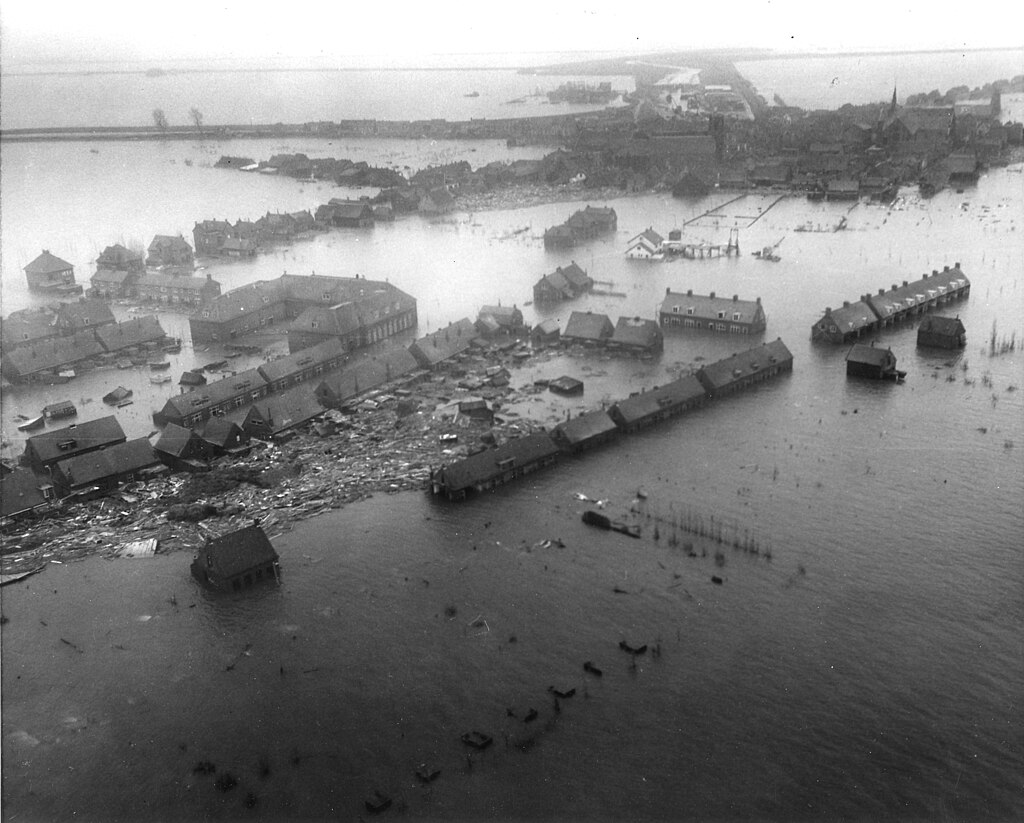
I'm sorry, Dutch people, "Watersnoosdramp" reminds me of Futurama. This is a picture of Oude Tonge, on the island of Goeree-Overflakkee, which has such a clumsy name because it is a relatively late formation, being carved out of the mainland of North Brabant and South Holland by flooding events in 1216 and 1421, per Wikipedia. Oude Tonge, first attested in 1420/1, is a village carved out of the "Old headland polder" in the manor of Grijsoord, which sounds like an exposed location, and proved to be so over the night of 31 January/1 February 1953 when a windstorm drove the spring high tides up over its embankments, killing 305 people in this village including 42 family members of poster-child survivor Jos de Boet.
The reclamation history of these islands in the Meuse/Maass/Escaut/Scheldt/New Rhine estuary (I vote for bringing back "the Maze" as the geographic designator) is an interesting one for the historian of the Late Middle Ages/Early Modern Period, perhaps the clearest evidence that the economy and population of northwestern Europe was expanding during the "waning of the Middle Ages" and not contracting as the grand overarching "The Black Plague Kills Everyone Except One Person To Pass On The Message" theory of European history. But I'm never going to roll that rock up that hill, so let's not talk about it. Let's talk about even older coastal defences, instead.
Saturday, November 12, 2022
The Bishops' Sea: Marine Ecology, Industry Fundamentals, and Ethnogenesis
So, yeah, not finding it, although I'm pretty sure it's out there and I've just not landed on it. But what I did find is some fine scholarship posted to the web here, here, and here, and a historiographic recommendation to Jeffrey Bolster's Mortal Sea, which turns out to be a book which I've bounced off before, so now I've got two copies counting a Kindle edition. Oops. (It seems I wanted Peter Pope's Fish Into Wine, at $57 for a paperback delivered next month. Fuck!) Anyway, I am presented with a thesis which, after reading about early Scottish lawsuits and Kim Stanley Robinson's New York, 2140AD, of all things, I now have something to say.
Sunday, August 28, 2022
Summer Trip and a Book: Reza Aslan's Zealot In Ranch Country
Sunday, June 19, 2022
Evangelists and Politicians: the Fall of Rome, IV: With Bonus Sacred Spring Engagement (Edited)
So I understand that the way to get ahead in this blogging game is to go after the big guns and Brett Devereaux, of A Collection of Unmitigated Pedantry, did a three-parter on the fall of Rome back during the winter. Well, I did a three parter back in 2013, and I could easily do a fourth, and I have some things to say about the things that Devereaux says about the fall of Rome!
Which, big deal. Everyone talks about the fall of Rome. People were talking about it before Edward Gibbon decided it would be a good idea for a big book that would make him famous and offer a sly commentary on the whole thing with America, which everyone was on about back in the day. The idea for the series was foisted on Devereaux by his Patreon patrons, and I am only talking about it because it is a way to focus on the throughline from the Early Iron Age Revival of the State. Also, apart from some minor errors in the ongoing archaeological-reconstruction-of-the-Roman-economy thing, Devereaux mainly put me out by trash-talking Gibbon. Which, the thing about Gibbon is that it is easy to trash talk the man; the writing finger moves on, and all that. But what we know about ancient Rome is still dominated by what ancient Romans said about Ancient Rome, and Gibbon lived in a milieu in which everyone read the ancient Romans in the original, and talked about them. We don't do that today, and it is easy to see how Gibbon might have had a fingertip feel for the way that Romans thought and lived their lives that even a modern archaeologist might lack.
Also, and most importantly to get at the throughline from Revival to Decline we go by the most prolific literature of ancient Rome, ancient Christian apologetics. and while I am not going to make a point from this literature that Gibbon knew so well, I am going to make a point about it.
Sunday, March 27, 2022
The Early Iron Age Revival of the State, XXIII: For the Bible Told Me So
Saturday, November 6, 2021
Wednesday, June 30, 2021
The Early Iron Age Revival of the State, XXII: Roman Britain's Window Into the Sacred Spring
Friday, February 5, 2021
The Early Iron Age Revival of the State: The Axial Age?
Not that I'm complaining or anything, but the Academia.edu algorithm can bombard you with tangents if once you reveal some idle curiosity to it. In its most recent assault on my attention span, I got a whole lot of papers and monographs related to religious change in Late Antiquity, and, in the midst of the bombardment, Guy Stroumsa's "The End of Sacrifice: Religious Mutations in Late Antiquity." Dr. Stroumsa is a historian of comparative religion, and it turns out that the end of animal sacrifice is important to those guys, so Stroumsa is onto the theological implications like nobody's business.
Fine. I'm not the Thought Police. If theology is your bag, it's your bag. The problem is that it isn't what I do around here. Here, it seems like a drastic transformation in the pastoral economy ought to have implications for land use, agronomics, taxation and transportation infrastructure, not to mention the rise of cavalry heavy armies. But people aren't talking about this, above and beyond the role that cavalry and Christianity has played in everyone's discussion of the Fall of the Roman Empire since, like, forever.
That's not a project I'm going to be following up on any time soon, but Stroumsa is an emeritus at the Hebrew University now, tidying up a lifetime of productive scholarship, and while I was offered "The End of Sacrifice" as a freestanding download, somehow I ended up with the version bundled into 2015's The Making of the Abrahamic Religions in Late Antiquity. As monographs go, it's a bit of fix-up of the kind you associate with Brill, but that's not necessarily a bad thing, and a little taste of that, in parallel with Robert G. Hoyland's Seeing Islam as Others Saw It left me with some questions about the Axial Age and early Zoroastrianism that bear on a project I am allowing myself to pursue: The Early Iron Age Revival of the State.
Friday, September 27, 2019
The Early Iron Age Revival of the State, 17: "Boiled in alkalis and then laid out in the sun and wind to bleach:"
Professor Bramwell explains that Weldon still was assembled of locally-available flagstones, boiled in tar if of porous stone, with seams closed by more tar, hemp cords, and external ties. The aqueous acid was collected as it dripped out of the still. Making bleaching powder involves some extra steps, of which the most hair-raising involves men with handkerchiefs tied over their mouths, raking a powder of hydrated lime laid on the floor of the insufferably hot still until it was deemed sufficiently saturated for sale.
Saturday, June 29, 2019
Camels, Salt, and the Rise of Islam: Some Small Reflections on a Minor Controversy on Someone Else's Blog
Friday, March 15, 2019
The Bishop's Sea (And, incidentally and Minimally, a Technical Appendix): Coldingham
Besides, with Brexit speeding rapidly towards the next thing that happens, what better time to return to the theme of European immigrants overrunning sea-girt Albion?
| By Emoscopes - Own work, CC BY-SA 3.0, https://commons.wikimedia.org/w/index.php?curid=4155435 |
Friday, December 14, 2018
A (Mostly) Technical Appendix to Postblogging Technology, October 1948, I; Hydraulic Despotism
Then I scanned the election numbers of Time and Newsweek and decided that I couldn't pass up a bit of digressive cultural look-what-I-foundism.
Saturday, May 26, 2018
The Early Iron Age Revival of the State, XII: The Queen of May
![]() |
Wednesday, June 14, 2017
God Speed the Plough! Recapping Two Collapses of Complex Society in Light of Planting and Hoarding
| Lotus bread; Or, actually, a raw bread made with oat flour, sunflower meal, hemp and chia seeds as well as lotus root. Recipe at Shokuikuaustralia (Current website for Melbourne raw food enthusiasts.) |
First off, apologies all around, because Nymphaea caerula, the blue lotus, one of the three species present in the Nile, contains " [an] aporphine having activity as a non-selective dopamine agonist," and it is a controlled substance in the Baltic states. That being said, some people get high by chewing an entire sheet of Zantac, and I kind of doubt that the Early Iron Age had a blue-lotus-related public health emergency going on.
It most certainly did have a problem with people who were tempted to take off into the marshes and get away from it all.
"A happy day, as we go down to the water-meadow
As we snare birds and catch many fish in Two-Waters [Fayum]
And the catcher and the harpooner come to us
As we draw the nets full of fowl
We moor our skiff at the thicket
And put offerings on the fire For Sobek, Lord of the Lake"
. . . I would do as my heart desires
When the country was my town
When the top of the water-meadow was my dwelling
No one could part me from the people my desires and from my friends
I would spend the day in the place of my longing
In the . . and the papyrus clumps
When it was dawn, I would have a snack
And be far away, walking in the place of my heart [Fragment of a New Kingdom poem; quoted in part from Blouin, trans. Parkinson, 1998, but lifted from here; reconstruction indications omitted]
Tuesday, June 6, 2017
Lotus Eaters: Flights and Fragments of the Year 251
![]() |
| Rubens, Consacration of Decius Mus |
On the other hand, what do you do with a chief executive you can't handle? You might notice a big caveat to my generalisation, above. In old English and more recent Moghul civil wars, the losing king pretty much always died. I'm going to suggest that that is because there was a different political dynamic at work in which death-in-battle was part of the succession process, and those handlers stood ready at hand to facilitate the unfolding of political life.
Friday, March 10, 2017
The Fall of Rome, IX: Transhumance and Local Elites
| Come, and trip it as you go | |
| On the light fantastic toe; | |
| And in thy right hand lead with thee | 35 |
| The mountain-nymph, sweet Liberty; | |
Thursday, February 16, 2017
Recapping the Fall of Rome: Game of Thrones
![]() |
| Lots of caption here, because credit where credit is due. This is Abdelratif Reda's fresh goat cheese, served with apricot jam on a bagel in the medina of Rabat, Morocco.. The photograph is by Eloise Schieferdecker (imputed c. 2015), and appears in an article by Zoë Hu, running in the online lifestyles magazine Zester Daily
Did Rome have a crisis? The basic outline of the rise and fall of the Roman Empire is Decadent First Century-Golden Second Century-Third Century Crisis-Fourth Century Dominate-Fifth Century Fall-Sixth Century-
Cliche, but good point. Let's just stay the heck away from the Byzantine Empire or whatever it is.
The confusing thing here is that the crisis comes in the middle. There's an elaborate theory of politics in which governments pass through cycles of development. Domitian's government is a "Dominate," replacing an earlier "Principate." Yes, the restored empire is a different, and lesser thing, rather like the old Chinese Western and Eastern dynasties, but it is restored.
In this analysis, it is all about politics. A number of specific factors make the Empire politically infeasible: the government is badly structured; The location of the Roman capital is bad; it is overspending to buy army support; changing elites mean that new groups will have to seize control of the imperial office, whatever the short term cost of political stability. Etc. Not a single mention of cream cheese for breakfast!
Since I am on record as arguing that the collapse of the Roman Empire in the west is due to a breakdown in long-distance trade causing a shortage of money and local deflation in the far west, it might be time to go through the long, long list of emperors and usurpers and highlight the factors that, I think, make a purely political explanation inadequate.
|