Monday, December 23, 2013

Postblogging Technology, December 19443: I'll Be Home For Christmas


Happy Christmas from Santa Clara!

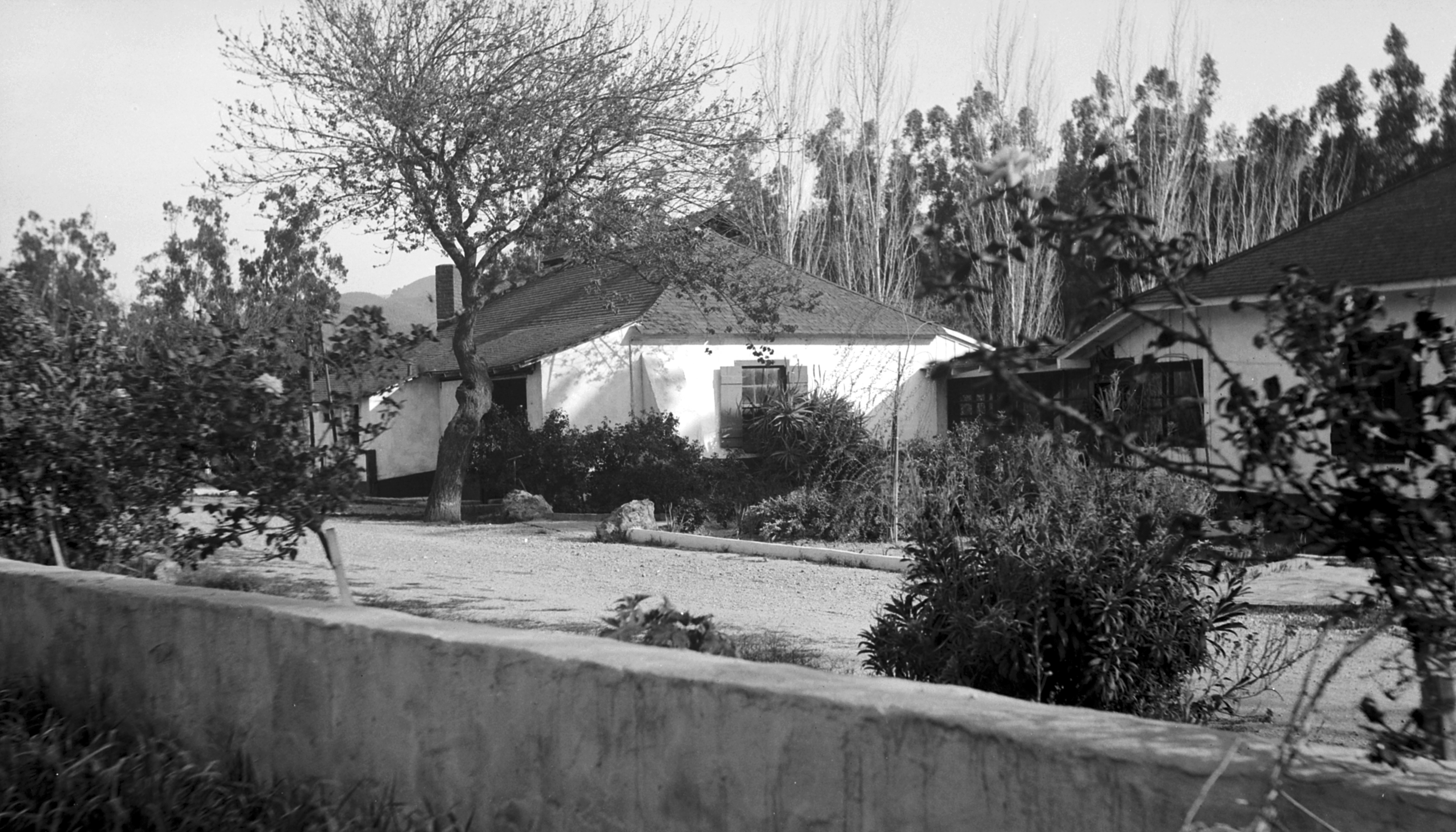
I apologise for including snapshots of the neighbours, but the pictures that I include are a great deal easier to parse than the family writing!


My Dearest Reggie:

I know that it is my invariable practice to wrap up the family news with an overlong restatement of my investment strategy, buttressed with the last month's news in scientific progress ("research and development" as we are saying now) and such economic, military and political news as seems relevant. You will find, as far as precendent goes, that this is a somewhat truncated entry due to my having left my copies of Fortune, Aviation and the month's run of The Economist in a certain library just to our north in a state of high dudgeon a week ago, but there is more than enough material for the boring parts, as you shall see.

As for habits, they are made to be broken. After a long and difficult month, I am finally in the Christmas spirit this holiday eve, and with a variegated feathered flock a-roast in the back under the supervision of your wife (Bill and David are most grateful for their Christmas gift), I shall endeavour to share the celebrations with you.

All of this was inspired in part by Mrs. J. C.'s blessed event, in part by potentially more dispiriting war news, which I think I will reserve a few weeks in the hopes that it will blow over. The long and the short of it is that we will have the Captain and Mrs. here with us on the West Coast for an indefinite extension, as the Engineer Vice-Admiral has conceived a lively concern about his newest pets that will only be assuaged by investigations on the ground. I am torn between rejoicing and trepidations, but I repeat myself, and I really should finish this letter. The indomitable mother-to-be has led the youngsters on a hike up the mountain. I have begged off with the excuse of fearing a recurrence of gout.


But it is only an excuse, as you will have realised by my mention of that certain library, it being you who forwarded the Earl's instructions to seek the Engineer's guidance concerning Cousin H. C.'s persistent requests for investment in his steel plant. See how I nickname him so respectfully? You, who know me so well, will seek out the irony and suspect that I imply that this honour is as empty as every other "achievement" of the life of his (real) father's son.

The Earl, of course, thinks that the son of the man whose oh-so-successful American life we helped launch will owe us dispassionate advice. I dissent on two grounds. First, gratitude is an odd thing, and in the Engineer's father's heart, I suspect that events in Batavia came long ago to be seen not as Great-Great-Grandfather sweeping a hanging crime under the rug, but rather as an excuse for Great-Grandfather's imposture: that the Engineer has aligned himself with our cousins across the divide of 1823.

So much for the incestuous concerns of our house, because, much more importantly, the Engineer is certainly bitter about this Administration, and dear Cousin H. C. owes virtually everything to it. This, at least, is my excuse for maintaining my side in our difficult interview, in which he did his best to encourage me to invest in the steel enterprise before dismissing me on the grounds that he was "busy" With his memoirs, or with coupon clipping, or with what other vital enterprise having to do with his legacy, I do not know. In any case, Wong Lee, whom I took as my driver on some mad impulse, had to lead me to the car by the shoulder, or I think that I should have burst back into the Engineer's study with some "wisdom of the staircase" that might have descended into fisticuffs.

In many ways, Wong Lee is a wiser man than I, hard as it is to tell when one's eyes go first to that kris scar. A more unlikely male nurse it is harder to imagine: but that is why Grandfather kept him around, I suspect, back when Grandfather was still making decisions. And his boy, who accompanied him, is smart as a whip, always with a "Number One Son" quip on his lips, as big as his father and as fair of face as his mother. (You remember Chang Wei, do you not? I believe that we had to make her a Peruvian to get her into the country. . . .)   I suspect that I am meant to conceive a desire to do a favour for the young man, which will be vouchsafed to me at the right moment. I shall not require much persuading.

Enough of this, then, especially as I owe you a month's worth of the "big" magazines yet. I shall even be able to cover the end of the month, in the unlikely event that major war news troubles the week between Christmas and New Years.


Monday, December 16, 2013

From Now On, No More Defeats: Crazy in the Night

(Now with brutal editorial clarity.)

Fur meine Eltern


Seventy years ago tonight, Bomber Command made its third major raid on the German capital city. 483 Lancasters (and 15 Mosquitos) were despatched. It was a brutally effective raid. The Wikipedia article reports that 1000 wagons (50 trains) bound for the Eastern Front were held up around Berlin for 6 days. It is the kind of blow to the German war effort that the USSBS did not even try to assess, but important for all that military historians do not often try to take such things into account.

On the other hand, this is the raid in which the old Prussian military archives were destroyed. That you will hear about. (Much more, for example, than someone pointing out that the Austrian military archives are fine, and just waiting for someone to use them.)

Petty chiding then falls away at the stark catastrophe so coolly summarised next. Twenty-five Lancasters were lost operationally, and another 28 in recovery due to unexpected low-level cloud over airfields in Britain. It is routine at this point to observe that, above about a 5% loss rate, only a statistically negligible number of bomber crews will survive their tour and go on to train the next generation. This constitutes the great tipping point of air warfare first discovered in WWI, where an air force bleeds experience faster than it can build it up.* Well, the losses over Berlin alone add up to 5.2%.

What is less often observed is that Bomber Command was not just suffering from a human catastrophe. Heavy bombers stand at the apex of industrial effort. The target for  the English Electric and Avro Manchester plants that delivered the Halifax and Lancaster, a target, not often achieved, was 250 planes a month. In January, only 160 would be received, winter being a slack time for industrial deliveries.(1) Bomber Command had just expended over a fifth of that total on a single night. Even given that it did not fly every night, the reason that it did not fly every night was mainly weather. Bomber Command was, in brief,  losing. And the men and women of the Reichsverteidigung were winning. High Wycomb had taken on a job that was beyond the technological capacity of the so-far mobilised work force. One that had to be done, if the Western Front were to be cracked. 

And seventy years and a little less than a month ago, with fully appreciating it, without, certainly, seeing that it had given birth to technological modernity, the Air Staff put the answer in place: 100 Group, Bomber Command.


Tuesday, December 10, 2013

Postblogging November 19443: Technical Appendix: The Alliance of Thrust and Iron

Wikipedia: The trackless forest of Anderida, where the Royal Navy's gunmakers lived and worked: Unsized because it's so damned evocative.. Obviously it's a bit spoiled by the embedded blog material, but you can go to the original if you like.

Robert Constant opens The Origins of the Turbojet Revolution in the mountains, in the same place that Clint Eastwood opens Pale Rider, with the same powerful vision. Water, under human control, washing down the mountains.

Wiki.
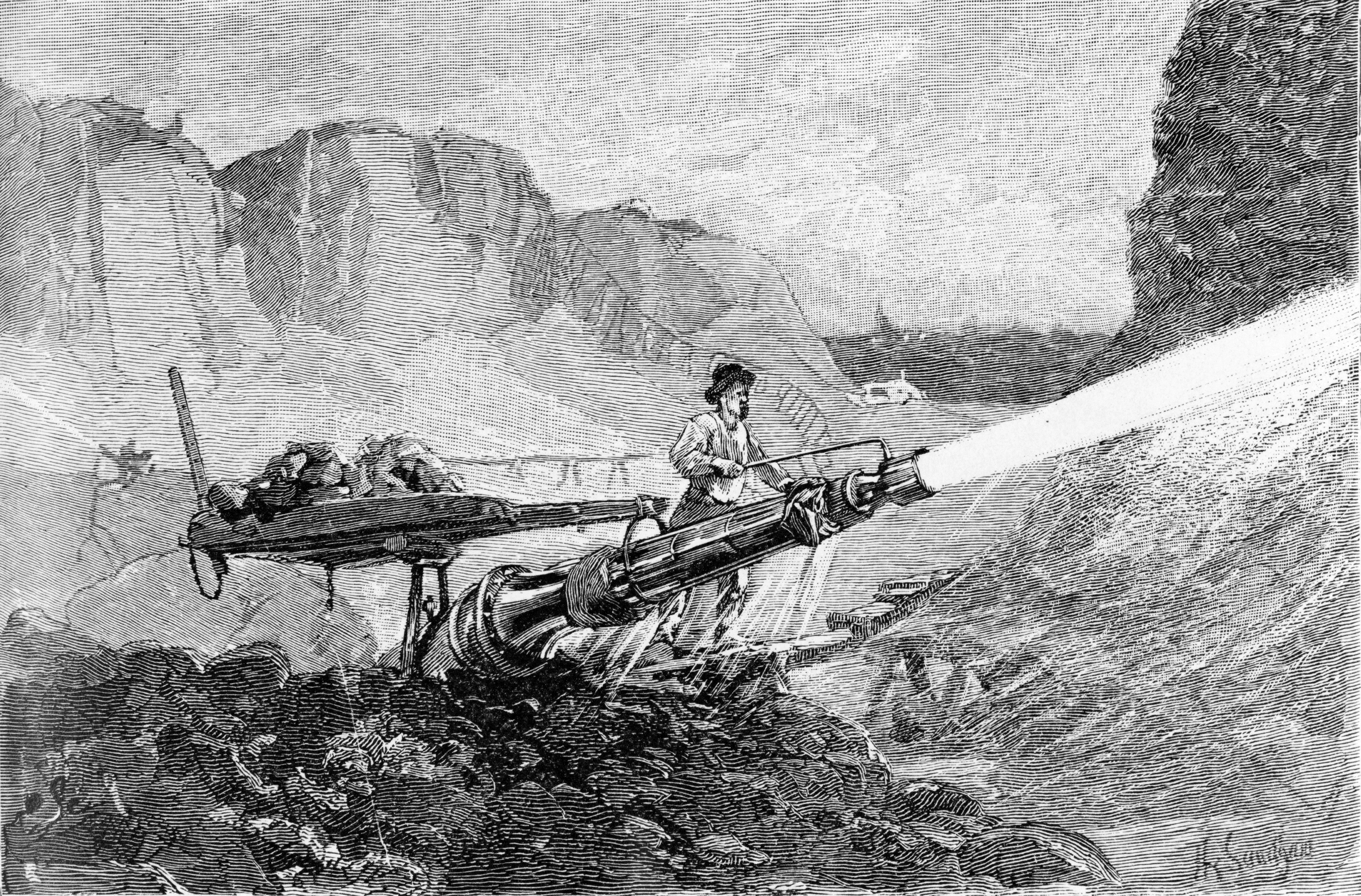
We are in the middle of a mountainside industrial revolution. Not in the Weald, but rather in the Sierra Nevada, this Monitor operator is finding gold with high-pressure water.  In Eastwood's vision, hydraulic mining is an evil thing. The cinematic composition implicates environmental hazard, but the crime that brings the  ghost of death(?) to town to kill all the bad people with guns is that of putting old fashioned panners out of work. In the nostalgic old days, people panned gold in communities. Now the Monitors had come to make their labour obsolete. This part, except for the offensive framing, is hard to swallow at this distance. It is not like panning in hillside shantytowns is a lifestyle that should have been preserved. Worst, behind it, and lurking just below the in-itself-defensible environmental talk is a discussion about  flood control-related public policy in California, where noble, anti-hydraulic mining discourse hides a less benevolent objection to state flood control intervention on the grounds that it would be paid for by taxes on people not directly affected. As time goes on, Pale Rider will be remembered more for Eastwood lifting his story than with an argument over the evils of hydraulic mining that may actually have had more to do with resistance to a. 

Anyway, Constant's take is less the Monitor than the Pelton wheel that was another component of this mining-industrial complex, because if you squint at the facts in the right way, you get to Lester Pelton's invention being the introduction of the "impulse turbine." If you have heard of the Pelton wheel, you have no excuse for being surprised by "the turbojet revolution."


Now, as usual, it turns out that calling it a "Pelton wheel" turns out to make us complicit in patent trolling. I wouldn't push this too far. Lester Pelton might have been inspired by, for example, the Fourneyron turbines rather than by a sudden thought that struck him as he looked at a water turbine made by the Knight Foundry. Again, there does seem to be dark deeds done here. The point of Pelton's improvement was to take business share from Knight. It was in no-one's interest to stop tinkerers in the California gold fields with vexatious patent-infringement suits, and even one's sympathy for Knight ought be measured. Pelton was able to build up a corporate interest that made a great deal of perfectly good mining equipment.


If Constant had started with Fourneyron, or with Charles Parsons, we would have missed a chance to see the Sierra Nevada. That he could have started with them is beside the point. He could have started in a great many places. Arguably, he ought to have started with those poor, sad Brown-Boveri salesmen trying to stimulate interest in their promising, new "gas turbine" concept in 1939.   They are the guys who put the technology of the combustion gas turbine out there on the market in the last years before World War II so that, finally, inescapably, it was obvious that the very near future belonged to turbines rotated by jets of combustion gas driving electrical generators, or powershafts, or compressors. Here is an actual industrial combine working to establish first mover advantage in what it clearly perceives to be a growth technology. The reason that we don't is so obvious as to be uninteresting. Brown-Boveri was a Swiss firm, and had no access to the Air Ministries of the great belligerents in an imminent world war. It was those air ministries that would pioneer the combustion gas turbine, because while Brown-Boveri was thinking of locomotives and ships and power regeneration in oil refineries, they missed the most important technology, the one area where buyers might be interested in something other than economic rationality: fighter jets!

By now we understand the problem. In its earliest stages, a combustion gas turbine installation is not likely to be more efficient than one of the highly-polished precursor technologies it is  meant to replace. A great deal of money is required bring the new technology to the point where a gas turbine pushes a freighter around more efficiently than a steam turbine --and steam turbines have never been that popular in mercantile shipping, anyway. On the other hand, as the speed of objects through air reaches a band within about 20% of the speed of sound, the air that it pushes aside ceases to be compressible and becomes incompressible. The rules of aerodynamics change and, unless the shape of the object likewise changes, its effect on the air changes, too. In a propeller-driven aircraft, this happens first at the tip of the screw, and that is why, in spite of ever more powerful engines, the top speeds of the hottest fighters of World War II top out around 460mph. Propel an aircraft with reaction mass out of a nozzle, and you can go much faster, and the "transsonic" limit will be reached by the plane's lifting surfaces instead, at speeds much closer to the local speed of sound. Your fighter jet will comfortably go a hundred miles per hour faster than its propeller-driven rivals, and getting through the transsonic limit to the endless horizons of supersonic flight is a possibility. 

I am throwing a "Patent Troll" tag on this posting in honour of Lester Pelton, but my tergiversations above will suggest that I am a little uncomfortable with this. I am not an impulse turbine expert, to put it mildly. But he's dead, and I don't think that he would mind developing the context of the posting in this manner because I think that there's an important point here. As long as we look at the advance of technology within the framework of heroic inventors, we belong in a conceptual universe such that the public revelation of the existence of jet fighters in early 1944 (spoiler alert!) is all about Ohain or Whittle having a Big Idea. Now that I have set the context, however, it becomes a little more puzzling. Why these two, heroic innovators. Why not everyone?

Here, then, I take you up into those other mountains, the Wealden fastness, to the lands of the charcoal burners and the ironmasters (and the Anglo-Saxon anarcho-syndicalistic commune of swineherds). It is time to contemplate our oldest and greatest communal technological praxis, to talk about blood and rye and salt and iron


Tuesday, December 3, 2013

Postblogging Technology, November, 1943: Caesar's New Clothes

Santaclararesearch.net


My Dearest Wing Commander:

I have received your last, and will try to reply to your questions in --well, I was about to write something grandiloquent about "in the order of their importance," but that is beyond my garrulous nature. I leave the most important to last, let us say.

First, it looks like we will be a houseful for some time. As might have been expected, the Admiralty's decision to build some of the later freighter-aircraft ships as "assault carriers" has evolved in the typical way from the stage at which we cared when naval architects talked about ship stability to the point at which the specialisms have had each their say. Now there are vast amounts of new equipment to be procured and installed, and the vessels are expected to float vaguely upright, and so your eldest has been cut new orders that will keep him on the "West Coast Shuffle" at least through the New Year. At least I can look forward to sharing a berth on the Seattle and Los Angeles trains!

Second, the Santa Clara estate is surprisingly little touched by the ravages of war and old age. There is even a  boy's crashing tread shivering the old timbers. Although your youngest is, of course, rather older than when we left for Greenwich! The western verandah has come out to make way for an outdoor carport, a long overdue "improvement" brought on by your son's attempts on an invalid Lincoln that he inherited from a friend of mine, a minor movie star gone to war. (I draw a curtain over the trip up from Los Angeles, whose details would hasten your graying.)

Once again I salute my wisdom of four years ago in taking the master suite instead of my old bedroom. Not only does it seem so much smaller now, but little could I imagine in 1939 that we would end up hiring out the cabin to no less than three dockyard workers' families! You can imagine the bedlam in the back yard. The long and the short of it is that the outdoor kitchen is running by shifts and the ranch hands take their meals on the back verandah. Michael and Joan have elected for the back bedroom, keeping the hands a little quieter knowing that their boss is overhead and that he speaks Spanish. Joan by the way, is seeing to her mother and the house in Pasadena, where they are to retire to be closer to their grandchildren. 

Of Shiwa Ta-Wan you will have heard from your wife and daughter, and I say no more of the ruinous old pile overlooking us. Your son, and daughter-out-of-law will be staying there. This rather avoided a bit of a scrape for we three bachelors, who received many a stern look on "Mrs. J. C.'s" (if I remember my coy little code from 1939, she was "Miss G. C." then). She seems to have been shocked as much by the amount of food lying around as by the mess. She also took a dim view of the effort put in by the local girl who is acting as our after-school housekeeper. What can I say? Good domestic help is impossible to find, and she is well-mannered and attractive, in that  blonde Californian way. "Mrs. J. C."  has taken it upon herself to organise Grandfather's papers. Thank God. I was not looking forward to trying to find a lawyer in San Francisco who could be trained to read the old Hakka pirate writing! (Not to mention that he would then be equipped to read this correspondence.) 

This brings me to two final and more sensitive matters. First, Grandfather was apparently roused to a rare moment of coherence upon hearing your letter read. (Congratulations on receiving the RAF "contract" by the way!) Bill and David were summoned up to the big house to give a seminar. Grandfather had lapsed by the time they arrived, of course. Fortunately, they are well-used to their patron's eccentricities, and took in stride receiving instructions from his "translator." It does not hurt that she was looking very fetching indeed in a beige linen dress! They recommended --but enough of that for now.

Second, or, as I think in this rambling pile of digressions I have quite lost the thread, most importantly, there are the Earl's rather pointed questions about my dissent from our cousin-in-law's business plans. I understand his anxiety. As much as you have disabused him about "H. C.'s" legendary (alleged) business genius, he still speaks very much the received West Coast wisdom. Given our inherited real estate profile, the future of a very large share of the family's fortune is  linked to the prosperity of the Pacific Slope. So why do I dissent? 

Ordinarily, I would give my answer in the financial newsletter appended. However, I did not feel comfortable rendering Bill and David's recommendations even in Hakka characters, so have hauled out the family one-time pad, and given that I was transcribing anyway, this month's newsletter brings England up-to-date on the sordid side of our real estate business. That being said, just because I was "feeling like" transcribing does not mean that I was feeling like waxing eloquent, so I have appended my argument with "H.C" to the end of my news roundup. Knowing my tendency to wax on, I take the liberty of bolding those bits of news and comment of special relevance.


Tuesday, November 26, 2013

The Plantation of the Atlantic, XX: A Crisis of Growth?

So, today, because I did not realise that I had missed the 75th anniversary of the foundation of 100 Group RAF last Saturday (looks like your card is going to be about a month late. I blame Canada Post) during my enormously restful vacation, we will be talking about Alex's challenge.* Why did things get better after Rome fell?

"So perhaps you've got a Marxist explanation here: the social relations of production, i.e. the Roman political economy, are holding back the material relations of production, i.e. the productive potential of the Roman periphery, by forcing it to produce grain inefficiently to serve the interests of the elite, when it could be doing something more like classic British mixed farming or just a shit load of livestock. As a dialectical materialist, the Marxist would say that the material forces of technology always prevail in the end. And then a revolution happens. This is basically a Latin American dependencia historian's view.

There's a passage somewhere, about how in the summer the young folk of the village would go up to the high places, the boys to shepherd the cattle, the girls to milk them and make the cheese (gender essentialism!), about how the milkmaids would have skin like the Milky Way, and that they  would lie out under the stars on a summer night, their elders a thousand feet below.

...As it turns out, "sexy milkmaid" is not a very useful Google search.

Anyway, Heidi Klum, everybody. (Important safety note: Do not wear open-toes around cows.) Also, The Silencers.

There's a passage somewhere, about how in the summer the young folk of the village would go up to the high places, the boys to shepherd the cattle, the girls to milk them and make the cheese (gender essentialism!), about how the milkmaids would have skin like the Milky Way, and that they  would lie out under the stars on a summer night, their elders a thousand feet below.

...As it turns out, "sexy milkmaid" is not a very useful Google search.

Anyway, Heidi Klum, everybody. (Important safety note: Do not wear open-toes around cows.) Also, The Silencers.

I call this an investigation, by the way, because I want to hang a great, big epistemic caution on it. A blog post is not the place for a turgid, thesis-style "historiography and methods" chapter, but this is a subject that calls forth grand explanatory structures that float well clear of the facts.


Sunday, November 17, 2013

The Fall of Rome, VI: Under the Green Cover

Yum.

Cold buckwheat noodle soup is the number one summertime dish in Korea, per aeriskitchen.com. I'm sure it's better than it looks, and that Koreans have fond childhood memories.


But. . .

How to make sausages eggplant and buckwheat "sandwiches."
Words fail me. 

One of the ways that we write about technology in an "I never thought of that" vein is to conjure up existential crises out of our dinner plates. Supposedly, in an era where in much of the world the total cultivated acreage is in decline, we are on the verge of a subsistence crisis by virtue of running out of inputs such as water or artificially fixed nitrogen, as though in two hundred thousand years of experimentation with landscape curation the human race has not developed a pretty extensive set of solutions to those problems, that the real problem is the very limited amount of buckwheat (and peas, vetch, millet, etc) that people can be persuaded to eat. 

As I have blogged before, Fagopyrum esculentum, is one of three species collectively known as "buckwheat" in genus Fagopyrum of family Polygonaceae which also contains sorrel, rhubarb and sea grape, as well as some of the nastiest and most persistent field weeds, such as the various knotweeds. With a short growing season, the heat-tolerant buckwheat fits into a larger family of plants that the poet tells us that we should sow on the wheat fields in June, "when all hope is gone."

 In other words, it is a food crop that you can plant after it is clear that your wheat or barley has failed. By the end of August, the field will be covered by purple flowers overshadowing black seed clusters. While harvesting a crop of buckwheat risks establishing it in the soil as a weed, buckwheat is tolerant of high nitrogen content, while using little of it or of residual soil moisture. It draws up other ions into the soil. In the tradition, it grows on "the moors," or is grown by "Moors," which in this context I take to be dirty poor folk on the fringes of civilised life in a parish-ordered Early Modern Europe. Buckwheat may not pay the tax bills of highly-capitalised farmers, but having food, however awful it looks, is better than not.

The complication here is that buckwheat's attributes also make it a good "green cover" crop. "Green cover," like "green manure," is one of those complications of agriculture-as-it-is-actually done that make our simple stories about it so unhelpful. Basically, if you sow buckwheat on a ruined field in June, you might be intending to take a food crop off it. If you are the landlord of tenants who do this, you might reasonably be concerned about that because of the whole establishing-a-field-weed-that-makes-bad-hay thing. However, you might also intend to plough the buckwheat right back into the soil. The point of planting the buckwheat in the first place was to conserve the soil moisture, vegetable fibre and nitrogenous material that would be lost otherwise. A vain crop of buckwheat this year means far more market grain next. 

Again, I am focussing on buckwheat because it is Heidenkorn, and I am playing to the whole "Moor" angle where it is (very arguably) the crop of the marginalised and the illegible. There are plenty of plantings that will do what buckwheat does, and it is quite possible that if I actually were an off-the-grid peasant in late medieval Europe trying to eat without drawing attention to myself, I would plant one of them. Buckwheat is not a good "green manure." You want vetch for that. If the soil is already nitrogen rich, you might want a better haying crop. Pearl millet is recommended by the Australian Northern Territory Government website. Interestingly,  I learned this by following up on the traditional recipe for couscous. This signature North African staple used to be made of pearl millet before semolina took its place. This at least suggests that if the original Moors needed a crop that was illegible to the state, they looked to pearl millet rather than buckwheat. The angle that I am aiming for, obviously, is the metaphor. How better to concretise this analogy than with the image of someone pulling a green cover over the landscape, and what better crop than Heidenkorn? And with that I am going to leave off making fun of earnest foodies. In the post-Apocalyptic future, we may all be eating buckwheat groats.

So. On to the green cover I have detected this week. 376, the Emperor Valens was defeated at Adrianople by an army of Goths. After a brief interregnum, the Spanish general Theodosius supplanted the dynasty of Valentinian and Valens, marrying into the family to heal wounds, fought a civil war, had the first recorded Canossa moment with Augustine's patron, Ambrose of Milan, and died, leaving two boys, Honorius and Arcadius, to be imperial colleagues. Arcadius died young in 408 in Istanbul, while Honorius made it to 423, pepetuating his dynasty. In a moment of turmoil during the reign of Honorius, there was a mass barbarian invasion, famously crossing the frozen Rhine at Main on New Year's Even, 405. From this eruption we trace the ultimate establishment of the "successor" kingdoms: Vandals in Africa, Visigoths in Spain; Burgundians in . . . Burgundy, Franks in France, Ostrogoths in Italy, Isaurians in Anatolia.

I throw that last one in as a bit of a joke. Attentive readers will already know that the Goths, Burgundians and Franks did not cross the frozen Rhine in 405, and once we reach the point of discussing an alleged barbarian invasion that originates in the Hittite heartland, we see that, in the famous words of every academic historian everywhere and in every time, "something more complicated is going on."

One attempt to solve this mystery has focussed, amazingly enough, on what the Romans said about it, which was that the barbarian armies were, in general, welcomed as, or subjected to, the status of foederati and settled on abandoned land. This has been formulated as everything from barbarians seizing land to farm to a version of "quartering" troops to, most controversially in the writings of Walter Goffart, to the pure allocation of tax farms to the support of units of the Roman army. 

Obviously, I intend my prolonged discussion of green cover and green manure crops to problematise the idea of "abandoned land." You may suspect by  now that I am likely to bring back horses. And, of course, I am going to make a big deal of The Amazing Thing I Learned On Wikipedia This Week. After the break, of course.


Tuesday, November 12, 2013

Postblogging October 1943: An Artificially Aged Technological Appendix


It turns out that I'm not the first person of our Modern Intertubes Era to be struck by the Bohn Aluminium and Brass Company's futuristic ads of the 1940s. Jim Edwards, of Business Insider, pointed out back in 2010 that "These Magnificent Paintings Of 'The Future' From 70 Years Ago Got Everything Hopelessly Wrong." That might be a little snarky. Lawnmowers are made of aluminum these days, and it's not the biggest mistake in the world to imagine them designed with an art deco touch back when art deco was still cool. 


Edwards should have substituted the aluminum high rise with button-adjustable room sizes for the lawnmower. Again, the vision is  not completely wrong, in that aluminum houses many North Americans today, and they are fairly modular and easily adjusted. As a young high school dropout at my employer pointed out the day that she was qualified as a cake decorator, "Now I can afford some class and get a double-wide." Which was not her exact phrasing, and, believe me, ex-con boyfriend, fake fingernails and all, she still had her tongue in cheek. No-one is so confused as to think that trailer parks are classy. As temporary housing, the old building codes here in British Columbia used to let you build them on the flood plains on the far side of the dykes. Hint hint, insert tornado joke here. Aluminum may have been cool once, but, like plastics, it has been "deglamorized."


After the jump, though, back with plane porn!