Friday, January 30, 2015

Postblogging Technology, December 1944, II: With Thundering Engines


Wing Commander R_. C_., RCAFVR, DFC (Bar),
L_. House,
Isle of Axholme,
Lincs, U.K.

Dear Sir:

I am glad that I was able to wish you a Happy Christmas in my last, for I see that I have held on to this one until it is too late even to wish you a Happy Christian New Year. Like many other people, I have been in a mood at the recent German successess, and only their definitive reversal has allowed me to get back to things such as my correspondence.

As though that were not stress enough, we had alarming news Christmas Even, as Tommy Wong received abrupt orders cancelling his leave and recalling him to appear before a Board chaired by one Captain Herbert Gates. It was not until the 26th that we had word from Uncle George, who knows Captain Gates socially, as well as being his advisor on matters radio repair-related (more maths, Uncle George complains, than he has seen since Keyham). It turns out that Captain Gates has the Admiral before him on another matter, his second "fouled bottom" in two months, and this one so serious that Chester himself is flying out from Pearl. Captain Gates is not a man who expects future promotions, but that does not mean that he is insensible to his prospects, and the news that Tommy could only speak to the earlier mistake put him right out of the witness list. Then, just as I recovered from that, word that James was also to go to Uthili, as the schedule for the new fire control apparatus was accelerated by demands from the battlefront again.  

Nor was Tommy's recall was rescinded. Something else is going on. If I could finagle an audience with Chester, I might learn just what, but as far as I know, it is nothing bad.

So there you have it, little word of Christmas in Santa Cruz, perhaps not surprising with so much to worry us, and so many of the young people away, and myself indisposed, once more the object of more care and concern of the matriarchs of our clan than I particularly care for --you must not breathe a word of that to your wife!

Look to the next, when perhaps Tommy's fate will be decided, on the eve of the Lunar festival, and we will look to signs of an auspicious future.


"GRACE"


P.S. Oh. And this little matter, from Time: “Murder at Honingham Hall”  Sir Eric Teichman, lord of the manor, shot in the woods, and it is agreed that it was by two American soldiers, who were poaching in his hunting preserve. Given the murder mystery setup, I can’t avoid noticing that his wife and her friend found the body. Though in a good novel, it would turn out to be related to his Central Asian adventures. At least I can safely say that Father liked him, and I am sure that no-one asked it of Fat Chow, who really does not like that kind of work. In case anyone was thinking of demanding it of him.


Monday, January 19, 2015

The Siege: Cold Ashes

From childhood, I remember some ancient bit of literary British domestic detail from that decade when the whole country, as I understood it, looked like an episode of On the Buses. That thing, a coin-operated space heater in a lodger's room seemed bad enough. The Secret Diaries of Adrian Mole exposed it as ann arcane joke about small horizons and diminished expectations behind it, akin to the notion of seaside holidays in Britain. The island of Britain is the largest fragment of the Old Red Sandstone Continent of the Devonian forests, and yet we are to imagine it as permanently damp and cold. No fires warmed its people, though it is green verdure stretched over a submerged mountain of coal. As I say, a vague age.  I had no idea what was going on. I though, instinctively, of the 1950s. That is a drear and dingy age, at least in Britain, right? But On the Buses and Doctors in the House, the shows that formed that impression, actually ran from 1969. There's still a story of a distressed island behind it, I suspect. The CBC picked the shows up and ran them in after-school slots because they were cheap. (And not-American.) Whatever. At least it saved us from the Mother Corp's smothering desire to make us better people, or, worse an even heavier rotation of King of Kensington. 

Second-rate, diminished, small, dark, close. Cold. That's what I want to dwell on at the head. It's an age with origins in war, the last small victory of the Wehrmacht. Welcome to the winter of 1945.

Saturday, January 17, 2015

Postblogging Technology, December 1944, I: Secular Stagnation Ahead?

Wall Street spends a lot of time on its mustache. A lot of time.


Wing Commander R_. C__, RCAFVR, D.F.C. (Bar)
L_. House,
Isle of Axholme, 
Lincs., U.K.

Dear Sir:

I hope this letter finds you well, at the threshold of the Christmas season. I hope our little package has found its way to you. It's been over a month in the mails, so please do let us know when you've received it. Business news and family secrets can take a back seat for a moment in our correspondence. 

On family matters, you find us well. Your youngest son will have communicated privately that he has passed through his basic flying training close to the head of his class. His path to instrument flying training is clear, and the programme at Berkeley allows him to "dip into" navigational and flight engineering. He has expressed some impatience to me, as, of course, he wants to be a fighter pilot, and suspects me of wanting him to move on to the big patrol planes. (As, of course, I do. But I think I understand young men well enough not to force him onto that path, but rather to bend his course towards the night fighters, as I have intimated before.)

James has received an intimation that he will be permitted to hoist his flag as a Rear Admiral (E) upon retirement beginning in January of 1947. Since he is due for half-pay leave tht he cannot take until Japan is sorted out, hs effective separation from the warm bosom of the Admiralty is not much farther off than the end of this beastly war! The pension notwithstanding, it's something of an empty honour, but an honour nonetheless, and one that,as you know, he has been waiting for. To be fair, he would have to wait until 1950, at least, to receive the promotion in due form! We've not sorted out the niceties of his board memberships and such as yet, but I imagine he will simply set up a consulting practice in the Bay Area and wait for formal incorporation of the shops around the Bay. Bill and David are talking about  waiting another decade, making the Admiralty look positively speedy by comparison. 

Vancouver is, unfortunately, quite out of the question, but at least you will be on the same continent at last, providing that the RCAF does not suddenly decide that it needs you to keep spying on Germany after the peace, as see below. Your two(?) grandchildren will be close, if not quite on your doorstep --unless you retire to take your ease on the old family homestead, she subtly hinted.

Miss "V.C." has done quite well in her Christmas exams. She will be spending two weeks with her parents in Chicago over the Break, but is eager to return and resume language lessons with Suzie, who will be attending Santa Clara this fall. She is also looking for instruction in Kwakiutl, perhaps via the agency of our new friend, the --landlord, we'll call  him? I think we will avoid naming him in the characters, as matters of language are coming ever more clearly into focus. Tommy Wong messages me with more hints of his new assignment in Alaska, such as he grasps of it, with the suggestion that a mastery of Asiatic languages is to be paired with a feel for electronics in a way that reminds one that it is impossible to read other people's mail unless you can get at it, and you can read the language. Though as dramatic as the spying stuff is, much more of his swotting is supposed to be devoted to meteorology. (You can imagine me pouting, now.)

 Well, that is the home front for you. Now I need to turn to the Earl's letter. First, I cannot say how pleased I am that you have finally won the Earl over to the case that Cousin Henry really does not know what he is doing in Fontana. I cannot say, however, reading between the lines, that I am likely to be more comfortable with his new investment preferences. I understand that, having turned him away from what must seem, from a certain perspective, a gilt-edged growth equity, that we are turning sour on stocks entirely. That is not the case! Uncle George's preference for equities over Treasuries is not just framed around a few pet businesses and that thrill of being near celebrity that comes of having our friend's confidence. Uncle George believes that we can make more money in equities. Surely that is important, too? 

I suppose the controversy here is over the vexed question of whether anything will be made and sold after the war? The vote of Santa Clara is for "yes." I shall have more to say about this below, as our friend, The Economist's "New York Correspondent," reappears to argue the Earl's position that we stand at the precipice of a new era of "secular stagnation." Apparently, wages are far higher in America than productivity gains will permit, and thus there will be a Depression-scale downward ratcheting of wages and prices (somehow?), followed by stagnation ever after as no-one ever invests in anything but Treasury Bonds again. 


I guess that I have telegraphed the conclusion ahead of the argument here, but the tradition of these letters is to take a moment to justify the abuses to which we've put the Earl's money ahead of our reading of the press to justify our actions. I can understand his dyspepsia, but I think we've earned some confidence! There will be money spent after the war. I'm certain of it.


"GRACE."

Tuesday, January 6, 2015

Chthon: Terror, Night and Earth. Plus Vikings

These Viking raid re-enactors are I don't even.
It seems like I waited forever for the library to scare up a copy of Peter Hodges' Goodbye to the Vikings. I don't know what was keeping it. Maybe a staff had snagged it. Everybody loves Vikings, Sexy, sexy Vikings.

I have the outlines of a speculation, you see. I think we can all agree that the "Viking Age" was as at least as much about trade as it was about raiding. You don't have to dip into the new Mediterranean history and read about how piracy rises alongside trade, rather than pulling it down to see this thesis trotted out. It's been around for years. To read a mid/early medieval historian on the subject of the "feudal anarchy of the Year 1000," you might think that the sub-Roman Iron Age was going down for the third time as the Christian odometer clicked around to its first three-place zero; but it clearly wasn't. The arc of progress was trending up, and if we leave aside the idea that the Vikings were impeding it, the case is more plauisbly that they were part of the upward arc. 

As a matter of fact, that's part of the bullshit race-science recasting of British electoral politics way back in the Nineteenth Century. It's probably in Freeman somewhere, not that I can be troubled to look. Doesn't mean that it's not true, though. From Peter Hodges, or from his contemporaries, one gets an exciting picture of the world on the edge of a Viking Age: of the emporia of Dorestad on the big, natural levee thrown up between the branches of the lower Rhine to serve the trade of "Frisia," back when that label took in everything from northern Belgium to southern Denmark, trading with Danes from about a century before they come into the view of fourteenth century Danish and Norwegian court historians. You get a view of the genesis of the Viking Age, in an already-existing commercial relationship which draws Danish mercenaries into the fratricidal conflicts of the Carolingian successors in the 850s. The breakdown of the Carolingian state draws in the Danes. Again, this is one too many breakdowns-of-states. We have seen what actually happens when states break down in the Late Bronze Age or Roman collapse. One thing that does not happen is that the cities of London and Paris (or, even more pointedly, Viking-raided-conquered-pillaged York and Rouen) do not go on, merrily growing and putting down their first well-stratified layers of old household rubbish since Roman times. They put down... but that's getting ahead of myself. 

The problem with that is that you have an earlier phase of Viking activity, documented mainly in the fabled Lindisfarne raid of 792, but associated with some other attacks, on the church settlements of Tynemouth, on Iona, on a few bits of Ireland. For the speculative "strong interpretation" of the Hodges-emporia-"endogenous origins of the Viking Age" to work, we have to find a way to dismiss these premature Viking raids from the historiography. I, personally, think that the way is clear to do that, that there are clues to the internal politics of these ostensibly outsiders' raids written all over them. 

From Hodges, I was hoping for something more than intuition. I did not get it. Hodges' contribution to this discussion is his excavations at the emporia of Hamwic, near modern Southampton. From there his focus wanders off to the Mediterranean. If archaeology is to settle the matter, it has instead to look at the "lost Viking colony" on the Scottish outer isles that would have been the waystation or source of these raids, and therefore would have been conquered or settled in the mid-700s.  

Those Vikings? People have been looking for them since the day when you could make a "pillage, loot, rape and burn" joke in polite society. Without much luck, I would add. From an area with megalithic remains on a scale with Stonehenge, the outer isles have decatyed into a very rural backwater, and it looks like the immediate pre-Viking era was comfortably post-decay. Heck, it looks like the beginning of the Iron Age is comfortably post decay. We're left with saying that since we really, really want those Viking raids to have happened the way we imagine them, that the archaeology is just bloody well going to have to catch up. 

What subtext? I don't see any subtext.


Tuesday, December 30, 2014

On Thalassocracy, II: Diana in the Reeds


Art by Jeffach: Deviantart Page; Pinterest; Tumblr


Great is Diana of the Ephesians!

Ephesus is an abandoned city three kilometers from the town of Selcuk in Turkey's Izmir Province, on the shores of the Aegean Sea. Once capital of the realm of Arzawa under the name of Apasa (at least in the Hittite rendering),


Ephesus was reconceived in Classical times as a colonial settlement of Athens, founded by Androklos, son of King Codrus, or by Ephos, Queen of the Amazons. I take this to be a fictive refounding, aimed at wedging Athens into the Ionian Games, and, later, justifying the Delian League, but the Wikipedia version wedges a refounding of the city into the Dark Ages of the 10th Century. (Compare the recent treatments of Miletos by Greaves and Gorman.)

In either case, Ephesus took the Mother of the Gods as its special patron, and then associated the Phrygian Kybele with the Greek goddess Artemis, or the Latin Diana, the name mob invoked when it rioted against the preaching of the Apostles. 

It has been suggested that the mob might have had some less-than-exalted motives, as the Artemis Temple of Ephesus was a major tourist attraction. Rebuilt at the expense of Croesus, the Man of Lydia, by the Cretan architect Chersiphron of Knosssus, it was counted as one of the Seven Wonders of the World. As completed in around 550BC, it was 115 meters long and 46 meters wide, with peripteral columns some 13 meters high above a 2.4 meter terrace built to raise the site above regular flooding, and which incidentally preserves archaeological remains of sacred sites rating back as early as the Bronze Age, and what is said to have been the first Greek temple surrounded by colonnades, the earlier foundation of c. 700BC.


Understandably, given its erection in the middle of a marsh, little remains of it today. 

A six-year search, eventually funded by the British Museum, found the pavement of the Artemision under twenty feet of silt, on the last day of 1869, and a single twelve ton marble drum excavated. Perhaps not surprisingly for such a "dark and dismal place," it was found to be decorated with an obscure but clearly chthonic scene from myth, with Hermes Psychopomp appearing to an unidentified woman in the company of a Thanatos, an angel of death.  

The decision to build such a grand structure in the middle of a marsh is a ....striking one. It is very definitely intended to make a statement of some kind, and, as you may have guessed by now, this post plunges back into the water margin and the tall reeds. It's a mystery, it needs resolving, and that solution is going to bear, pretty directly, on "thalassocracy."

Thursday, December 25, 2014

Techblogging November, 1944, II: Meanwhile, at the North Pole


Wing Commander R_. C_. RCAFVR, DFC (Bar),
L_. House,
Isle of Axholme,
Lincs.

Dear Sir:

I do not know if I can alleviate your concerns, but I will try. I know how urgent the last few days have been for you. A back-of-the-envelope calculation suggests that you have to fly very close to a cyclotron --even a big one-- to pick up its x-ray emissions, and that the film exposure will be faint and difficult to make out. For all our sakes', I hope you cannot find any.

As for the Far East, Tommy Wong is not in the brig. In fact, he is in Sydney, right now, Thanks be to Heaven. He has been briefed to expect a transfer to Alaska, either in glory as a conquering hero or near-convict in disgrace will be determined later, although the posting will be the same. All depends on the decision of-

-Well, I should back up. At your request, I sought out one of Chester's pets in San Francisco, with some success. His most favourite of all, recently parachuted direct from his staff to command the latest battleship in the Fleet, is to conduct an inquiry. It will be left to him to decide whether a board needs to be convened, As he will not be on station until the new year, we must steel outselves to wait through the holiday season. I am told in confidence that you may expect inquiries through channels, and since you have your ducks in a row, you should be in no trouble.

In the mean time, looking for the silver lining to it all, "Miss V.C." points out that we will  have a new baby in our midst come the summer, as Miss Leung's military career is necessarily at an end, and her language skills have apparently recommended her to someone in San Francisco. (Not to jinx the case, but this has something to do with Chester's pet. It's also a bit alarming, as I gather that some of those skills have been a bit exaggerated, but in a fortunate coincidence, "Miss v. Q." has found lodgings with a professor's family, and there is room for Miss Leung. Iinstruction in Chinese for Russian, favours rendered, might be extended to West Fleet Hakka. I hope that Fat Chow, international man of mystery, will not be too discomfited to have a fiancee (yes, the official word is...) who speaks his own mother's tongue.

As a last consolation, or perhaps galley humour, we've been scratching our heads about what Tommy might be expected to do in Alaska, and it has been suggested that the Navy is looking for Santa Claus. Or Father Christmas. Whichever. The point is, that we ladies of Santa Clara are at our Christmas shopping already, and I was looking for an excuse to make this letter a little seasonal, anyway, and, so, all too early but perhaps not unwelcome, here are Christmas greetings from the women of the Home Front, your sons, your grandchildren, and your wife, who has flown down to spend the holidays with us on the single condition that no creature of the Engineer will darken our door. And although I find myself ending on a distinctly un-Christian note, nevertheless, best of the season and a Happy Christmas, sir.

"GRACE."


Wednesday, December 17, 2014

The Bronze Age Collapse, VI: Sea of Flowers

EDIT: I can't spell.

With wild surmise, from a hill at Kerkenes Dag, a discovery:


This looks down on a sea of flowers in the spring

The Argument

This is a "Blog Comment Follow Up," so it's primarily a response to Graydon talking about thalassocracy. I have opinions! More importantly, Michael Munn does. Make what you will of this fabric of speculation, but Munn deserves respect. As I'm going to take a while to get to his argument, the shorter summary is that "thalassocracy" is an Athenian ideological conception meant to distinguish the Persian Empire-in-Europe as hubristic, in that it passes the "natural" boundary between Europe and Asia, while Athens' Delian League, which can be understood as an Athenian (European) empire in Asia is pious and godly, because it is a "thalassocracy." 

Incidentally, and on my own hook, I'll throw in some observations about the likely realities of Ancient naval warfare, these are in part aimed at the claims of the Trireme Trust but could just as easily go to the Nineteenth Century argument about the steam ram. 

To make things more complicated, I've also had a nice email from Lameen alerting me to a post at the Mountain reviewing Brown, Wichmann and Beck establishing that Chitimacha, a Louisanan language previously thought to be an isolate, is actually genetically  Totozoquean. That is, a Mesoamerican language transmitted by a prehistoric Mesoamerican colonisation of the Gulf Coast, perhaps at the beginning of archaeologically-attested corn farming there. The origins of the idea of "thalassocracy" are, it seems to me, linked to changing ideas about the religious foundations of natural sovereignity that are easily lost when we insist on immmanent national-religious identities that distinguish Asian (Phrygian, Lydian, Persian, Median, Cimmerian) identities --and languages-- from "European" (Greek, Scythian, Thracian). This becomes even more pressing when we consider the evidence that the boundary between "Europe" and "not-Europe" was moved from the Halys, which practically runs under Kerkenes Dag, to the Hellespont, thus moving the Phyrgians and Lydians from Europe to Asia. I continue to believe that the language changes with which the early Iron Age was so fertile would have been impossible were it not so hard to express Big Ideas without fancy new jargon with its own implict, prescriptive grammar. That is, that spread of ideas, and not migration of nations, should be the preferred model of language change for the Iron Age and the much-discussed Spread of Indo-European. This is why Kerkenes is important here. I might have lost this thread a bit, but Kerkenes is an archaeological anomaly which makes no sense in our understood scheme of the spread of Indo-European, so, naturally, I'm demanding that an alternative paradigm rather than an alternate reading of the archaeology and/or specific language history. 

This post is also an exercise in talking about books and scholars that I've read that deserve wider exposure, and it deserves a bibliographic section. I would put one in, were it not that it is already 4PM in the freaking afternoon as I write.

The Digressive Prologue, To Get it Out of My System, Hopefully

As readers of this blog may be aware, insofar as I understand the historical linguistics stuff, and my music tastes should sufficiently demonstrate the tin ears that handicap me here, I tend to prefer accounts of language change that privilege technological change, broadly understood, over migration narratives. New techne are brought by people, to be sure, but they can only teach with the vocabulary they have, and that vocabulary carries its own prescriptive rules that enter the local discourse and modify it, perhaps --perhaps!-- creating a language different enough from the original that we can then proclaim a genetic relationship with the prestige-tongue that brought the new techniques in the first place.

This particular change is particularly heavily loaded. We are talking about the formation of Eastern Woodland civilisation: turkey at Thanksgiving, college football, sundowner towns. Important stuff. The horizon our linguistic scientists have discovered, c. 850AD, is pretty clearly not the first moment of diffusion of corn farming into North America, much less of Mesoamerican crops, since tobacco precedes corn by perhaps a thousand years. What it is, is a cultural horizon 
What happened to you if you texted during lecture in the old days

that makes corn farming visible. It's a cultural horizon that is associated with the rise in North America of a civic architecture of mound-pyramids erected over levelled plazas on which sacred games are played, and with which are associated earth lodges in which the members of fraternal societies gather to drink the heavily caffeinated "black drink." I am not being entirely whimsical in associating all of this with the modern college campus, or in suggesting that if scholars as insightful as Tim Pawtucket can go on record suggesting that this doesn't reflect the propagation of Mesoamerican cultural influences through the Eastern Woodlands hinterland, then the denial is almost more interesting, than the archaeology itself. 

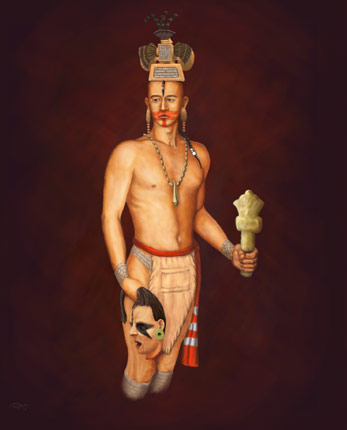
Fifteen hundred years ago, the glamour of Azatlan spread through this land. The moccasin and canoe blade of the sacred traveller, practically invested with the task of carrying toolstone down to the alluvial flats, but protected by the sacred glamour of the shadow of Azatlan. If it is erased, it is because a few centuries later, the routes reversed, and a new story, of a land of techne across the sea, was overlaid upon the story of the Place of Reeds. Lost, confused, yet mythopoeically overwhelmed with the project of creating a country for themselves, Americans compromised by building their own Place of Reeds that looks out over "seapower" rather than back the hutted knoll of their birth (1, 2, 3; though I'm not sure that I've ever rambled on about Wyandotte and American origins here.).  

Uhm, Kerkenes! You see the connection, right? Look! A video!