Sunday, March 27, 2022

The Early Iron Age Revival of the State, XXIII: For the Bible Told Me So


(Richard Gere is only fifteen years older than I am, and was in a BBC show as recently as 2019. I find that I am extremely jealous so I'll repeat the gerbil insinuation)


It has been a while since I visited this topic, but interesting things have come up, so I thought I would write about them. Oh, I can hear you thinking, "But, Erik, weren't you just working on Postblogging Technology, December 1951, II, yesterday?" And I can firmly answer that I don't know where you heard that, but it must be wrong. I would never bail on a postblogging entry after realising that this was a three-issue-month and that I was running out of time even before realising that I would have to cover three issues of Newsweek and Aviation Week, and that next week I have three days off in a row instead of single days split up, like this week. You can hear more about the rise of the cubicle next week! (There's already been an ad for cubicles in the series, which is why I say, "more." It's going to involve another Illinois university experimental house, State, this time, and the guinea pigs are going to be a select nuclear family and not undergraduate engineers.)

So. Ahem. The general thesis around here is that, the end of the Late Bronze Age was, sometimes, at least, a "successful collapse" responsive to the breakdown of inter-regional exchange, involving a systemic reorientation of economic exploitation from the coastal lowlands to upland niches that were more productive at a subsistence level but less able to generate agricultural and craft exports, albeit still able to take part in exchange via livestock. For lack of surplusses, these polities were necessarily non-state entities, but as they succeeded and grew, economic activity pushed downslope to the lowlands to exploit biotically productive lacustrine environments, giving rise to what I think I dubbed "lagoon states" on the model of Carthage, in particular. 

In all of this, I have been neglecting what might be the paradigmatic case, the Land of Israel. 

Sunday, March 20, 2022

Postblogging Technology, December 1951, I: Christmas Truce


R_. C_.,
Arcadia,
Santa Clara,
California

Dear Father:

In the end, Reggie did decide to go to the memorial, so your phone call did some good, after all.  I hardly knew the 124283 crew, so I was sentimental for a completely different reason. Wong Lee came down to drive us to the club, and not only did we catch up, I got to watch him practice his "evasionary driving!" I have no idea what ONI makes of the crash at this point, but I have to note that they  haven't released a flight number, so it was probably best to make sure we didn't lead the Examiner to the ceremony!  I don't think it would be good for anyone's career to have a Hearstling crash the memorial! the memorial!  Reggie was pretty blue until the band struck up "Ghost Riders in the Sky," which really broke the ice! In the morning, well, no, in the afternoon, by which time he'd finally begun to shake his hangover, he went down to see Bill and Dave. (I think they're cooking up something in the electric guitar way.) 

So I think we are over the hump as long as the Hungarians are nice and release their Dakota. (And, no, I have absolutely nothing on the grapevine about that. There's talk it might have been dropping spies for Tito? Which would be a bit of a hot tamale, let me tell you!)

Looking forward to seeing you on Christmas Eve, and also to handing this to you in person, which is why I am being a dreadful security risk and writing it in English.


Your Loving Daughter,

Ronnie

Friday, March 11, 2022

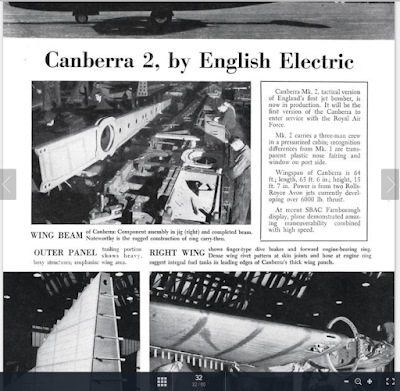
A Technological Appendix to Postblogging July 1951, II With Some Public Engagement, Even: MiG Alley


In the course of a bit more than a century of aviation, the air has seen its share of  the ancient tradition of deniable war. For example, the Condor Legion and Republican aircraft smugglers in Spain, the AVG in China, and the American volunteers of the Ethiopian air force. Probably the single most currently relevant example is one I have been postblogging: The clandestine participation of the Soviet 64th Fighter Aviation Corps in the Korean War.  Clandestine, in that Soviet pilots flew aircraft with North Korean and Chinese insignia. Everyone knew what was going on. The secret existed only because  it was in everyone's  interest to pretend that it was secret. Although I do not find numbers for the personnel side of the Russian auxiliaries, the Wikipedia account says that there were 297 Sabres available in theatre facing 950 MiGs at the time of the 27 July 1953 ceasefire, flown by Chinese and North Korean as well as Soviet pilots. 

So that's an occasion when the pilots of one nuclear power faced off against another under a convenient veil of ignorance and also with the pilots of one of the powers further insulated from the brute realities of great power politics by a collective action system in which there was some guarantee that, between a provoked American President and a final nuclear confrontation, there would interpose an angry Clement Attlee or avuncular Winston Churchill. 

We have seen UN pilots playing the numbers game in the contemporary press, with a final claim of 792 MiG-15s shot down against 78 Sabres. A more recent estimate indicates a kill ratio closet to 1.3 to 1 in favour of American F-86s.This is, however, exclusive of other Allied jets and piston planes, and the point of the fighting was to drive off the B-29s bombing the Communist staging area on the Korean side of the Yalu around Sinanju, a name I cannot type without free associating.Which I probably should have repressed harder, since it turns out I was reminiscing about a yellowface performance.. 

It was the failure of the B-29, and not the F-86, which proved to be the crisis of the air war, since it was deemed necessary to maintain pressure on the airfields around Sinanju to prevent the Red Air Force from contesting air superiority over the battle front. The fact that the crisis did not eventuate does not change the fact that there was a bit of a "Fokker panic" going on in Korea in the fall of 1951. The USAF needed a new bomber, urgently. And while the aircraft in question was not ready in time for Korea, the USAF did get one, and that is the story on which this little technological appendix hangs. 

Friday, March 4, 2022

The Bishop's Sea: Wage Slavery


Oops! Turns out that the Statute of Labourers was passed in the twenty-fourth year of Edward III. Although I was looking for a fashion-plate sort of image, and everyone knows that gay men are fabulous, right? Gaveston's gloves, at least, look like fine Moroccan leather. 

Friday, February 25, 2022

Postblogging Technology, November, 1951, II: The Full Moon Brings Out the Crazies


R_. C_.,
Shaughnessy,
Vancouver,
Canada


Dear Father:

I would get your darling son's chop on this, but he is celebrating his leave by taking the pram and his son  on a perambulation of the neighbourhood which will end (he does not fool me for a second!) in  celebratory drinks in Bill and David's shop down on Page Mill. Their appearance in New Aviation Products makes them  a "real company" at last, and not just a Navy shop with a Disney sideline. He will probably also tinker with the tape readers. I told him I needed a man around the house, it being Friday night, lest a passel of freshman engineers turn up on a panty raid, which he is actually taking quite seriously. We had a talk about whether we want to spring for one of Fat Chow's men as a "houseboy," but it would add a lot to the domestic budget my father is covering, and I would probably stand out more than I am protected. Besides, it is very unusual for this sort of thing to go off campus, and I have no late classes on Wednesday or Friday, so I miss most of it. 

I have to say that I would be a lot happier if the administration would just expel some of the worst troublemakers, but I gather that the university's books look very, very bleak this year, so if the boys want to drink and carouse and also crib, what are you going to do. At least, I look at my tuition invoice and know I am doing my part:  $600!!!! (Though it would be more than double that if I lived on campus, so I guess I am not being a true Daughter of Leland. Ugh.)


Your Loving Daughter,


Ronnie

Sunday, February 20, 2022

Postblogging Technology, November 1951, I: Shedding the Load

[See relevant link for very tenuous connection with Grand Central Aircraft]


R_. C__.,
Shaughnessy,
Vancouver,
Canada


Dear Father:

Somehow in spite of just having seen you at the talk, I am so far behind that the only way to get this to you is to put it in the  mail. You will probably find this about as interesting as building houses on slabs of prestressed concrete. Since we could make a lot of money out of the houses, you should probably focus on that. 


Your Loving Daughter,
Ronnie

Friday, February 11, 2022

A Continued Technological Appendix to Postblogging Technology, October 1951: British Nuclear Submarines, What's Going On, Here?


This is a pretty famous boat these days, HMS R3. It is the best photographed of 10 R-class boats built during WWI, and I see from my hard drive that it has appeared around here before. Designed specifically for high underwater speed as submarine hunter killers, they were fairly unsuccessful due to not being able to actually find their targets. Evaluating the USN's extensive trials of USS Albacore from 1953 to 1960 (but in particular a 1955--56 series), Norman Friedman called attention to another aspect of the R-class's unfortunate performance, their poor underwater handling. He points out, somewhere in The Postwar Naval Revolution that the R-class were in the range in which simplified fluid dynamics modelling fails, much as is the case with the transonic flight regime in  aerodynamics. Just as postwar aerodynamics depended extensively on full-scale models due to the inability to extrapolate from wind tunnel testing, so the Albacore was a good way of getting past the limits of theory to a good hull form for Skipjack and later nuclear submarines. 

Whether any of this features in the Admiralty response to WWI-era experience with the R-class, the fact remains that another R-class, R4, was retained in service until 1934 as a high-speed underwater target. The whole idea of a submarine optimised for submerged speed with a "teardrop" hull was no novelty for the postwar Admiralty, is what I'm saying, and it is hard to believe that anyone ever thought that it was. 

Unbelievable, but because of the October, 1952 decision to cancel the British nuclear submarine programme, one that I want to hold up to the light and squint at for a bit.  Seriously. What's going on?